I’m just a singer in a rock ‘n roll band
In 1975, immediately following completion of the group’s “The Lamb Lies Down on Broadway” tour, Peter Gabriel, Genesis’s brilliantly charismatic frontman and singer, announced his retirement from the band.
Most observers felt the group would never survive the loss. Even the remaining band members were unsure of how to proceed. They’d written some new songs and laid down some backing tracks, but who would handle the vocals? They held auditions for Gabriel’s replacement, which lasted nearly two months and involved more than 50  candidates. None seemed promising. They tried one fellow in the studio, but it didn’t pan out.
With tour dates looming, and studio hours piling up, Genesis was getting desperate. Finally, drummer Phil Collins surprised his mates when he suggested, “How about I have a go?” They sighed and said, “Might as well.” So he takes a shot at singing “Squonk,” a track from their album-in-progress, “A Trick of the Tail.” The others look at each other in the control room, and their eyebrows say it all: By George, I think he’s got it!
In his autobiography, “Not Dead Yet,” Collins recalls that day. “Looking back, it was a defining moment for me. And yet we were still dazed and confused. The one guy we thought might manage the vocals has proved a bust, and now the drummer’s had a pop and doesn’t sound bad. But over the whole album? Is that wise?
“We’re caught between a rock and a soft place. Having explored every other angle, it seems like the drummer is the last-ditch, last-resort-only option. None of us can take this entirely seriously. Surely some mistake? I’m just as conflicted, because I really enjoy playing the drums. That’s where I live. Yet there’s no denying the truth: I can sing the songs.
“Finally, a compromise: I might consider this if we can find another drummer I like,  because I’m not up for double duty. Don Henley (in The Eagles) did OK for a song or two, and Levon Helm (in The Band) did great for a song or two. But neither would have been able to sustain contact with an audience throughout a two-hour set, and neither could I.
“The lead singer singing from behind a drum kit is alienating for an audience. There’s all these cymbals and stuff getting in the way of any connection between vocalist and crowd.”
**************
And that, in a nutshell, is why you so rarely see a drummer — or a bass player, for that matter — as the lead vocalist in a rock band.
Most musicians and those with showmanship savvy don’t find this all that surprising, but the average fan might wonder, “You know, I never thought about it before, but it’s true. Why aren’t there many lead vocalists who also play drums, or bass?”
Since the dawning days of rock, lead singers have been the focal point, the visual center of any band, especially in live performances.
Because the vocals are so crucial, they are often handled by someone whose attention is focused exclusively on the microphone, like Gabriel. Or Mick Jagger. Or Roger Daltrey. Or Janis Joplin. Or Joe Cocker. Or Robert Plant. Or Jon Anderson. Or David Bowie. Or Freddie Mercury. Or Bono.
Alternatively, many bands have employed a lead singer who also plays guitar. Think of Chuck Berry, or John Lennon, or Jimi Hendrix, or Tom Petty, or Neil Young, or Joan Jett.
And then there are the lead singers who sit at the keyboards, like Jerry Lee Lewis, or Leon Russell, or Elton John, or Stevie Wonder, or Gregg Allman, or Steve Winwood.
What you rarely see is a lead singer who’s in the back, sitting behind a drum kit. As  drummers explain it, there are various good reasons for this.
In a 1989 Drummer magazine interview, Don Henley said, “I have a bad back today partially from my years playing the drums and singing. I had to hold my body in such a position that my spine got out of alignment. Between playing drums and keeping my mouth in front of the microphone, it really twisted my whole body. One of my shoulders got to be an inch or two higher than the other one.”
My friend Paul Vayda, who’s been playing drums for 50 years, points out, “Drummers think differently than singers or guitarists. They care more about the rhythm and tempo than melody or lyrics. The few drummers who also sing are generally just keeping the beat while singing rather than doing anything intricate.”
Then there’s the issue of being the center of attention. Many drummers want to avoid it. My son-in-law Mike Reaves, whose many talents include drumming, notes, “As a drummer, I’m not sure I want the attention. I want to be part of the group, part of the  music making, but not the focal point.”
Collins, who only occasionally drummed and sang simultaneously, relinquished the role of being Genesis’s drummer, first to Bill Bruford for a year or so and then Chester Thompson from then on. Collins, meanwhile, had to learn a new set of skills. “I was insecure as hell about being a frontman, particularly following Pete (Gabriel). The thing I most had to overcome was my fear of performing with just a microphone stand. I was used to having a row of cymbals between me and the audience. It was nerve-wracking. In particular, what was I supposed to do when there’s no singing?”
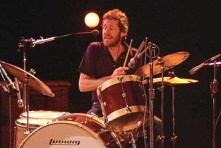 In addition to Collins and Henley, The Band’s Levon Helm was a prominent drummer who handled some of his group’s lead vocals, most notably on hits like “The Weight,” “The Night They Drove Old Dixie Down” and “Up on Cripple Creek.”
Even if just as a novelty, The Beatles gave Ringo Starr one  song per album to sing, and he went on to sing and play drums together in concert on such songs as “Boys,” “Honey Don’t” and “Yellow Submarine.”
Singer extraordinaire Karen Carpenter was actually an impressive jazz-style drummer whose skills on the skins were often unknown to  her fans, who insisted she come out from behind the drums to be the visual focal point.
Other drummers who have done at least some of the lead vocals include Buddy Miles (of Hendrix’s Band of Gypsys), Roger Taylor of Queen and Peter Criss of Kiss.
What about that bass?
For many of the same reasons drummers struggle with singing, bass players are likewise usually too busy concentrating on holding down the rhythm foundation to be able to sing at the same time. If the bass part is simple, it’s not too difficult to manage lead vocals if the melody is also easy to sing. But if the bass line is heavily syncopated, or even just emphasizes different parts of the beat than the vocal melody does, the bassist/vocalist must learn to synthesize the two parts almost like a jigsaw puzzle. Some can’t manage this at all; others can but must work hard to master it for the songs where their voice is required.
“Bassists need to focus on keeping a solid rhythm foundation going that is harmony or counterpoint/syncopation to the melody, so that it makes it much more challenging to simultaneously sing the lead melody,” observes my friend Steve Rolnick, an accomplished bass player since the late ’60s. “Maybe some backup harmonies or phrases, but not lead vocals.”
And yet, there are a few prominent examples of lead vocalist bass players in the rock 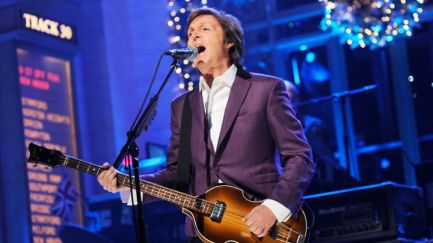 pantheon. We need look no further than Sir Paul McCartney, one of the finest bass players and overall musicians in the rock era. He provided lead vocals or harmonies while playing bass on nearly every Beatles song when they performed live, and he continued to handle double duty on bass and lead vocals throughout his lengthy solo career.
It’s interesting to note that McCartney was a guitarist and piano player first, and only became a bassist when pressed into service when The Beatles needed one after the ineffective Stu Sutcliffe left their early lineup. “Didn’t really want to play bass, but someone had to,” he recalled. “So I learned as I went, and kept the bass lines pretty  simple at first so I could also continue singing.”
As the group’s music became more sophisticated and their recordings showed more innovation, McCartney’s bass lines evolved into something more demanding. “The thing for me that was hard, beginning around the time of ‘Revolver,’ was that some of the bass parts were now independent melodic parts, and it became much more difficult to sing the main melody simultaneously. It was like patting your head and rubbing your stomach at the same time. So I had to put special effort into that, which made it very interesting.”
So, like anything else, there’s really no big secret to singing one melody and playing a different melodic part on bass at the same time. It’s a matter of hard work, practice and concentration, using what is often referred to as “muscle memory” to play the bass part while the mind focuses on singing the lyrics.
 This may be why lead-vocal bassists are a little less rare than lead-vocal drummers. Sting was the lead singer of The Police for 10 years, and he managed to simultaneously play some amazing bass lines on so many great songs, including those with complicated jazz, reggae and/or New Wave rhythms. Once he went solo, Sting continued to sing and play bass on multiple world tours (although he also played guitar and other unusual stringed instruments on occasion).
Equally impressive was the late great Jack Bruce, who sang lead vocals on 90 percent of Cream’s sometimes complex blues rock repertoire. Geddy Lee is another singing bass  player who successfully navigated the progressive rock material of Rush while handling both responsibilities. Greg Lake, whose vocals are so pivotal on the early King Crimson albums as well as the complete oeuvre of Emerson, Lake and Palmer, also performed commanding bass lines at the same time.
Bassist Roger Waters shared lead vocals with guitarist David Gilmour on all but the earliest Pink Floyd albums, and somehow still managed to offer strong bass performances as well. In the early years of The Beach Boys, Brian Wilson played bass while still singing lead or primary harmony vocals when they performed in concert. Peter Cetera was one of three lead vocalists during Chicago’s first decade in the business, and he offered fine bass work too. Timothy B. Schmidt was a singing bass player with Poco and The Eagles, sometimes singing lead. Same with John Lodge of The Moody Blues, Phil Lynott of Thin Lizzy and Lemmy Kilmister of Motorhead.
 entirely from the public consciousness.
 never achieved further success on the charts. (Poor management/promotion, radio station indifference, record company blackballing, etc.). A few examples of this sad phenomenon are: Karla Bonoff, Argent, Sanford and Townsend, Rickie Lee Jones, Golden Earring, Steve Forbert, Free.
 “Fire,” Crazy World of Arthur Brown, 1968
 “Black is Black,” Los Bravos, 1966
 “All Right Now,” Free, 1970
 “Magic,” Pilot, 1974
 “99 Luftballons,” Nena, 1984
  “Ooh Child,” The Five Stairsteps, 1970
 “Hocus Pocus,” Focus, 1973
 “Little Girl,” Syndicate of Sound, 1966
 “867-5309/Jenny,” Tommy Tutone, 1982
 “I Fooled Around and Fell in Love,” Elvin Bishop, 1976
 “Ride Captain Ride,” Blues Image, 1970
 “One Toke Over the Line,” Brewer & Shipley, 1971
 “Hold Your Head Up,” Argent, 1972
 “What I Am,” Edie Brickell & New Bohemians, 1989
 “Pictures of Matchstick Men,” Status Quo, 1968
 Hack's Back Pages