A working class hero is something to be

In 1882, the first parade that celebrated the contributions of laborers to the country’s development was staged in New York City. Within the decade, more than 30 states were holding their own events honoring workers, and by 1894, Congress passed a bill recognizing the first Monday of September as Labor Day and making it an official federal holiday.

Today, we all enjoy the three-day Labor Day weekend even as it marks the unofficial end of summer and a return to school. We tend to forget the holiday’s original meaning…but not here at Hack’s Back Pages! For this post, I have collected 15 songs from the classic rock era that celebrate and commiserate with the plight of the overworked and underpaid. Perhaps you can use the Spotify playlist found at the end of the post as a soundtrack to your weekend activities!

*************************

“Five O’Clock World,” Vogues, 1965

Songwriter Allen Reynolds, who became a successful songwriters’ publisher in Nashville, wrote the workday anthem “Five O’Clock World” in 1965, and it became a Top Five hit for The Vogues, a Pittsburgh-based vocal group that had just scored another Top Five hit with “You’re the One.” Reynolds remembers watching commuters coming and going one weekday morning and thought it would make a great pop song: “Up every morning just to keep a job, I gotta fight my way through the hustling mob, /Sounds of the city poundin’ in my brain while another day goes down the drain…” Artists as varied as country singer Hal Ketchum and synth pop band Ballistic Kisses have covered the song over the years, and The Vogues’ version was used as the theme song for comedian Drew Carey’s workplace sitcom “The Drew Carey Show” in the 1990s.

“Workin’ For a Livin’,” Huey Lewis & The News, 1982

Lewis spent much of the ’70s in San Francisco bars and London pubs as lead singer and harmonica player in various bands. By 1980, he won a record contract as Huey Lewis and The News, and in 1982, the group broke through with “Do You Believe in Love,” a #7 hit on the pop chart. The follow-up single, the energetic “Workin’ For a Livin’,” stalled at #41 but became a fan favorite in concert. Said Lewis, “I wrote it while I was working as a truck driver, and I thought about these other jobs I’d had, like bartender and bus boy.” Lewis re-recorded the song 25 years later in a duet with Garth Brooks, which reached #20 on the country chart: “Hundred dollar car note, two hundred rent, I get a check on Friday, but it’s already spent, /Workin’ for a livin’, livin’ and workin’, I’m taking what they givin’ ’cause I’m working for a livin’…”

“Factory,” Bruce Springsteen, 1978

Springsteen’s first three albums created characters and settings full of romance and hope, but his fourth LP, “Darkness on the Edge of Town,” is decidedly more downbeat. Critics praised a maturity and evolution in his music and lyrics, noting how punk rock and country music had begun to influence his songs. Boston reviewer Trevor Levin said Springsteen “has perfected a genre of rock meant to embrace working class American life while depicting it as essentially joyless and cursed.” A strong example of this is the deep track “Factory,” a concise study of the dead-end life that awaits factory workers each day: “Early in the morning, factory whistle blows, /Man rises from bed and puts on his clothes, /Man takes his lunch, walks out in the morning light, /It’s the working, the working, just the working life…”

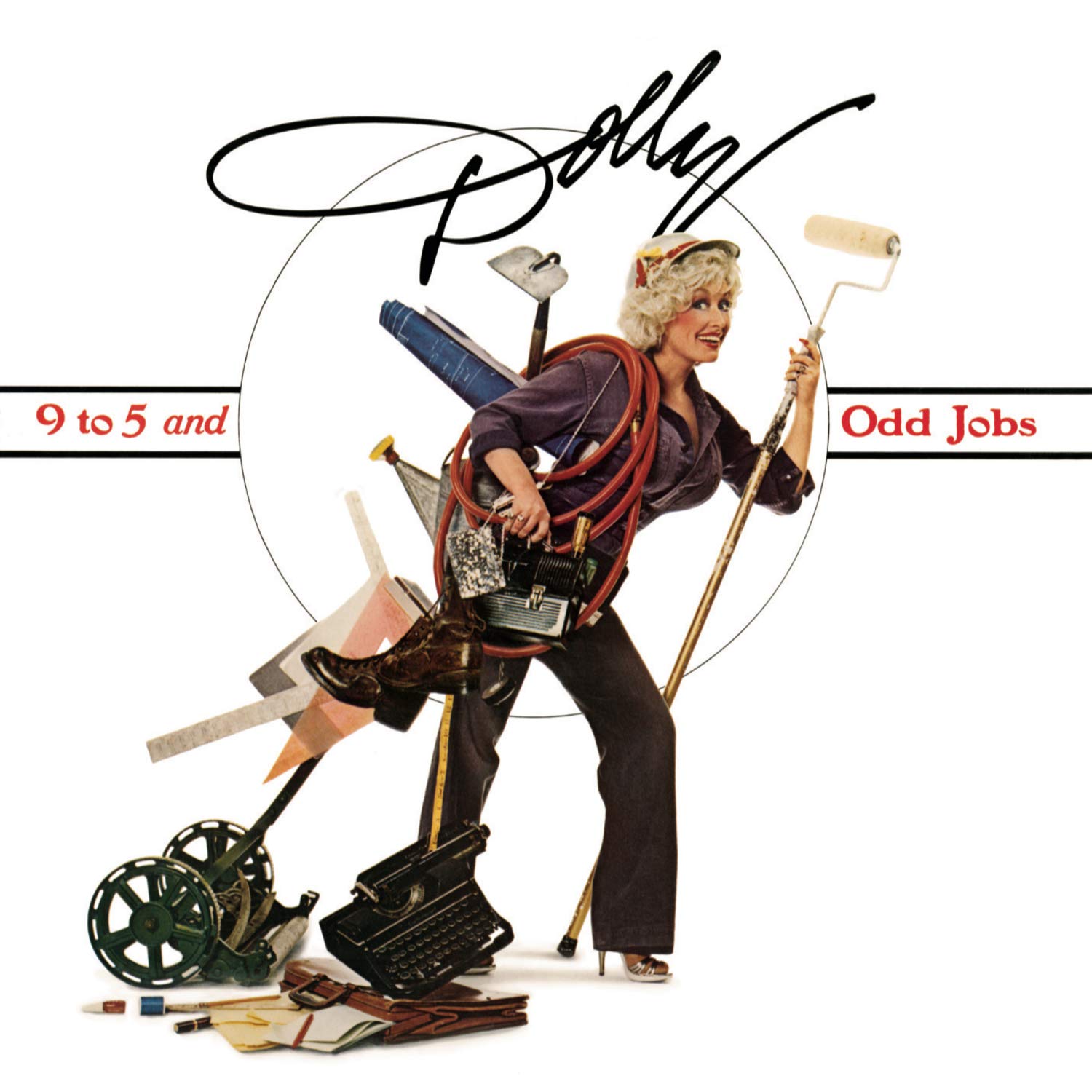
“9 to 5,” Dolly Parton, 1980

When Jane Fonda came up with the idea of a film about women office workers, she envisioned it as a drama, “but it was coming across too preachy, too much like lecturing the audience. So we decided to make it a comedy instead.” They hired Director Colin Higgins and said, “What you have to do is write a screenplay which shows you can run an office without a boss, but you can’t run an office without the secretaries.” The resulting film — starring Fonda, Lily Tomlin and breakout star Dolly Parton — was a huge hit, and Parton wrote and sang the infectious theme song, which reached #1 on both the pop and country charts, winning two Grammys. The lyrics paint a bleak picture of how secretaries are treated: “Workin’ 9 to 5, what a way to make a livin’, /Barely gettin’ by, it’s all takin’ and no givin’, /They just use your mind, and you never get the credit, /It’s enough to drive you crazy if you let it…”

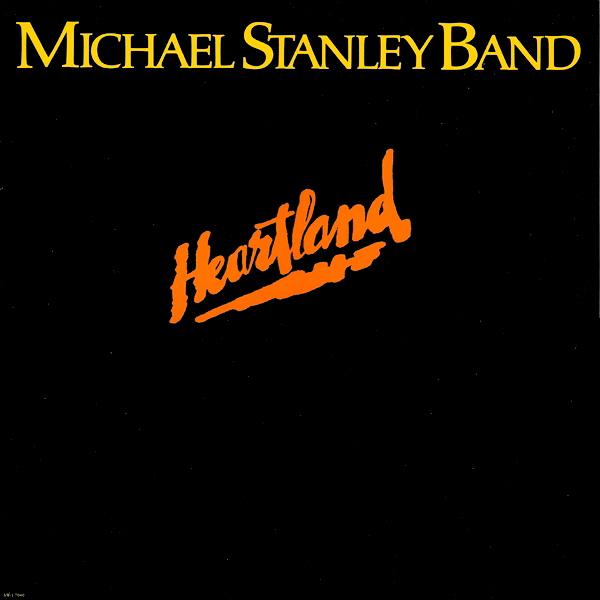
“Working Again,” Michael Stanley Band, 1980

Cleveland’s hometown musical hero led one of the best underrated bands in the country during the 1975-1985 period, cranking out dozens of great Midwest rock and roll songs, smartly arranged and produced, but the fame they deserved largely eluded them. MSB, as their fans called them, recorded passionate songs of romance and loss, of dreams and despair, mirroring the lives of the working class kids who made up the bulk of their listening audience. On their 1980 LP, “Heartland,” Stanley wrote “Working Again,” a pounding rock track about the daily grind at work made tolerable by escapist evenings: “I’m gonna make it to the line, and put my time inn, like my old man. before me, died in dreamland with the union by his side, /But not tonight, tonight I’m gonna try a little harder, but come the light, I’m gonna be working, working again…”

“Get a Job,” The Silhouettes, 1958

Richard Lewis, Bill Horton, Earl Beal and Raymond Edwards comprised The Silhouettes, one of Philadelphia’s better R&B vocal groups. They scored their biggest hit right out of the gate, “Get a Job,” a doo-wop classic that hit #1 on the pop and R&B charts in 1958 and was covered by many artists and used in such films as “American Graffiti,” “Trading Places” and “Good Morning, Vietnam.” It was Lewis who wrote the lyrics about a man whose wife berates him for his unemployment even though he is desperately struggling to find a job: “Well every morning about this time, (Sha-na-na-na, sha-na-na-na-na), She gets me out of bed, a-crying, ‘get a job!’ (Sha-na-na-na, sha-na-na-na-na), /After breakfast every day, she throws the want ads right my way, and never fails to say, ‘get a job!’…” It turned out to be their only Top 40 chart appearance, and one supposes they all had to get a job at that point.

“Work to Do,” Average White Band, 1974

This Scottish R&B band were struggling along in the early ’70s when Eric Clapton’s manager took a shine to their lively neo-soul, flew them to L.A. and put them in the capable hands of producer Arif Mardin. Their self-titled second album vaulted to #1 in the US (#6 in the UK) on the strength of the mostly-instrumental track “Pick Up the Pieces,” which also reached #1. I actually preferred the B-side of that single, the insistent “Work To Do,” which drove home the idea that, as much as I’d like to spend more time with you, there’s work to be done first: “I’ve been trying to make it, woman, can’t you see? /Takes a lot of money to make it, let’s talk truthfully, /Keep your love light burning, and a little food hot in a plate, /You might as well get used to me coming home a little late, /’Cause I got work to do, I got work, baby…”

“Working Man Blues,” Merle Haggard, 1969

Country music legend Merle Haggard, who helped develop the country sub-genre known as the “Bakersfield Sound,” had a traumatic childhood scarred by his father’s death, a path of petty crime and violence, and multiple incarcerations. By 1960, he straightened himself out, adopting a strong work ethic as he pursued a career in music, writing and recording many dozens of songs and amassing an astounding 38 #1 hits on the country charts between 1965 and 2015. One of his most widely praised tunes is “Working Man Blues” from his 1969 LP “A Portrait of Merle Haggard,” featuring fine guitar work from the wondrous James Burton: “Hey hey, the working man, the working man like me, /I ain’t never been on welfare, that’s one place I won’t be, /’Cause I’ll be working long as my two hands are fit to use, /I drink a little beer in a tavern, sing a little bit of these working man blues…”

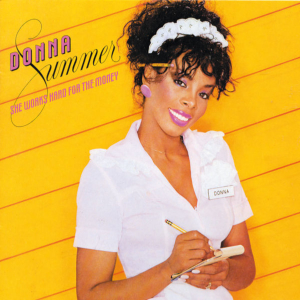
“She Works Hard For the Money,” Donna Summer, 1983

After years as a stage performer ion Germany and Austria, Summer returned to the US and became the undisputed “Queen of Disco” with a dozen Top Ten hits, many with longer dance-club versions. In 1983, she was at a private party at a West Hollywood restaurant when she visited the ladies’ room and encountered an attendant who was sound asleep, exhausted from her day-long work shift. “I looked at her,” Summer recalled, “and my heart just filled up with compassion for this lady, and I thought, ‘God, she works hard for the money, cooped up in this stinky little room all night.’ Then a light went off in my head, and I said, ‘She works hard for the money! That’s a song!'” It went to #1: “It’s a sacrifice working day to day for little money, just tips for pay, /But it’s worth it all to hear them say that they care, /She works hard for the money, so you better treat her right…”

“I’ve Been Working,” Van Morrison, 1970

The free, relaxed sound that Morrison conjured for his iconic “Moondance” LP in 1970 was markedly different from the quieter, more vulnerable vibe of his “Astral Weeks” album before it. Morrison originally intended that the next project be recorded a cappella with a small chorus, but he ended up using the same backing musicians from the “Moondance” album and tour, and additional voices, and the record company saw fit to call the album “His Band and The Street Choir.” One track, “I’ve Been Working,” had been tried twice before in earlier album sessions, and the third time captured a wonderfully hypnotic groove based around the opening lyric “I’ve been working so hard” and “I’ve been grinding so long,” devolving into “woman, woman, woman, woman” and “all right, all right, all right, all right.”

“Takin’ Care of Business,” Bachman-Turner Overdrive, 1973

While still in The Guess Who, Randy Bachman had written a tune he called “White Collar Worker,” but the rest of the band rejected it, leading Bachman to depart in 1970. He formed another group called Brave Belt, which morphed into Bachman-Turner Overdrive by 1973. He revived “White Collar Worker” for their setlist, but one day, he heard a Vancouver radio deejay say, “We’re takin’ care of business here at CFUN Radio,” and decided to insert the phrase in the chorus where “white collar worker” had been. The crowd ate it up, stomping and shouting along to what became the song’s new title when they recorded it weeks later. It’s one of BTO’s signature songs, and an anthem of the working world: “You get up every morning from your ‘larm clock’s warning, take the 8:15 into the city, /There’s a whistle up above, and people pushin’, people shovin’, and the girls who try to look pretty, /And if your train’s on time, you can get to work by nine, and start your slaving job to get your pay…”

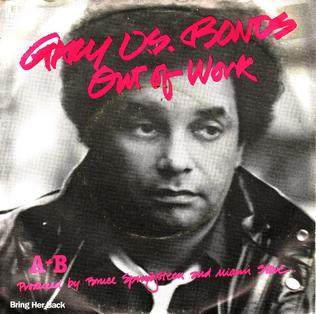
“Out of Work,” Gary U.S. Bonds, 1983

Gary Anderson, who later adopted the stage name Gary U.S. Bonds, scored four Top Ten hits in the early ’60s, most notably the rave-up “Quarter to Three,” a feisty little blues rocker that topped the charts in 1961. Bonds proved to be an early influence on Bruce Springsteen, who was happy to use his clout to help revive Bonds’ career in the early 1980s, writing ten songs that appeared on two Bonds LPs in 1982 and 1983. Most notable were the hit singles “This Little Girl” and “Out of Work,” both of which benefitted from the participation of The E Street Band in the studio. In “Out of Work” (basically a rewrite of Springsteen’s “Heavy Heart”), Bonds sings lyrics that struck home with many during the Reagan recession: “8 A.M., I’m up and my feet beating on the sidewalk, /Down at the unemployment agency, all I get’s talk, /I check the want ads but there just ain’t nobody hiring, /What’s a man supposed to do when he’s down and out of work, I need a job, I’m out of work…”

“The Working Man,” Creedence Clearwater Revival, 1968

John Fogerty was still honing his songwriting chops when his band Creedence Clearwater Revival recorded their debut LP in 1968. While he went on to write a dozen Top Ten hits over the next four years, at that point, the group’s best efforts came on the Dale Hawkins classic “Susie-Q” and the Screamin’ Jay Hawkins slow blues, “I Put a Spell on You.” Wedged between those two tracks was a Fogerty original called “The Working Man,” which served as a prototype for later Creedence songs like “Penthouse Pauper” and “Tombstone Shadow.” The song’s lyrics laid out Fogerty’s no-nonsense work ethic: “Well, I was born on a Sunday, on Thursday, I had me a job, /I was born on a Sunday, by Thursday, I was workin’ out on the job, I ain’t never had no day off since I learned right from wrong…”

“I’ve Been Working Too Hard,” Southside Johnny and The Asbury Jukes, 1991

One of the great unheralded bands from the ’70s/’80s was this group of R&B devotees from the Jersey shore fronted by singer John Lyons. Their first three LPs in 1976-1978 received immeasurable support from Lyons’ longtime pal Steve Van Zandt, who wrote and/or produced most of the best songs in the Asbury Jukes catalog. So it was only natural that, after suffering a rough patch in the late ’80s, Lyons called upon Van Zandt to fuel his comeback LP, “Better Days.” One of the highlights from that disc is “I’ve Been Working Too Hard,” a glorious, horns-driven rocker: “Now, money and me don’t talk too much, we never got along too well, /But when I got some in my pocket, I seem to have a lot more friends, /I pay the landlord and the taxman, and it’s time to go to work again, /Can I get a witness? /Let me hear you say, I’ve been workin’ too hard…”

“Take this Job and Shove It,” Johnny Paycheck, 1982

Donald Lytle was a harmony singer for country music legends like Ray Price and George Jones before he changed his name to Johnny Paycheck (contrary to popular myth, it was not meant as a parody of Johnny Cash). In the late ’70s, Paycheck became part of the outlaw country scene alongside Waylon Jennings, Willie Nelson and Hank Williams Jr., and enjoyed his own #1 song on the country charts, the iconic “Take This Job and Shove It.” Written by fellow outlaw David Allan Coe, the song’s title became a ubiquitous phrase in popular culture, not only among unhappy employees but among those who could no longer tolerate their car, their spouse, their whatever: “One of these days I’m gonna blow my top, and that sucker, he’s gonna pay, /Lord, I can’t wait to see their faces when I get the nerve to say, /Take this job and shove it, I ain’t working here no more…”

****************************

Honorable mention:

Blue Collar,” Bachman-Turner Overdrive, 1973; “Working Girl,” Cher, 1987; “Bus Rider,” The Guess Who, 1970; “Working in the Coal Mine,” Lee Dorsey 1966; “Morning Train (Nine to Five),” Sheena Easton, 1980; “Manic Monday,” The Bangles, 1986; “Working John, Working Joe,” Jethro Tull, 1980; “Money For Nothing,” Dire Straits, 1985; “Working Man,” Rush, 1974; “Chain Gang,” Sam Cooke, 1960.

*****************************

We’re all weird people, and we love it

I was scrolling through Facebook recently, where my feed typically includes music-related posts based on my tendency toward music-related topics. Some random website came up with a playlist of “Weird Songs We Love,” which definitely piqued my interest. Most of the selections were from recent years by artists I didn’t know, but it got me thinking about compiling a list of weird songs I like from the ’60s, ’70s and ’80s, which readers know is the era I write about on “Hack’s Back Pages.”

Let’s define our terms. Historically, “weird” meant eerie or supernatural, but on this post, I’m talking about weird as in bizarre, strange, odd, eccentric, or off the wall. I don’t mean silly, which generally means foolish, idiotic or frivolous. I’m referring to music that is intentionally unusual, even uncategorizable. It might offer the use of quirky sound effects, or an unorthodox blend of instruments, or somewhat nonsensical lyrics. And yet, the result is music that some people might find strangely appealing.

You’ll notice that more than half of the songs on the playlist were released in the ’60s, a time when boundaries were being broken and conventional approaches were being questioned. For instance, some tracks are almost atonal in their strangeness. Some are rather shocking (or were, for their time). Most are merely outside the box, seriously different from what we’re used to hearing.

Conventional or narrow-minded listeners might consider these tunes to be “songs that make you say ‘WTF?'” The dozen songs I have included here, probably the most subjective list I’ve ever assembled, are for the more broadly receptive listeners who are willing to experience these artists’ experimental projects. No doubt many of you can come up with your own candidates for “weird songs we love.”

It might be tough to play this setlist in its entirety, but I hope you’re curious enough to put your expectations and preconceptions on the shelf for a spell and try to absorb what’s going on here. Perhaps you’ll be surprised by how compelling some of this stuff can be.

****************************

“The Intro and The Outro,” Bonzo Dog Doodah Band, 1967

The Bonzos were British art school multi-instrumentalists and performers in the 1960s who creatively combined elements of music hall, jazz and psychedelia with surreal humor and avant-garde art. Their 1967 debut album “Gorilla” includes “Death Cab For Cutie,” a song heard in The Beatles’ surreal “Magical Mystery Tour” film (and also inspired the 1990s/2000s band of the same name). I’ve always been amused by “The Intro and The Outro,” on which droll member Viv Stanshall rattles off the names of people who ostensibly perform on the track (Quasimodo? Roy Rogers? Liberace? Adolph Hitler?) while a loose jazz jam plays in the background. Funny, and weird.

“Plastic People,” Mothers of Invention, 1967

It’s no surprise that California had its own avant-garde music scene, led by the brilliant, prickly maverick Frank Zappa and his erstwhile band, The Mothers of Invention. Zappa was heavily into sonic experimentation and outrageous lyrics with the band’s original lineup (1966-1970), and those first several albums broke barriers and had many listeners scratching their heads. The band brazenly debuted with a double album called “Freak Out” that inspired dozens of edgy bands in the coming decades. On their second album, the opening track, “Plastic People” offers a fine example of The Mothers’ singularly weird stew of rock, classical, jazz and atonal musical genres.

“Let X=X,” Laurie Anderson, 1982

A super-literate performance artist, composer and multi-instrumentalist, Anderson emerged from the New York arts scene in the mid-’70s with an arresting brand of avant-garde music, merging unusual vocalizing and instrumentation with the latest music technology. Her first album, “Big Science,” turned a lot of heads, and its uncommercial 8-minute single, “O Superman,” somehow reached #2 in the UK. Anderson’s virtuosity on violin was typically overshadowed by her fascination with innovations like vocal filters and talking sticks, creating weirdly compelling sounds like on “Let X=X” from the “Big Science” LP. She ended up marrying iconoclast Lou Reed later in life.

“You Know My Name (Look Up the Number),” The Beatles, 1970

This track, one of the weirdest in The Beatles’ catalog, was recorded over four separate sessions between 1967 and 1969. It wasn’t released until 1970 when it became the B-side of the “Let It Be” single. As Paul McCartney recalled, “John turned up at the studio and said, ‘I’ve got a new song’. I said, ‘What’s the words?’ and he replied, ‘You know my name, look up the number.’ I asked, ‘What’s the rest of it?’ ‘No, no other words, those are the words. And I want to do it like a mantra.” That’s exactly what they did, repeating the phrase in various affected voices over a plodding rock beat, a cocktail-lounge shuffle and a jazzy night-club groove with disruptive asides shouted intermittently. Don’t know why I love it. I just do.

“They’re Coming to Take Me Away, Ha Ha,” Napoleon XIV, 1966

I suppose this track would be considered offensive today to those with severe mental illnesses who require institutionalization, but in 1966, it qualified as a novelty hit that actually reached #3 on the US pop charts. A singer/songwriter/producer named Jerry Samuels adopted the stage name Napoleon XIV to record the track, randomly speeding up and slowing down the tempo to make the vocals sound crazier. It’s one of several he recorded that comically explored insanity (“Bats in My Belfry,” “The Nuts On My Family Tree,” “I Live in a Split-Level Head”). On the B-side of the “They’re Coming to Take Me Away, Ha-Haaa!” single was the same song recorded backwards (“”!aaaH-aH ,yawA eM ekaT oT gnimoC er’yehT”). Talk about WEIRD.

“Oscillations,” Silver Apples, 1968

On of the earliest influences on my rock music listening habits was my friend Paul and his brother Joe, who turned me on to boundary-pushing artists like Frank Zappa and also lesser-known ones like Silver Apples, a New York City synthesizers-and-drums duo. Simeon Coxe and Danny Taylor were among the first to make use of electronic music techniques in the rock/pop genre, employing pulsating rhythms and synthesized melodies from primitive equipment of Coxe’s own devising. These days, electronica is an accepted genre played by many dozens of bands worldwide, but in 1968, Silver Apples — and songs like “Oscillations” — were definitely at the vanguard of a new, weird genre.

“The Scarecrow,” Pink Floyd, 1967

There are those who think the bulk of Pink Floyd’s repertoire qualifies as weird, but in my view, only their earliest work (1967-1971) falls under that category. In particular, the group’s debut LP, “The Piper at the Gates of Dawn,” largely written by their ill-fated founder Syd Barrett, was really out there, an enigmatic, perplexing batch of tracks the likes of which no one had heard before. I could’ve selected any of the “tunes” from this LP for this post’s playlist, but I settled on “The Scarecrow,” a strange, brief track, using primarily percussion and organ, which equates the scarecrow with society’s outcasts: “The black and green scarecrow, as everyone knows, stood with a bird on his hat and straw everywhere, /He didn’t care…”

“Pasties and a G-String,” Tom Waits, 1976

Waits arrived in 1973 with a remarkable debut album, “Closing Time,” which offered gorgeous melodies and poignant lyrics delivered with vocals so gravelly as to make Bob Dylan sound like a choir boy in comparison. Waits often wrote about outliers and sketchy characters from life’s dark underbelly, championing them as people who were merely dealt a bad hand. His material drifted into looser jazz arrangements as his career progressed, and by 1976, his LP “Loose Change” included quasi-improvisational tracks like “Pasties and a G-String,” with its strip-club lyrics and weird forms of scat singing/talking. Waits has dabbled in blues, rock and experimental genres well into the 2000s.

“The Dust Blows Forward and the Dust Blows Back,” Captain Beefheart, 1969

Right up there with the other iconoclasts of the avant-garde frontier of ’60s rock music was Don Van Vliet, who assumed the stage name Captain Beefheart. The California-based artist imposed dictatorial control over his rotating ensemble called His Magic Band, pumping out a dozen albums between 1967-1982 that offered idiosyncratic free jazz, blues rock and absurdist lyrics. His high-water mark, if you can call it that, came when he collaborated with Zappa on “Trout Mask Replica,” a favorite LP of many critics of that era. Beefheart’s recorded output was as influential as it was weird. Take a listen to “The Dust Blows Forward and the Dust Blows Back” for a quintessential sample.

“Zilch,” The Monkees, 1967

“Headquarters,” The Monkees’ third LP, was their first with songwriting and instrumental performances by members of the group. Michael Nesmith wrote three songs himself and five others were written or co-written by the other three Monkees. One of these was the zany tongue twister “Zilch,” in which each band member repeated a nonsensical line they had heard on film, in court or on loudspeakers: “Mr. Dobbaleena, Mr Bob Dobbaleena”; “China Clipper calling Alameda”; “Never mind the ‘furthermore,’ the plea is self-defense”; “It is of my opinion that the people are intending.” It’s a precisely timed vocal exercise until it eventually degenerates into chaos and laughter. To a 12-year-old like me, this was both weird and hilarious.

“Chant of the Ever Circling Skeletal Family,” David Bowie, 1974

The late, great David Bowie has been likened to a chameleon for the way he would continually change his persona and musical approach, sometimes radically, throughout his six decades in the business. He thought nothing of giving his listeners figurative whiplash as he flip-flopped from accessible to dense, from sunny pop to weird industrial. Sometimes this happened on the same album; on 1974’s “Diamond Dogs,” Bowie gave us the commercial rock anthem “Rebel Rebel” as well as the head-scratching finale, “Chant of the Ever Circling Skeletal Family.” The full range of Bowie’s musical spectrum is on display in a new biopic called “Moonage Daydream,” to be released at IMAX theaters in mid-September.

“Surfin’ Bird,” The Trashmen, 1963

In 1962, a talented vocal doo-wop trio from Los Angeles called The Rivingtons came up with a gritty soul classic called “Papa-Oom-Mow-Mow” that, while memorable, stalled at #48 on the charts. They tried again the following year with the similar sounding “The Bird’s the Word,” which also failed to connect with listeners. Then came The Trashmen, a Minneapolis band that billed itself as “the premier landlocked Midwestern surf group of the ’60s,” who took elements of both Rivingtons tracks and came up with “Surfin’ Bird,” which has a more garage-band feel and the outrageously abrasive vocals of drummer Steve Wahrer. Nowhere near as good as The Rivingtons, but it reached #3 on the charts. How weird is that?

***************************
Honorable mention:

C.I.A. Man,” The Fugs, 1967; “Baby’s On Fire,” Brian Eno, 1974; “Heinz Baked Beans,” The Who, 1968; “Hocus Pocus,” Focus, 1973; “The Lantern,” The Rolling Stones, 1967; Do the Strand,” Roxy Music, 1972; “Alley Oop,” The Hollywood Argyles, 1960; “Coconut,” Harry Nilsson, 1972; “Ahab the Arab,” Ray Stevens, 1962.

*****************************