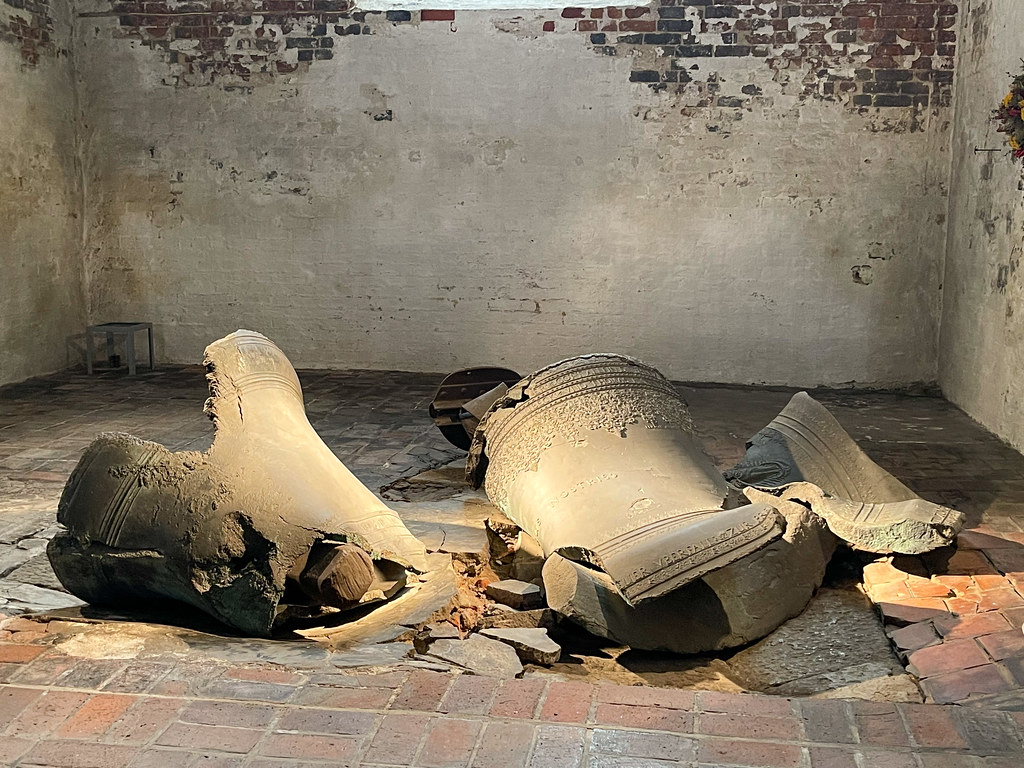
Do you recall what was revealed?

I’ve recently written a couple blogs that delve into the meaning behind some classic rock song lyrics. When I happened to mention to a few folks that I would be writing a blog post solely about Don McLean’s iconic opus “American Pie” — seeing as how it was released 50 years ago this week — one friend said, “Oh God, please don’t. Tell me when that’ll be published so I can skip your blog that week.” Others said they were looking forward to it, recalling the great memories the song evokes for them.

Don McLean, 1972

Either way, here we go.

“American Pie” is quite possibly the most (over)analyzed song in rock history, which was pretty much what McLean, now 76, had been hoping for. “It turned out beyond my wildest dreams,” he said in a 2020 article in American Songwriter. “I wanted to write a big song about America, so I came up with this idea that politics and music influence one another and flow parallel together, forward, but I had no clue how to begin to express that. Then one day, I was singing into the tape recorder, and the first verse all came tumbling out, like a genie from the bottle. ‘A long, long time ago’ all the way through to ‘the day the music died.’ I thought, ‘Whoa, what is that?!'”

One of the motivating factors in McLean’s songwriting through the years has been a family secret that McLean never discussed openly until recently. He had a sister, fifteen years his senior, who was an alcoholic and drug addict “who almost ruined my childhood. It was a disaster to see it. It was just awful. That’s one big reason why I’m a blue guy, I guess. All my songs are about loss – and a certain kind of psychic pain. I’ve never really been happy.”

McLean had a decent career, with several other popular singles like “Vincent” (a #12 hit) and “Dreidel” (#21) and a cover of Roy Orbison’s “Crying” (#5), but without question it was “American Pie” that defined him… and sustained him… and exasperated him as well. It was a mighty bold undertaking to attempt a song that chronicled the rise and fall of rock & roll in an infectious and expansive radio-friendly pop song, and everyone has been relentlessly asking him what the words really mean. His pat answer was always, “It means I don’t have to ever work again if I don’t want to.” (Indeed, he pulls in about $400,000 in annual royalties, and the handwritten lyrics fetched a cool $2 million at auction in 2015.)

But he’s been talking about it more openly these days. I have researched numerous articles and essays, published long ago and more recently, to assess various interpretations that either confirmed my thinking or put forth something entirely different. Today, I offer my view on the words that many of us can and still do sing along to when the song is played.

*********************

A long, long time ago,
I can still remember how that music
Used to make me smile,
And I knew if I had my chance
That I could make those people dance
And maybe they’d be happy for a while

But February made me shiver
With every paper I’d deliver,
Bad news on the doorstep,
I couldn’t take one more step,
I can’t remember if I cried
When I read about his widowed bride,
Something touched me deep inside
The day the music died

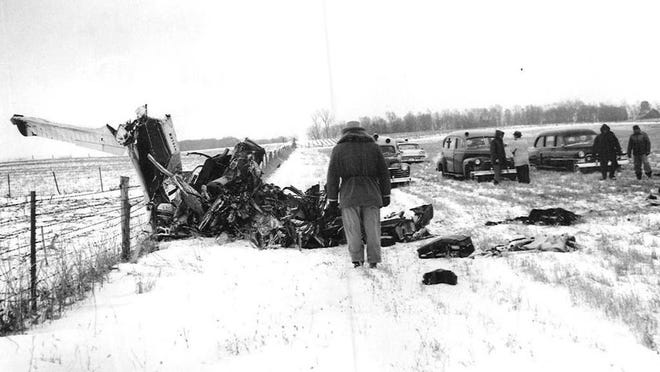
The site of the plane crash that claimed Buddy Holly, Ritchie Valens and The Big Bopper, 1959

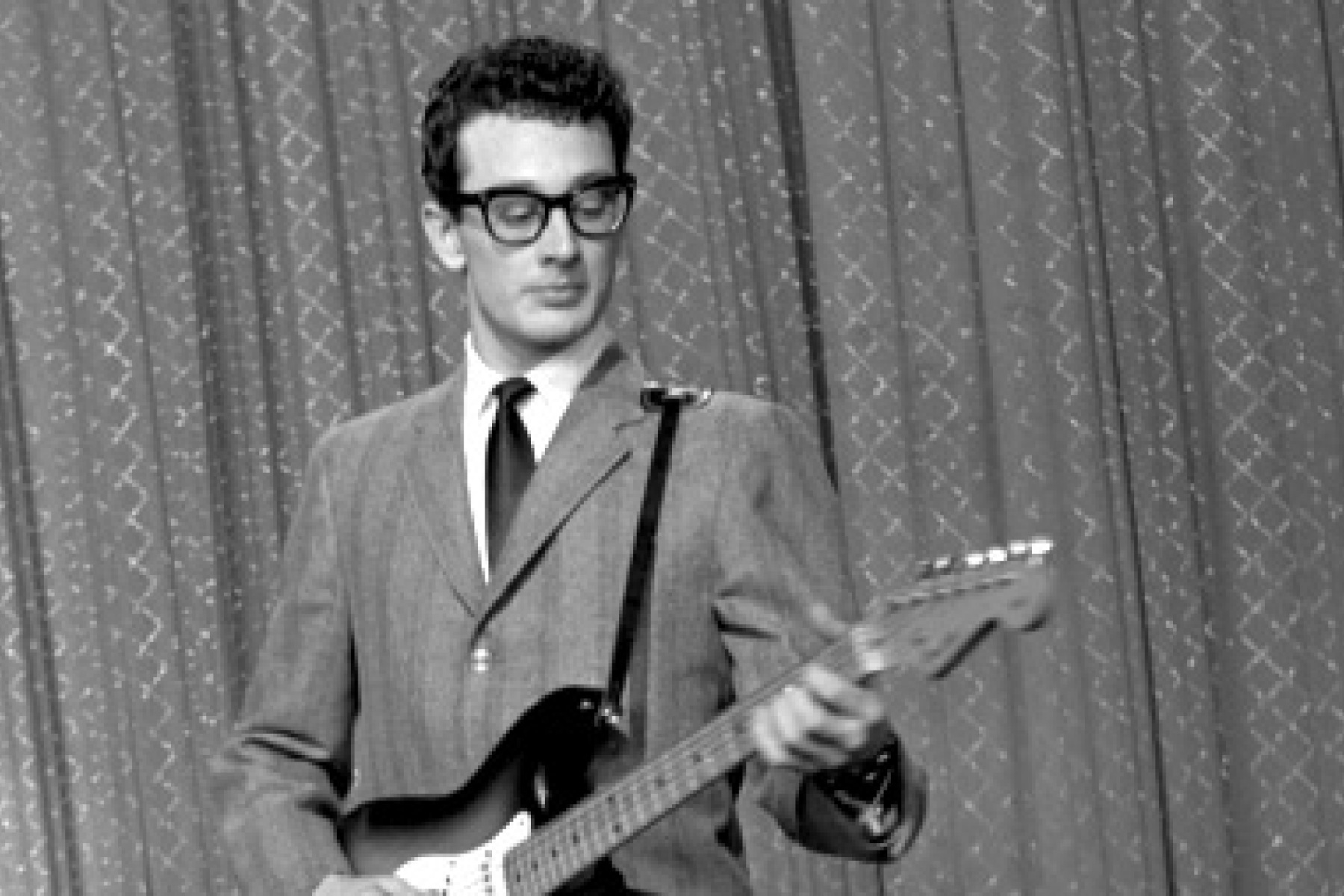
McLean was a 14-year-old paper boy on February 4, 1959, when he was sucker-punched by the headline about the plane crash that took the life of Buddy Holly and two other vintage rockers. He had loved Elvis and Chuck Berry and Little Richard, but they had joined the Army, gone to jail and converted to gospel music, so when Holly went down too, McLean felt as if a chapter of his life, and what he regarded as the innocent life of ’50s America, had come to an end. Compounding this in real terms is the fact that McLean’s father died the next year, leaving him on his own to figure things out. He felt it acutely at age 26 as he began writing the song in 1971 and realizing how much had changed in only a dozen years. Something indeed touched him deep inside, and he was moved to write it all down in five more lengthy verses and a repeated chorus.

Buddy Holly

***********************

So, bye-bye, Miss American Pie,
Drove my Chevy to the levee, but the levee was dry,
And them good ol’ boys were drinkin’ whiskey and rye,
Singin’, “This’ll be the day that I die,
This’ll be the day that I die”

Here he is singing a fond farewell to childhood, to apple pie and Miss America. Some of you may recall the old TV commercial with the tagline, “See the U.S.A. in your Chevrolet…” That’s how the Chevy reference ties in, but he’s finding the well of innocence has run dry for him. In another nod to Buddy Holly, McLean altered his song “That’ll Be the Day,” turning a romantic negotiation into something far more solemn. McLean’s mourning for simpler times is initially set to a slow, ballad tempo, and again in the song’s coda, but the majority of the record gallops along as an infectious, uptempo romp that kept most of our melancholy musings at bay while we sang along. Very clever of him to put all these thought-provoking lyrics to a pleasant, sing-along melody, or the entire enterprise might have never been noticed in the first place.

Alexis Petridis, music critic for The Guardian, summed it up this way: “Dylan talked to us in dense, cryptic, apocalyptic terms. But McLean says similar ominous things in a pop language that mainstream listeners could understand. The chorus is so good that it lets you wallow in the confusion and wistfulness of that moment, and be comforted at the same time. It’s bubblegum Dylan, really.”

************************

Did you write the book of love
And do you have faith in God above
If the Bible tells you so?
Now, do you believe in rock ‘n’ roll?
Can music save your mortal soul?
And can you teach me how to dance real slow?

Well, I know that you’re in love with him
‘Cause I saw you dancin’ in the gym,
You both kicked off your shoes,
Man, I dig those rhythm and blues,
I was a lonely teenage bronckin’ buck
With a pink carnation and a pickup truck,
But I knew I was out of luck
The day the music died

It’s crystal clear that McLean is weaving spiritual thoughts into the lyrics at several points, most notably here, where he uses the 1950s hit songs “The Book of Love” and “The Bible Tells Me So” to compare faith in God with faith in rock ‘n’ roll music (as the Lovin’ Spoonful had asked in “Do You Believe in Magic?” in 1965). McLean takes us back to sock hops, cool cars, great dance tunes and how “I knew I was out of luck” because his innocent childhood had ended. He felt it was useless to keep yearning for those old days now that so much had transpired by the time he wrote the song in 1971, as we shall see.

***********************

Now, for ten years we’ve been on our own,
And moss grows fat on a rollin’ stone
But that’s not how it used to be,
When the jester sang for the king and queen
In a coat he borrowed from James Dean
And a voice that came from you and me

Oh, and while the king was looking down,
The jester stole his thorny crown,
The courtroom was adjourned
No verdict was returned,
And while Lenin read a book on Marx,
A quartet practiced in the park,
And we sang dirges in the dark
The day the music died

Here the lyrics start to become a more interesting guessing game. Who is the Jester? The King and Queen? What courtroom? Who is the quartet practicing in the park?

Bob Dylan has dismissed the notion that he might be the Jester in McLean’s story (“A jester?” he scoffed. “Sure, the Jester writes songs like ‘Masters of War’ and ‘A Hard Rain’s Gonna Fall’ – some jester. I have to think he’s talking about somebody else.”). But it makes sense from the standpoint of Dylan assuming the musical mantle in 1963 that had been cast aside by The King, who is, of course, Elvis. The coat Dylan borrowed from James Dean — symbolically, anyway — can be seen on the cover of his landmark “The Freewheelin’ Bob Dylan” album.

Some observers saw the lyrics here as more political. The King and Queen, they say, were John and Jackie Kennedy, and the Jester who stole the thorny crown was Lee Harvey Oswald. An intriguing idea…and this would actually tie in nicely to McLean’s premise about our national loss of innocence, but I’m not buying it.

The courtroom was the court of public opinion, where people’s tastes in music were splintering into different factions (folk versus rock, etc.) and, hence, no verdict was returned. Again, in the matter of Kennedy’s assassination, many in the court of public opinion never accepted the Warren Commission’s conclusions, which can translate to a “no verdict.”

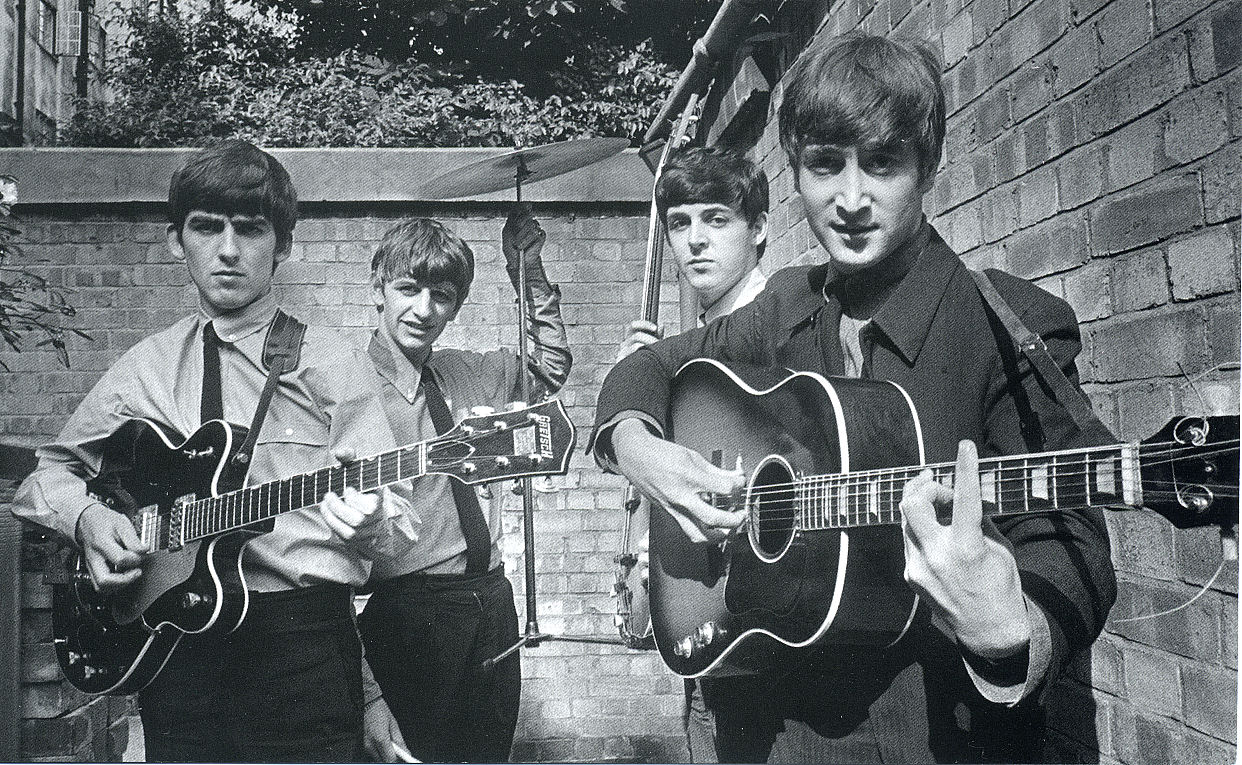
The quartet who were honing their skills in 1963, I think we can all agree, were The Beatles, whose seismic impact on rock music was about to be felt. Meantime, pop radio would be filled with inconsequential pablum — “dirges in the dark” — until their arrival.

************************

Helter skelter in a summer swelter,
The birds flew off with a fallout shelter,
Eight miles high and falling fast,
It landed foul on the grass,
The players tried for a forward pass
With the jester on the sidelines in a cast

Now, the halftime air was sweet perfume
While sergeants played a marching tune,
We all got up to dance,
Oh, but we never got the chance
‘Cause the players tried to take the field,
The marching band refused to yield,
Do you recall what was revealed
The day the music died?

The merger of folk and rock symbolized by The Byrds and “Eight Miles High” in 1966-67 was the high point of ’60s optimism, which at first, rivaled the carefree sunniness of the ’50s. The “players” who “tried for a forward pass” were, I submit, The Rolling Stones, who were enjoying a string of edgy yet broadly accessible mid-’60s hits (“Satisfaction,” “Get Off My Cloud,” “Paint It Black”) while Dylan sat “on the sidelines in a cast,” convalescing from a motorcycle accident. With their milestone “Sgt. Pepper” LP in 1967, The Beatles had morphed from the quartet into the Marching Band, hoping to maintain the air of “sweet perfume,” but the false promises of The Summer of Love were dissolving, and “we never got the chance” to dance because psychedelia, acid rock and new tensions were on the rise.

The politically based interpretation says the “players” are the civil rights protesters, and the marching band is the authoritarian establishment who “refused to yield.” And what was it that was revealed? You can make the case that the seemingly intractable division between the political left and right that haunts us even more today than 50 years ago was first on display in the Chicago streets outside the 1968 Democratic Convention. It was the dark underside of the American Dream.

***********************

Oh, and there we were all in one place,
A generation lost in space,
With no time left to start again,
So, come on, Jack be nimble, Jack be quick,
Jack Flash sat on a candlestick,
‘Cause fire is the Devil’s only friend

Oh, and as I watched him on the stage,
My hands were clenched in fists of rage
No angel born in Hell
Could break that Satan spell,
And as the flames climbed high into the night
To light the sacrificial rite,
I saw Satan laughing with delight
The day the music died

This verse opens with a description of the crowd at a music festival, presumably Woodstock with all its good vibes, but we soon see it’s the darker, violent Altamont festival that McLean is talking about. “Fire is the Devil’s only friend” ties together “Sympathy for the Devil” and The Rolling Stones’ performance there, during which Hell’s Angels “security” beat a concertgoer to death in full of view of the red-caped Mick Jagger and the band on stage. To McLean, this was the nadir of the story’s arc, the moment when any hope of innocence returning had been dashed. The story, and the words he uses to tell it, get a bit melodramatic at this point, but he’s trying to drive the point home that nothing “could break that Satan spell.”

Listeners who were paying attention to the words at this point could be forgiven for concluding, “This is one depressing song.”

The Rolling Stones at Altamont, 1969

**********************

I met a girl who sang the blues
And I asked her for some happy news,
But she just smiled and turned away,
I went down to the sacred store
Where I’d heard the music years before,
But the man there said the music wouldn’t play

And in the streets, the children screamed,
The lovers cried, and the poets dreamed,
But not a word was spoken,
The church bells all were broken,
And the three men I admire most,
The Father, Son and the Holy Ghost,
They caught the last train for the coast
The day the music died

Janis Joplin, 1970

As the tempo returns to a slower, more reflective pace, McLean touches on the sad tale of Janis Joplin, whose career briefly shone brightly but ended in tragedy and drug overdose (“she just smiled and turned away”) in 1970. The “sacred store” where “the music wouldn’t play” was, I believe, the neighborhood record store, where there had once been listening rooms for buyers to check out records. More to the point, the music of McLean’s youth was now passé, shoved aside by the cynicism of the newer generation. The faith in music had not been rewarded — instead, “the church bells all were broken.” Everyone had abandoned the chance of innocence, even “the three men I admire the most,” the Holy Trinity, who chose to metaphorically skip town.

***********************

“American Pie” is, in essence, a cautionary tale about how, as Joni Mitchell once sang, “you don’t know what you’ve got ’til it’s gone.” Any interpretations of the lyrics, including mine, have to be taken with reservations, just as with any cryptic song lyric of that period, or any period. “Basically, in ‘American Pie,’ things are heading in the wrong direction,” concludes McLean. “Life is becoming less idyllic. I don’t know whether you consider that wrong or right, but it is a morality song, in a sense.”

Despite its catchy melody, there’s little to really cheer about in “American Pie.” McLean did come up with one more upbeat verse where the music gets “reborn” at the end, but he ditched it. “Things weren’t going that way,” he said in a 2020 interview. “I didn’t see America improving intellectually or politically. It was going steadily downhill, and so was the music.”

Here in 2021, you can make a convincing case that the innocent, simple days of 1950s America McLean longed for weren’t so innocent nor simple, especially not if you were Black, or Hispanic, or a woman who wanted to be something other than a housewife. And the civil unrest of the ’60s that McLean disparages was, in my view, a necessary battle that brought about some long-needed change in terms of voting rights and job/housing discrimination, to name just two areas.

But we’re talking about one man’s lyrical poetry put to music in 1971, describing the previous ten years. It’s a pop song — a major achievement in pop culture, to be sure — but still just a song. Let’s not assign too much importance to it.

Rob Patterson, a writer at the Best Classic Bands website, put it nicely in perspective: “It’s less important what McLean may say it means, and more important what it means to the listener – not who was what, but how it feels and its emotional impact. One of the true beauties of a great song is how it can become a part of your own experience, your feelings and your life.”

For me personally, “American Pie” is a song I like to play on guitar with a choir of family and friends singing along at the top of their lungs. People have told me they’re amazed I’m able to remember all the words, but that’s because they’re ingrained in my memory since I first learned them.

And to those who are sick to death of “American Pie” or never liked it in the first place, I say, you better look out. McLean announced recently there’ll be a documentary, “The Day The Music Died: The Story Behind Don McLean’s American Pie,” set for release at the end of 2021, and some sort of stage play in 2022 about McLean’s career and the song’s impact, and even a children’s book based on the song.

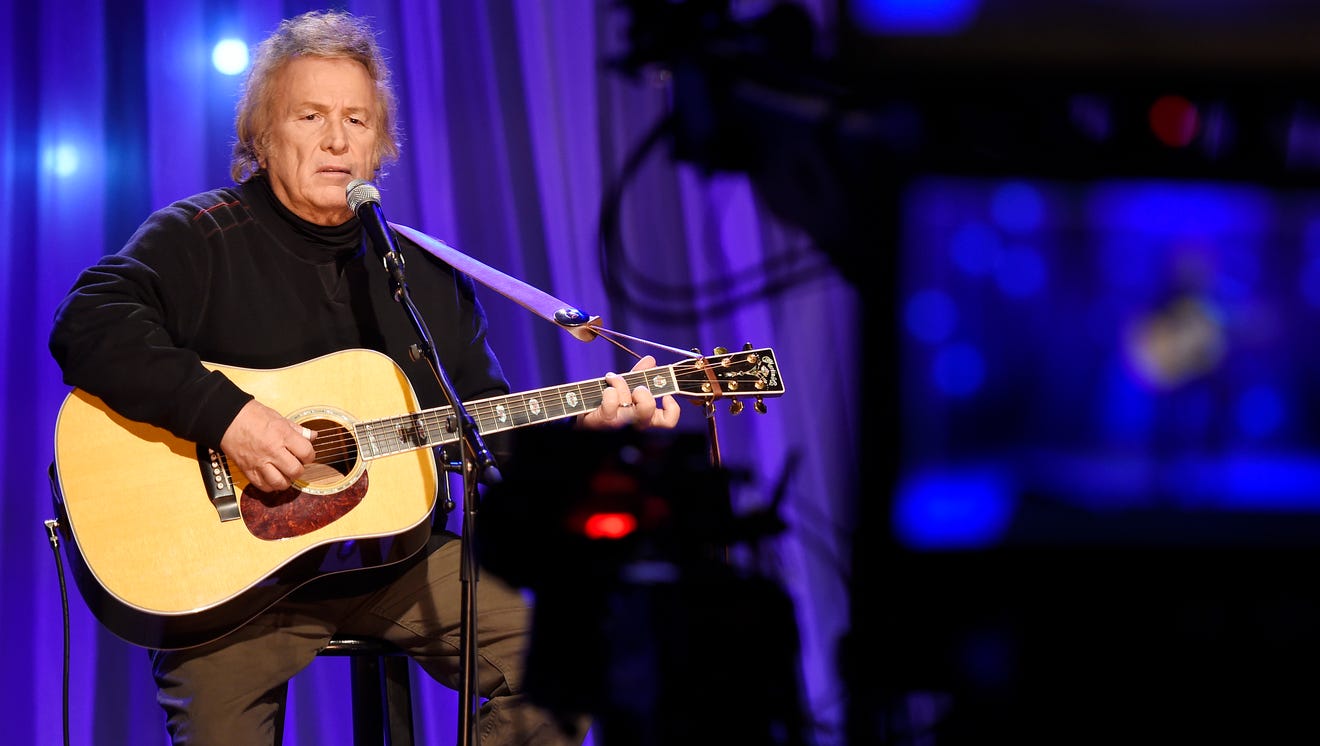
Don McLean, 2016

Apparently, the music, McLean’s music, never died after all.

***********************

The Spotify playlist below is short and to the point. First, of course, is “American Pie,” followed by eight tracks that are mentioned specifically or alluded to in the lyrics, and then concluding with “Vincent,” McLean’s sad ode to Vincent Van Gogh.

It’s time for us to take a second look

Times change. Tastes change. Social mores change. What was once taboo is now OK. What was once considered harmless is now objectionable.

Have you watched TV lately? Have you heard some of today’s Top Ten hits? Wow. Dialog and lyrics, and the subjects they explore now, go places nobody dreamed of 40, 50 years ago. From “The Handmaid’s Tale” to Cardi B’s “WAP,” we’re clearly in radically new territory here.

These days, too, everyone seems so damn touchy, so quick to find offense. There’s also this phenomenon that some call “cancel culture,” where something that’s been around a long time is now seen in a new light, and someone wants something physically removed or digitally deleted. Is it justified? Is it overkill? Well, one man’s ceiling is another man’s floor.

It’s my view that pop/rock song lyrics that condone or even celebrate violence, racism and misogyny should be held up to a bright light and exposed for what they are. You can make a case that today’s lyrics, especially in the hip-hop genre, are WAY beyond what most people find acceptable, but if you go back to tunes from the ’50s, ’60s, ’70s and ’80s, there are some pretty glaring examples from that time of songs that cry out for re-examination.

I’ve selected 15 songs — hit singles and album tracks — from decades ago that, on second look, leave me speechless as to how they were ever given the green light. You might not agree with me, but for what it’s worth, I’m suggesting a reassessment is in order.

There’s a Spotify playlist at the end so you can give these tracks a fresh listen.

***************************

“He Hit Me (And It Felt Like a Kiss),” The Crystals, 1962

The sad irony behind this apparent endorsement of violent relationships is that it was co-written by Carole King, who later endured repeated physical abuse by her third husband, Rick Evers, during their marriage in the late 1970s. King wrote it back in 1962 with her first husband and songwriting collaborator Gerry Goffin after their babysitter, “Little” Eva Boyd, told them she’d been beaten by her boyfriend for seeing another guy. The song was recorded and released by The Crystals as their third single, but it never charted because of a backlash from listeners and radio stations. King has often said she wished she had never had anything to do with the song.

“This Girl is a Woman Now,” Gary Puckett & The Union Gap, 1969

Puckett teamed up with a songwriter/producer named Jerry Fuller, who seemed to write only about girls he couldn’t have. Fuller’s songs ended up as hit singles for Puckett — “Young Girl,” “Woman, Woman,” “Lady Willpower,” “Over You,” “Don’t Give In to Him” — but they had an undeniable creepiness factor that bordered on obsession. Perhaps most egregious was “This Girl is a Woman Now,” in which the narrator boasts about deflowering a young virgin. Songwriters Victor Millrose and Alan Bernstein were responsible for this overreach: “Our hearts told us we were right, and on that sweet and velvet night, a child had died, a woman had been born, /This girl is a woman now, and she’s learning how to give…”

“Cruisin’ and Boozin’,” Sammy Hagar, 1977

Let’s talk about drunk driving, shall we? Innocent people die every day at the hands of people who get behind the wheel while hammered, or even drink while they’re driving. (I confess I used to be one of them.) Do we need songs that condone this destructive behavior? Classic rock artists didn’t make it a dominant theme, but still, there are examples like Hagar, never one of my favorites, who wrote a drunk driving anthem called “Cruisin’ and Boozin.'” It wasn’t a hit, but the lyrics clearly celebrate what is both illegal and stupidly dangerous: “We got JD in the back seat, we drink nothin’ but the best, /Pump a buck in the gas tank, oh, we’ll drink up the rest, yeah, we’ll drink up the rest, /Cruisin’ and boozin’, trying to have a good time…”

“All in the Name Of,” Motley Crüe, 1988

The dudes in glam heavy metal band Motley Crüe — Nikki Sixx, Tommy Lee, Vince Neil and Mick Mars — were known for, and brazenly promoted, their image as druggy sex fiends, so perhaps it’s silly to call them on the carpet for over-the-line lyrics. The thing is, most of their material was arguably within most people’s idea of acceptable, but there’s at least one track that goes too far: “All In the Name Of” from their 1987 LP “Girls, Girls, Girls.” Sorry, but there’s no way Sixx and Neil can justify lyrics like these: “Says to me, ‘Daddy, can I have some candy? /Wanna be your nasty anytime you want, /You know you can have me’… /She’s only fifteen, she’s the reason, the reason that I can’t sleep, /You say illegal, I say legal’s never been my scene, /I try like hell, but I’m out of control, all in the name of rock and roll…”

“A Man Needs a Maid,” Neil Young, 1972

It’s hard not to interpret the lyrics to this tune from Young’s #1 album “Harvest” as pretty chauvinistic. He has tried to defend it over the years by saying he has always struggled with personal relationships and that maybe he’d be better off living alone and just hiring someone to cook and clean. Well, if she remains an employee, I suppose that’s acceptable, but he ends the song by asking “When will I see you again?” which can be interpreted as carrying on a romantic relationship with her as well. It all sounds a bit too misogynistic for my tastes: “I was thinking that maybe I’d get a maid, find a place nearby for her to stay, /Just someone to keep my house clean, fix my meals and go away, /A maid, a man needs a maid…”

“Sweet Little Sixteen,” Chuck Berry, 1958

When rock ‘n’ roll was in its infancy, most song lyrics were geared toward the intended audience — teenagers, and their school woes, their first loves, their cars, their dreams. Berry, one of the chief architects of the new genre, wrote some beauties (“Maybellene,” “School Day,” “Rock and Roll Music,” “Johnny B. Goode”). One of his biggest, “Sweet Little Sixteen,” appears sketchy now for a couple of reasons. He was already 32 when he wrote it, and not long afterwards, he was arrested and convicted for sex with an underage girl, which makes lines like these seem disturbing: “Sweet little sixteen, she’s got the grown-up blues, /Tight dresses and lipstick, she’s sportin’ high-heeled shoes, /Oh, but tomorrow morning, she’ll have to change her trend and be sweet sixteen, and back in class again…”

“Illegal Alien,” Genesis, 1983

The members of Genesis have protested that “Illegal Alien” is a sympathetic satire of the plight of the undocumented immigrant’s challenges, but under closer examination, that just doesn’t wash. The speedy Gonzales-type accent Phil Collins uses as he sings, the litany of disrespectful Mexican stereotypes found in the lyrics (even a line about “I’ve got a sister who’d be willing to oblige“), and the cheesy costumes worn by the band in the accompanying music video all combine to create a racist portrayal of the immigrants in question. Critics called the lyrics “misguided” and “confusing and confused” and described the video as “seemingly well-intentioned” but ultimately “a train wreck.”

“Run For Your Life,” The Beatles, 1965

To their fans, John, Paul, George and Ringo could do no wrong. We wouldn’t learn until much later about Lennon’s traumatic childhood and emotional issues regarding anger management and abandonment. He apparently hit his first wife Cynthia more than once, and his second wife Yoko as well, before coming to terms with it through intensive therapy. In his song “Run For Your Life” from the group’s 1965 “Rubber Soul” LP, Lennon’s narrator warned his woman not to make eyes at anyone else or she might meet a violent end: “Let this be a sermon, I mean everything I’ve said, /Baby, I’m determined and I’d rather see you dead, /You better run for your life if you can, little girl, hide your head in the sand, little girl, /Catch you with another man, that’s the end of little girl…”

“Every Breath You Take,” The Police, 1983

Interestingly, Sting fully acknowledges that the lyrics to this massively popular song (#1 in a dozen countries in 1983) are sinister and passively intimidating. “It’s clearly about an obsessed former lover who is jealously stalking his ex,” he said, adding that he was disconcerted by how many people regard it as a love song. “One couple told me, ‘Oh, we love that song! Its was the main song played at our wedding.’ I said, ‘Really? Well, good luck.’ It’s not a love song, it’s quite the opposite.” The dark theme is undeniable: “Oh can’t you see you belong to me? How my poor heart aches with every step you take, /Every move you make, every vow you break, every smile you fake, every claim you stake, I’ll be watching you…”

“Ahab the Arab,” Ray Stevens, 1962

I can hear some people scoffing at this choice, saying, “Oh come on, it’s a novelty song, a parody done for laughs, and it was friggin’ 1962!” That’s all true, and overall, it didn’t present a derogatory image of Arabs (although all the stereotypes are present). Still, the way Stevens imitated Arabic speech was pretty condescending, and even the title pronounced Arab as “Ay-Rab,” which is the way ignorant Americans pronounce it when they don’t think much of people from that part of the world. It’s interesting to note that Stevens took this track to #5 in 1962, one of his most successful singles in a decades-long career. I don’t know if he still performs it in concert, but perhaps he ought to consider retiring it now.

“Everyone’s Gone to the Movies,” Steely Dan, 1975

The captivating, compelling music that Donald Fagen and Walter Becker created for the Steely Dan catalog is often accessible, sunny pop, but if you delve into the lyrics, you’ll find serial killers, outlaws, drug dealers and even pedophiles. In this track from their 1975 LP “Katy Lied,” they sing of a creepy dude named Mr. LaPage, who evidently invites neighborhood teens into his house to…watch porn movies? Expose himself? It’s not crystal clear, but there’s no question there’s some creepy shit going on. Did they go over the line with this one? Maybe: “Kids if you want some fun, Mr. LaPage is your man, /He’s always laughing, having fun, showing his films in the den, /Come on, come on, soon you will be eighteen, I think you know what I mean, /Don’t tell your mama, your daddy or mama, they’ll never know where you been…”

“Johnny Are You Queer,” Josie Cotton, 1981

This notorious tune, written by Bobby and Larson Paine, was intended for two audiences: young women who had dated guys who turned out to be gay, and interestingly, the gay community, who appreciated the punk-rock attempt to win back the ironic use of the word “queer” from the bigots and homophobes. The Go-Go’s sang it live, but it was a new talent named Josie Cotton, managed by the Laine brothers, who made a record of it in 1981. The song never did much on the US charts because the radio stations were afraid of it or disapproved, but the gay clubs loved it and it went Top Ten in Canada. The evangelicals went ballistic, and the haters laughed and held it up to derision, posing the question menacingly to gays: “Oh, why are you so weird, boy? Johnny, are you queer, boy?…”

“Hot Child in the City,” Nick Gilder, 1978

Gilder, a native of Vancouver, Canada, had been in the glam rock band Sweeney Todd but went solo in 1977 and scored a Juno Award (like a Canadian Grammy) for “Hot Child in the City,” which also reached #1 in the US. Said Gilder, “I’d seen a lot of young girls, 15 and 16, walking down Hollywood Boulevard with their pimps. Their horrible home environment drove them to run away, only to be trapped by something even worse. It hurt to see that, so I tried writing a pop song from the perspective of a customer.” Gee, thanks, Nick — not sure we needed this: “So young to be loose and on her own, /Young boys, they all want to take her home, /She goes downtown, the boys all stop and stare, /When she goes downtown, she walks like she just don’t care, /Hot child in the city, hot child in the city, runnin’ wild and lookin’ pretty…”

“Used to Love Her,” Guns ‘n Roses, 1988

A hard rock band like Guns ‘n’ Roses, aiming to follow in the footsteps of The Stones and Zeppelin, offered lyrics that painted themselves as bad boys, capable of anything. Well, fine, I guess, but yikes, surely there are limits. I thought I’d found their most offensive lyrics in “One in a Million,” when they railed against “immigrants and faggots…starting some mini-Iran or spreading some fucking disease…” But then I found another one called “Used to Love Her” that’s totally beyond the pale: “I used to love her, but I had to kill her, /I knew I’d miss her, so I had to keep her, /She’s buried right in my back yard… She bitched so much, she drove me nuts, and now I am happier this way…” Both tracks appear on their “G N’ R Lies” LP, which reached #2 and sold five million US copies.

“Brown Sugar,” The Rolling Stones, 1971

It’s one thing for Mick Jagger and Keith Richards to push the envelope of what a pop song might be about by focusing on interracial sex, S&M, oral sex and hard drug use. We can at least assume (or pretend) that everything is between consenting adults. But I submit that slavery and rape never were and never will be appropriate subject matter for the Top 40, let alone the #1 song in the country for multiple weeks. How did this one get by? Simple — Jagger blurred his pronunciation so most listeners really didn’t know the words. Bet you never actually read the lyrics before: “Gold coast slave ship bound for cotton fields, sold in a market down in New Orleans, /Scarred old slaver knows he’s doing alright, hear him whip the women just around midnight…”

*************************