It never felt so good, it never felt so right

As the story goes, a Texas woman named Wilma Oday gave birth in 1947 to “nine pounds of ground chuck,” as Wilma’s husband Orvis described the infant’s reddish appearance.

Marvin Lee Aday soon came to be known by his initials “M.L.,” which also stood for Meat Loaf among those who would bully and tease the boy for his large, chubby frame.

That this kid would grow up to become one of the most unlikely rock stars of his generation speaks volumes about how serendipity, perseverance and a phenomenal voice can combine to create one of the best-selling albums in the history of rock and roll.

Meat Loaf died last week at age 74. There’s no official word on the cause of death but it appears to be due to complications from the coronavirus. What a sad ending to a dramatic life.

But I don’t want to dwell on that, because this is a rock music blog, not a medical science forum or political soapbox. Let us focus, if you please, on Meat Loaf’s talents, his accomplishments and his unique story that thrilled many millions of record buyers and concert goers between his dizzying debut LP in 1977 and his passing in 2022.

The man’s name may have been Marvin Aday (which he later changed to Michael), but the entire world knew him as Meat Loaf, which means that, on second reference, I’m supposed to refer to him as Loaf, which seems either awkward or amusing. (The staid New York Times, following its formal newswriting style, would always refer to him as “Mr. Loaf,” which I found hilarious.)

Getting the facts about this guy’s story is a challenge, largely because he relished the opportunity to continually embellish it with fantastic tall tales that contributed to his larger-than-life persona. In most articles published since his death, the authors have conceded that they don’t know for sure which anecdotes are fact and which are fiction.

For example, Meat Loaf himself claimed that when he was 16, he was hit in the head with a 12-pound shot put thrown from 50 feet away, and woke up the next morning with a three-octave voice of great power and nuance. True? It’s never been verified, but it makes great copy. In a 2013 interview, he stated he had survived 18 concussions, eight car crashes and a three-story fall. Any proof of this? Nope.

Here’s another: When his mother passed away in 1966 when Loaf was 19, he insisted that his violent, alcoholic father tried to kill him following her funeral, kicking open Loaf’s bedroom door and coming at him with a butcher knife. “I rolled off the bed just as he put that knife right in my mattress,” he had said. “I fought for my life. Apparently I broke three of his ribs and his nose, and left the house barefoot in gym shorts and a T-shirt.” (Note the use of the word “apparently.” Even Loaf isn’t sure what happened.)

What we do know for certain is that Loaf played tackle on his high school football team but also sang in his high school chorus and appeared in drama productions of “The Music Man” and “Where’s Charley?” His passion for and abilities in the arts led him to Los Angeles in the late ’60s, where he shone in rock and soul bands while also appearing in stage productions. His band Floating Circus warmed up for bands like The Who, The Stooges and the Grateful Dead, and concurrently, he appeared in the L.A. cast of “Hair.” Improbably, this led to a contract with Motown, where he was teamed with Shaun “Stoney” Murphy and, as Stoney and Meatloaf, released one album in 1971 that included a single “What You See is What You Get,” which managed to reach #36 on R&B charts (and #74 on the pop charts).

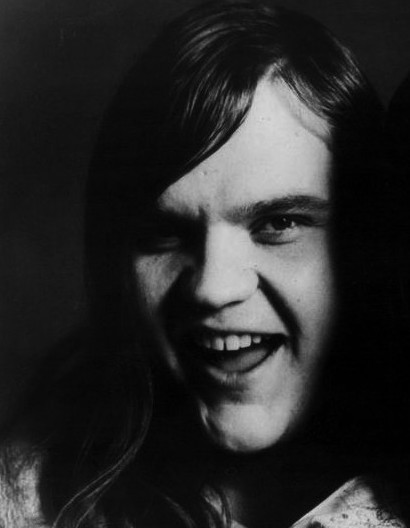
Meat Loaf in 1971

Overall, though, Loaf found his initial experience in the music business to be unsatisfying. He once said his biggest struggle in life was “not being taken seriously in the music industry. They treated me like a circus clown.”

Consequently, he pursued theater arts again by moving to New York and rejoining the cast of “Hair,” this time on Broadway, and also appeared in several other productions alongside future acting stars like Raul Julia, Mary Beth Hurt and Ron Silver. In 1973, Loaf appeared in an L.A.-based production of Richard O’Brien’s notoriously campy “The Rocky Horror Show,” a chaotic but hugely successful mix of science fiction, B horror movies, transvestism and ’50s rock and roll. When the play was made into the film “Rocky Horror Picture Show” in 1975, Loaf was again cast as the deranged Eddie, a small but important role that led to bit parts in more than 50 movies over several decades. Most were forgettable, but his appearances in “Wayne’s World,” “Black Dog,” “Spice World” and “Fight Club” drew good reviews.

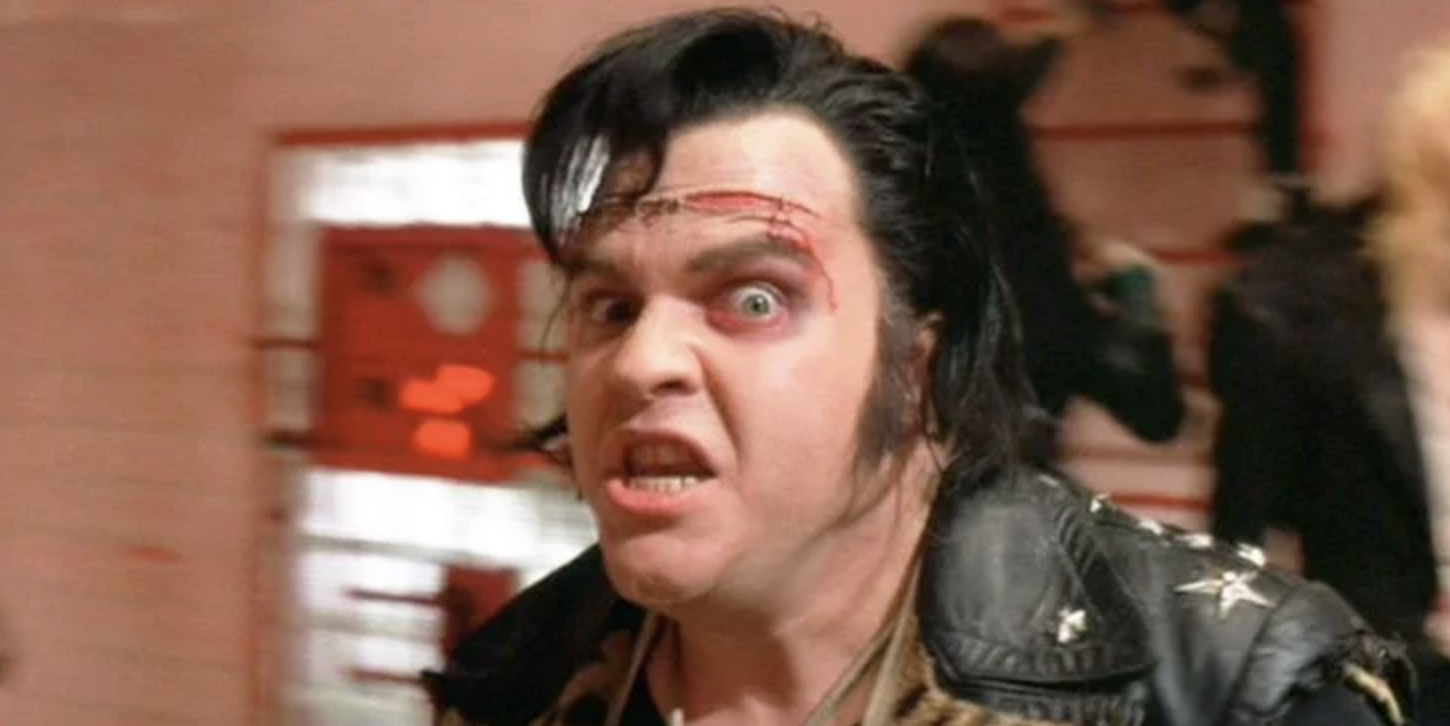
Meat Loaf as Eddie in “Rocky Horror Picture Show” in 1975

In 1973, during his time with “Rocky Horror,” Loaf met eccentric songwriter-producer Jim Steinman, who had been working on developing “Neverland,” a futuristic rock version of the Peter Pan story, for which he had written several lengthy, grandiose songs. Steinman worked with Loaf on the set of the stage show “National Lampoon: Lemmings,” where Loaf served as understudy to John Belushi. Hearing and seeing Loaf sing and perform convinced Steinman that the two should collaborate, and with singer Ellen Foley also involved, they set out to create demos of four of his songs: “Bat Out of Hell,” “Paradise By the Dashboard Light,” “You Took the Words Right Out of My Mouth” and “Two Out of Three Ain’t Bad.”

Each of these extravagant, theatrical tracks were presented to, and rejected by, dozens of record companies over the next couple of years. They were told the material didn’t fit any “recognized music industry styles,” a typically myopic view that record executives have adopted in almost every decade of the rock era.

Enter Todd Rundgren, songwriter/singer/producer and still one of the true innovators in rock. “They set up in a rehearsal studio, Jim Steinman and Meat Loaf and (singer) Ellen Foley, just the three of them, and they essentially performed most of what turned out to be the first record for me. I saw the whole presentation as a spoof of Bruce Springsteen, a guy who I thought needed to be spoofed. That’s why I decided to get involved. There was a lot of interesting stuff in there.  Steinman kind of wove this sense of humor into the material in a way that Springsteen didn’t.  I was rolling on the floor laughing at how over-the-top and pretentious it was.  I thought, ‘I’ve got to do this album.’”

Rundgren added guitar parts and brought in his bandmates from Utopia, plus Edgar Winter on sax, and even Roy Bittan and Max Weinberg, pianist and drummer with The E Street Band. Rundgren brought an intensity and “Wall of Sound” richness to the production, befitting the bombastic nature of the material.

“Bat Out of Hell” wasn’t well received in the US upon its release. Critics found it overly operatic and ostentatious, and radio program directors didn’t quite know what to make of it. Some DJs embraced it from the beginning, like the great Kid Leo on Cleveland’s dominant WMMS-FM, but it was slow to get any sort of national attention. Intense, persistent marketing efforts by Steve Popovich of Epic Record’s Cleveland International label eventually paid off, and once Meat Loaf and company performed on “Saturday Night Live” in March 1978, the floodgates opened. Suddenly, there was praise. As critic Stephen Erlewine put it, “It’s epic, gothic, and silly, and it’s appealing because of all of this. Steinman is a composer without peer, simply because nobody else wants to make mini-epics like this. It may elevate adolescent passion to operatic dimensions, but it’s hard not to marvel at the skill behind this grandly pompous yet irresistible album.”

“Bat Out of Hell” now ranks third on the list of all-time most successful albums, with more than 45 million albums sold. It still sells something like 200,000 units a year.

Jim Steinman and Meat Loaf in 1978

Meat Loaf and his ensemble toured relentlessly as momentum continued to build, which took its toll on the star, who was diagnosed with a chronic heart condition made worse by his frenetic delivery on stage. He was advised to step away from performing for a while, but he eventually resumed recording, with and without Steinman on hand to write songs for him.

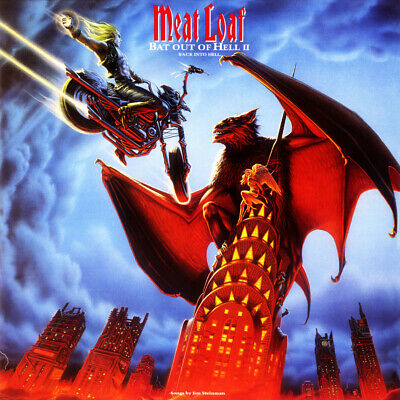
Four Meat Loaf LPs in the 1980s — “Dead Ringer” (1981), “Midnight at the Lost and Found” (1983), “Bad Attitude” (1984) and especially “Blind Before I Stop” (1986) — stiffed pretty badly in the US, although they always seemed to find an appreciative audience in Britain. It wasn’t until Loaf and Steinman reunited fully in 1993 and had the audacity to release “Bat Out of Hell II: Back Into Hell” that they were able to pull off one of rock’s greatest comebacks. The album matched the first one’s grandiosity, reaching #1 in a dozen countries, and its lead single, “I’d Do Anything For Love (But I Won’t Do That),” also topped the charts around the world.

Loaf’s 1995 follow-up, “Welcome to the Neighborhood,” did respectably, as did the single, “I’d Lie For You (And That’s the Truth).” But by 2006, it was clear he’d gone to the well one time too many. He and Steinman had had a series of legal disputes that delayed production of “Bat Out of Hell III: The Monster is Loose,” and it showed. Critics pounced, calling it “overblown and frequently ridiculous.” The fact that it’s the only Meat Loaf LP unavailable on Spotify says all you need to know.

Throughout the 1990s, 2000s and 2010s, Loaf seesawed between suffering poor-health episodes (heart attack, shattered leg, exhaustion/collapse) and following a physical therapy regimen that permitted periodic returns to touring. You’ve got to give him credit for staying in the game for as long as he did.

Many people, including my wife, regard the original “Bat Out of Hell” album as life-changing, an absolute classic of teenage angst and bravado, and I’m inclined to agree. I’m crazy about the title song, and the funny sex romp of “Paradise” never fails to liven up a party. Without question, it has earned its place in the pantheon of pivotal rock and roll music. Not bad for a guy who Foley once described this way: “Growing up in a bumfuck Texas town, he might have become a serial killer or the guy who shot up the local 7-Eleven. But the first time I saw him, he walked in with this incredible bravado and confidence, like in his mind he was already fully formed. He had this will that allowed him to do what he had to do to survive and exorcise a lot of his demons through music. But there’s a lot of sadness and anger, which is pretty much at the core of what he does.”

******************************

I’ve assembled a Meat Loaf playlist on Spotify that features songs from throughout his career, many of which, admittedly, I didn’t know until I took a deep dive into his catalog over the past seven days. Naturally, my list emphasizes the “Bat Out of Hell” material, but also includes early tracks like his “Rocky Horror” moment, “Hot Patootie – Bless My Soul,” and other worthy tracks from his later years.

Play me one more song that I’ll always remember

Back in 2002, Graham Nash released an underappreciated album called “Songs For Survivors,” a sort of companion LP to his 1971 solo debut, “Songs For Beginners.” Its highlight was a wistful tune called “Lost Another One,” with lyrics that bemoan the passing of a fellow musical traveler:

Just another morning cup of tea, I turn my radio on
And in between the static and the headlines, I heard that you were gone
We lost another one

There was a time we thought we were invincible, that we’d go on and on and on
And all along we’d thought we’d do another show and write another song
But I guess we’ve lost another one
…”

If Nash wrote it about a particular person, he never talked about it, which was probably wise, because now it can apply more generally to anyone’s (and everyone’s) death.

In 2021, we lost at least two dozen notable artists in the rock music pantheon, and Hack’s Back Pages is paying tribute to them in this post, the final one of this very strange year. I’ve included a Spotify playlist with a couple samplings from each of those being honored.

Rest in peace, rockers. In 1974, the Righteous Brothers song said, “If there’s a rock and roll heaven, well, you know they’ve got a hell of a band.” Imagine how phenomenal that band must be 50 years later!

************************

Charles “Charlie” Watts, widely respected drummer of The Rolling Stones from their inception in 1963 until his death on August 24th, died at 80. He regarded himself as more of a jazz drummer, and occasionally played side gigs in small jazz clubs, but his presence on The Stones’ recordings and at concerts for nearly 60 years was, as Keith Richards put it, “the secret essence of the whole thing.” For an in-depth reflection on Watts and his seismic impact on rock music, please check out my earlier blog post, “A line of cars and they’re all painted black.” https://hackbackpages.com/2021/09/03/a-line-of-cars-and-theyre-all-painted-black/


Keith Allison, guitarist and vocalist for ’60s pop favorites Paul Revere and The Raiders, died November 17 at age 79. Allison joined Revere and The Raiders after their initial heyday in 1968 and remained through 1975. Beyond that tenure, Allison also contributed to recording sessions for a host of rock’s elite, including Ringo Starr, Harry Nilsson, Sonny and Cher, Johnny Rivers, Rick Nelson, The Monkees and Alice Cooper.

David “Jay Black” Blatt (far right)

David Blatt, known professionally as Jay Black as the lead singer of ’60s pop group Jay and The Americans, died October 22 at age 82. He was not the group’s original lead singer, but when he replaced Jay Traynor, the group enjoyed their greatest successes, first in 1964-65 with “Come a Little Bit Closer” (#3) and “Cara Mia” (#4) and later in 1969 with their cover version of the Drifters’ “This Magic Moment” (#6). Black left in 1973 and continued to tour as Jay and the Americans using different backing musicians, which generated contentious legal disputes.

Tim Bogert (left) with Jeff Beck

John “Tim” Bogert III, innovative bass player and vocalist for ’60s hard rock band Vanilla Fudge and blues rock group the Jeff Beck Group, died of cancer January 13 at age 76. He helped found Vanilla Fudge, known for extended heavy rock versions of popular hits (“You Keep Me Hanging On”), then left in 1970 to form the short-lived band Cactus with drummer Carmine Appice. In 1973, they both teamed up with Beck on tour and then recorded the “Beck Bogert & Appice” LP as a power trio, which included a fabulous cover of “Superstition.” Bogert was a pioneer of using distortion with his bass to help it cut through the mix with the low-powered amps of his time.

Neville O’Riley Livingston, founding member of the pioneering Jamaican reggae group The Wailers, died March 2 at age 73. Livingston was known professionally as Bunny Wailer, one of two singer-songwriters in the group along with Bob Marley, and also its percussionist. As Marley became the more dominant figure when the group began seeking international fame, Wailer chose to embark own a solo career, generally staying in Jamaica. His Solo album “Blackheart Man” and several compilation LPs won Grammy awards in the ’80s and ’90s.

Ron Bushy, drummer for ’60s hard rock band Iron Butterfly, died August 29 at age 79. Bushy is best known for the widely familiar drum solo he performed (in one take!) in the middle of the group’s 17-minute iconic psychedelic piece, “In-A-Gadda-Da-Vida.” He was a founder of the Los Angeles-based band in 1967 and stayed in the lineup for all of the group’s six albums, through 1975. He recalled how Iron Butterfly’s pièce de resistance was originally just a two-minute ditty, “a love song from Adam to Eve,” until they went into the studio in 1968 and expanded it into one of the true classics of that era.

Armando Anthony “Chick” Corea, considered one of the foremost jazz pianists of the post-John Coltrane era, died of a rare form of cancer February 9 at age 79. He was an accomplished composer, keyboardist, bandleader, and occasional percussionist, playing with the great Miles Davis in the late ’60s at the birth of the jazz fusion genre. His own ’70s jazz ensemble Return to Forever influenced a generation of jazz fusion artists, and Corea’s compositions like “Spain,” “500 Miles High,” “La Fiesta” and “Windows” are considered jazz standards. Corea won 25 Grammys and was nominated 60 times.

George “Commander Cody” Frayne IV, leader, pianist and vocalist of the ’70s country rock band Commander Cody and His Lost Planet Airmen, died September 26 at age 77. The band came up with a unique, compelling brew of music that melded country and rock with older styles like Western swing, jump blues and boogie-woogie. Their 1971 album “Lost in the Ozone” is regarded as a must-have LP of that period, partly because of their one hit single, a cover of the 1955 speed-talking, fast-picking “Hot Rod Lincoln.”

Graeme Charles Edge, drummer and lyrical poet for The Moody Blues from the group’s beginnings in the early ’60s, died November 11 at age 80. He saw the band through its first phase with singer Denny Laine, followed by the triumphant years as trailblazers of the British progressive rock era (1967-1973), and eventually into a new period of chart success in the 1980s. Edge was a consistent contributor, not only on the drum kit but by providing spoken-word poetry as an element of The Moodies’ sound. For more about the lasting legacy of The Moody Blues, and Edge’s contributions, see my earlier blog post, “The music to the story in your eyes.” https://hackbackpages.com/2021/11/19/the-music-to-the-story-in-your-eyes/

The Everly Brothers, Don at right

Isaac Donald “Don” Everly, one half of the ’50s-’60s vocal duo The Everly Brothers, died August 21 at age 84. Together with younger brother Phil, who died in 2014, The Everly Brothers rode high on the charts from 1957 to 1965 with their sweet harmonizing on such classics as “Wake Up, Little Susie,” “All I Have to Do is Dream,” “Bye Bye Love” and “Cathy’s Clown.” The brothers endured a rocky period but eventually reunited and also appeared in concert and on record with Simon and Garfunkel in the early 2000s. For more about Don and Phil Everly and their impact on early rock vocals, please see my earlier blog post, “Bye bye, my love, goodbye.” https://hackbackpages.com/2021/08/27/bye-bye-my-love-goodbye/

Michael Kelly Finnigan, an extraordinarily in-demand keyboard player in recording sessions and on tour, died from cancer on August 11 at age 76. A master of the Hammond organ and a vocal contributor as well, Finnigan toured with and played on sessions for some of the biggest names in rock, including Jimi Hendrix, Crosby Stills and Nash, Dave Mason, Michael McDonald, Joe Cocker, Buddy Guy, Etta James, Peter Frampton, Ringo Starr, Cher, Bonnie Raitt, Tracy Chapman and Rod Stewart. In the playlist at the end of this piece I’ve included three tracks on which he made a significant contribution: “Rainy Day, Dream Away” by Hendrix; “Bring It On Home to Me” by Mason; and “Southern Cross” by Crosby Stills & Nash.

Joe Michael “Dusty” Hill, longtime bass player and singer for ZZ Top, died July 28 at age 72. Hill, guitarist Billy Gibbons and drummer Frank Beard hold rock music’s longevity record for longest lifespan of a band without a personnel change (51 years). Founded in 1969, ZZ Top was a Texas blues/boogie band in its first iteration with tunes like “Lagrange” and “Tush” but later morphed into MTV favorites with synthesizer-laced hits like “Legs,” “Give Me All Your Lovin'” and “Sleeping Bag.” For more about Hill and his part in the story of ZZ Top, I direct you to my earlier blog post, “I said, lord, take me downtown.” https://hackbackpages.com/2021/08/06/i-said-lord-take-me-downtown/

Gerard “Gerry” Marsden, leader and singer of the British Merseybeat group Gerry and The Pacemakers, died from a blood infection January 3 at age 78. Marsden and his group were signed to EMI Records by George Martin, who had also signed The Beatles around the same time. The Pacemakers’ first hit, in fact, was “How Do You Do It,” which The Beatles also recorded but rejected in favor of their original, “Love Me Do.” The Pacemakers took their version to #1 in the UK (it reached #9 in the US later on). Marsden and company also scored hits in the US with “Don’t Let the Sun Catch You Crying” and “Ferry Cross the Mersey.”

Robert Michael Nesmith, guitarist, singer and songwriter as a member of the The Monkees, died December 10 at age 78. He pushed for and won greater control of The Monkees’ recorded output, which included such successes as “I’m a Believer,””Plesasant Valley Sunday” and “Daydream Believer,” as well as lesser-known tracks penned and sung by Nesmith. He was also an unsung pioneer of the country rock genre, releasing several country-flavored albums with The First National Band and under his own name. He was involved behind the scenes in early iterations of the music video revolution that came in the 1980s. For more on Nesmith, please refer to my earlier blog post, “Disappointed haunted all my dreams.” https://hackbackpages.com/2021/12/17/disappointment-haunted-all-my-dreams/

Harvey Phillip “Phil” Spector, a titanic name in pop music history for his innovative recording techniques in the 1960s, died in prison on January 16 at age 82. Spector came up with what is known as the “Wall of Sound” approach, in which he used multiple pianos, guitars, strings, horns and voices in a “Wagnerian approach to rock and roll,” as he put it. His hits for The Ronettes (“Be My Baby”), the Crystals (“He’s a Rebel”) and The Righteous Brothers (“You’ve Lost That Lovin’ Feeling” and “Unchained Melody”) made effective use of this practice. Spector also produced The Beatles’ “Let It Be” LP and the first couple of solo albums by John Lennon (“John Lennon/Plastic Ono Band” and “Imagine”) and George Harrison (“All Things Must Pass” and “Concert For Bangla Desh”). In 2009, Spector was convicted of the 2003 murder of actress Lana Clarkson and sentenced to 19 years to life.

Michael Stanley Gee, leader, guitarist singer and songwriter of The Michael Stanley Band, died on March 5 at age 72. The pride of Cleveland, Ohio, Stanley began as an acoustic singer-songwriter in the early ’70s, collaborating with Joe Walsh, which inspired his move to form MSB in 1975 , beginning a string of 10 solid Midwest rock albums that should have become nationwide successes but caught on only fleetingly. Still, the band set attendance records at venues throughout Ohio and other Midwest towns where they enjoyed a diehard following well into the 2000s. For a deeper look at Stanley and his band, please read my earlier blog post, “Here’s a song for a friend soon gone.” https://hackbackpages.com/2021/03/12/heres-a-song-for-a-friend-soon-gone/

Billy Joe “B.J.” Thomas, widely known as a singer of pop and country hits in the ’60s and ’70s, died May 29 at age 78. He charted six songs in the US Top 20 between 1966 and 1975, including two #1 hits — Burt Bacharach’s “Raindrops Keep Fallin’ On My Head,” which won a Best Song Oscar from the “Butch Cassidy and the Sundance Kid” film soundtrack, and the 1976 Best Country Song Grammy winner (and the longest song title of any #1 song ever), “(Hey Won’t You Play) Another Somebody Done Somebody Wrong Song.” Other notable hits by Thomas include the original version of “Hooked On a Feeling,” a cover of the Hank Williams chestnut “I’m So Lonesome I Could Cry,” “I Just Can’t Help Believing” and”Rock and Roll Lullaby.”

Mary Wilson (center) with The Supremes

Mary Wilson, one of the three founding members of The Supremes, died February 8 at age 76. Along with Diana Ross and Florence Ballard, Wilson reached the pinnacle of success as The Supremes, Motown Records’ most successful act and the highest-charting female group in history. They compiled an astonishing 12 #1 hits between 1964 and 1970, including “Stop! In the Name of Love,” “Come See About Me,” “Baby Love,” “I Hear a Symphony,” “You Can’t Hurry Love,” “Love Child” and “Someday We’ll Be Together.” After Ballard and Ross left, Wilson remained as new members were brought to the lineup, and she stayed until the group’s dissolution in 1977. She later set sales records for her autobiography “Dreamgirl: My Life as a Supreme” in 1986.

Norman Russell “Rusty” Young, pedal steel guitarist and vocalist for the country rock band Poco, died April 14 at age 75. He was a founding member, having met Jim Messina and Richie Furay during sessions for Buffalo Springfield’s final LP. Young was known as a virtuoso and innovator on pedal steel, coaxing a Hammond organ sound out of it by playing it through a Leslie speaker cabinet. After Furay left in 1975, Young stepped up in both songwriting and singing, and ended up songs like “Rose of Cimarron” and Poco’s biggest hit, “Crazy Love.”

Norman Paul Cotton, guitarist and singer-songwriter for Poco, died July 31 at age 78. He joined Poco in 1970 following the departure of founding member Jim Messina and remained an integral member of the band until 2010. It was Cotton who wrote “Heart of the Night,” one of Poco’s two Top ten hits from the 1978 LP”Legend,” and he also wrote such gems as “Down in the Quarter,” “Indian Summer” and “Bad Weather.”

For a closer look at Poco, and Young’s and Cotton’s work, please see my earlier blog post, “We’re bringin’ you back down home.” https://hackbackpages.com/2021/04/23/were-bringin-you-back-down-home/

*****************************

For this playlist, I’ve selected two songs for each honoree, except Charlie Watts, who deserves three, and the two members of Poco, who deserve three between them.