Don’t you feel like trying something new
This is the eighth in a series of posts that will feature detailed analysis and commentary about some of my all-time favorite albums and artists.
***************
When punk music reared its brash, ugly head in London and New York in the mid-’70s, it was a direct, angry response to what its practitioners felt was a woefully tired, bloated scene dominated by “dinosaur” rock bands well past their prime.
While there was some truth to that viewpoint, punk was clearly not the answer for many listeners. Even The Sex Pistols, The Ramones and other purveyors of the raw, visceral sounds that characterized punk rock in its heyday will admit that they were not accomplished musicians or songwriters. It was all about the attitude (in your face) and energy (over the top).
The same was true, to some extent, when rock and roll was born some 20 years earlier.

Joe Jackson, circa 1979
The attitude, the energy, and the beat were paramount to differentiate rock music from the conventional tunes you heard on the Top 40 in the 1940s and early ’50s. But there was a crucial difference: The songs and the performances by Chuck Berry, Little Richard, Buddy Holly, Elvis Presley and others had staying power. The music was intrinsically strong, the singing and playing inherently iconic. The proof is that we still value those old records 60-plus years later.
Not so with punk, for the most part. How many punk rock classics can you name? How often do you hear them, or want to hear them?
My point here is, although punk was a fleeting genre, it spawned some truly great lasting music and artists that came to be known as “New Wave.” They adroitly took the attitude and energy of punk and infused it with quality musicianship and inventive songwriting to produce captivating songs and albums that hold up well many decades later.
The Police would be an obvious British example. Their five albums from 1978-1983 just got better and better, thanks to the increasingly sophisticated songs Sting came up with. Same goes for The Talking Heads, who were probably the best of the American pioneers of New Wave sensibilities of that period, and David Byrne’s top-notch material is a huge reason for that. Elvis Costello also comes immediately to mind. His “My Aim is True” debut LP is a keeper, as are at least a half-dozen more in his voluminous catalog that runs from the late ’70s to the current day.
But my choice for the real gem in this whole group is Joe Jackson, whose extraordinary  pedigree and musical capabilities were not necessarily evident to most pop music fans even at his brief commercial peak. But I firmly believe his substantial repertoire is in a class of its own among artists of his age and proclivities.
David Joe Jackson grew up in Portsmouth, England, as a shy skinny kid who loved books and dreamed of being a writer until he took a violin class at age 11. To his surprise, he found himself fascinated enough by music to immerse himself in its theory and history. Soon enough, he switched to piano and aspired to be a composer of classical piano pieces.
He was also intrigued by the excitement and possibilities of pop music in the post-Beatles era and drifted in that direction, even as he won a scholarship to study piano composition at London’s Royal Academy of Music. During his years there, he was all over the map, also working with a fringe theater group, studying jazz with the National Youth Jazz Orchestra, and sitting in with rock bands in area pubs. He even detoured briefly into the world of cabaret as pianist and musical director for the Portsmouth Playboy Club.
 By 1978, he had formed the Joe Jackson Band (including Graham Maby on bass, Dave Houghton on drums and Gary Sanford on guitar) and was in search of a record deal, hawking an album-length demo of smart songs melding rock, melodic jazz and New Wave that became the surprisingly notable debut “Look Sharp!” Released on A&M in the US in 1979, it reached #20 on the album charts here, thanks in part to airplay given to the quirky “Is She Really Going Out With Him?” and “Sunday Papers.”
Two follow-ups with a similar focus (1979’s “I’m the Man” and 1980’s “Beat Crazy”) did only moderately well, although the single “It’s Different for Girls” peaked at #5 in the UK.
 Jackson showed his willingness to take a risk and stretch his own musical horizons (as well as those of his listeners) by making his next project a loving tribute to the genre of Big Band and the swing music artists of the ’40s like Louis Jordan and Cab Calloway. The result, the irresistible “Jumpin’ Jive,” reached a respectable #42 in the US in 1981 and made it to #14 in the UK. It also inadvertently served to jumpstart a popular revival of other traditional dance genres like rockabilly (The Stray Cats, The Blasters).
It was in 1982 when Jackson truly came into his own with “Night and Day,” a superb song-cycle that lovingly examines his new home of New York City with sophisticated and diverse musical styles. Impeccably produced and arranged, the LP reached the Top 5 here and in England, and deservedly so. “Cancer” is an uptempo piece with an extended  jazz workout in the middle break; “Target,” “Another World” and “T.V. Age” adopt pogo-like New Wave rhythms; “Chinatown” utilizes Asian chord changes and melody lines in its soundscape; and the slower dramatic ballads “Real Men” and “A Slow Song” feature exquisite, Broadway-like song structures.
Thanks to Maby’s prominently hypnotic bass line and Jackson’s emphatic piano work, the dazzling hit single “Steppin’ Out” became the artist’s most well-known track, peaking at #6 in both the US and the UK. Its follow-up was the tender piano tune “Breaking Us in Two,” which charted at #18 here.
I will concede, as I did in my analysis of Mark Knopfler and Dire Straits last week, that Jackson’s strength is not in his vocals. His over-enunciated voice hits a flat or sharp note every now and then, causing me to wince a bit. But I’ve been willing to forgive this deficiency because of his extraordinary prowess at songwriting, arranging, and piano
playing, and his willingness to successfully push boundaries. 
Two more albums in the “Night and Day” vein — 1984’s jazzy “Body and Soul” and 1986’s “Big World” — cemented Jackson’s reputation among music critics and industry observers, even if they didn’t catch on commercially. On “Body and Soul,” Jackson made liberal use of horns on the minor hit “You Can’t Get What You Want (‘Til You Know What You Want),” Latin percussion on “Cha Cha Loco,” and guest vocalist Elaine  Caswell on effervescent pop tracks like “Happy Ending.” On “Big World,” he took the boldly creative tack of recording live in an acoustically pristine music hall before an audience instructed to remain silent. As the album title implies, he dabbled in a smorgasbord of styles from salsa to punk, from tango to jazz, from torch song to pop, from soul to cabaret.
By then, Jackson was showing signs of burnout from all the touring he did in support of these fine records. He was ready to pull back from the commercial road and devote his efforts exclusively to the classically based music he’d first embraced as a teenager.
But before doing so for most of the 1990s, he had another major milestone up his sleeve: the majestic, stylish “Blaze of Glory,” released as a sort of personal statement in 1989 and played in its entirety in concerts that year. Jackson has said the songs represent “an examination of my generation as the 1980s  were ending,” commenting on the optimism of their 1950s childhood (“Tomorrow’s World”), the politics of terrorism and the Cold War (“Rant and Rave” and “Evil Empire”), yuppies and materialism (“Discipline”) and rockers who wear out their welcome (“Nineteen Forever”). He thought it was his best work and was sorely disappointed at what he felt was the indifference of his record label, the critics, and even his audience.
I happen to agree that “Blaze of Glory” (particularly the spectacular title track) is probably Jackson’s most consistently strong LP and am dumbfounded it seemed to fall on deaf ears (it stiffed at #61 in the US). He toured with an impressive 11-piece band, but many concertgoers hadn’t yet purchased or heard the album, and his insistence on playing it straight through no doubt tried their patience. Such a shame — these are really  great songs, well played and magnificently produced.
Jackson is now 64, and has continued to make excellent, compelling music in the new millennium, including “Night and Day II,” a sequel of sorts that again explores the vagaries of life in Manhattan, and 2015’s “Fast Forward,” a 16-song collection with four songs recorded in each of four cities (London, Berlin, New York and New Orleans) with different backing musicians. He has a new LP ready to go in early 2019 (entitled “Fool”) and will be back on the road promoting it, and he promises to offer music from throughout his exemplary career.
 Many of my readers, I’m guessing, barely know Jackson’s work. I offer this strong encouragement to listen closely to “Night and Day” and “Blaze of Glory,” and, indeed, much of his catalog. He’s the real deal.
**************
On the Spotify playlist included here, you’ll hear all of “Night and Day” and “Blaze of Glory,” plus some bonus tracks from “Body and Soul” and “Big World” as segues bridging my two featured album favorites.
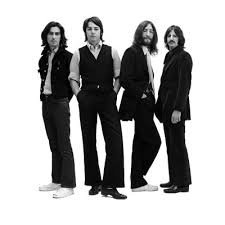 As a Beatles fanatic for more than 50 years, I concluded that there’s no way my list can be limited to only one, or two, or even three of their albums.
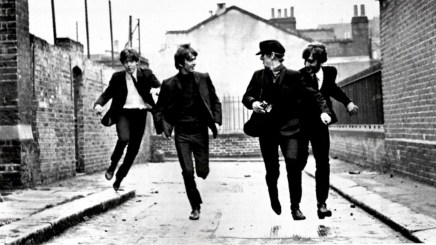 lives — particularly the songwriting careers of John Lennon and Paul McCartney — when their music was, by and large, simple and joyous, a huge breeze of fresh air that helped transform the popular music scene in Europe, the U.S. and elsewhere. It was especially catchy and eminently danceable, and it got into your bloodstream and made you want to get up and shout.
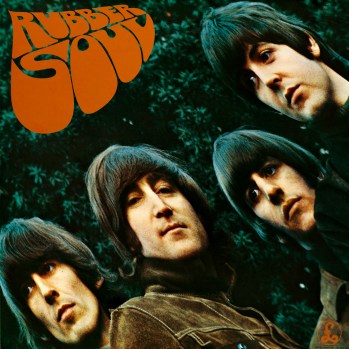 challenging melody lines, more sophisticated arrangements, and lyrics that often went beyond the customary love-and-romance topics. It was the beginning of the demarcation between their celebrity live act as The Fab Four and their more mature ambitions as recording artists.
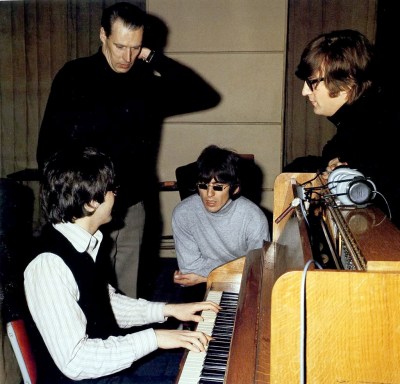 McCartney has mentioned being inspired by the triad harmonies and jangly guitars of the Byrds and other American folk-rock bands, as well as the vibrant soul and R&B coming from Stax and Motown artists throughout 1965. Songs like “Drive My Car,” “Wait,” “I’m Looking Through You” and the early peace-movement anthem “The Word” clearly reflect these influences. At the same time, the band’s frequent use of marijuana had increased that year, broadening their palettes, imaginations and artistic interests.
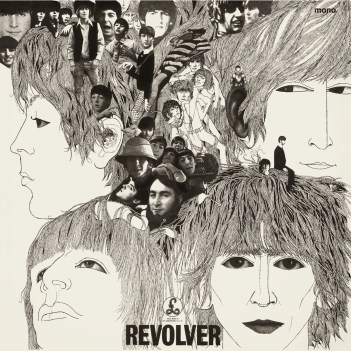 the recording studio and its seemingly infinite possibilities, encouraged by producer George Martin and facilitated by engineer Geoff Emerick to come up with new sounds, new techniques, new sonic landscapes that couldn’t be (and weren’t meant to be) duplicated in concert anyway.
 Tell You,” rock out as hard as almost anything in their catalog, thanks to some fine bass work and drum fills from McCartney and drummer Ringo Starr.
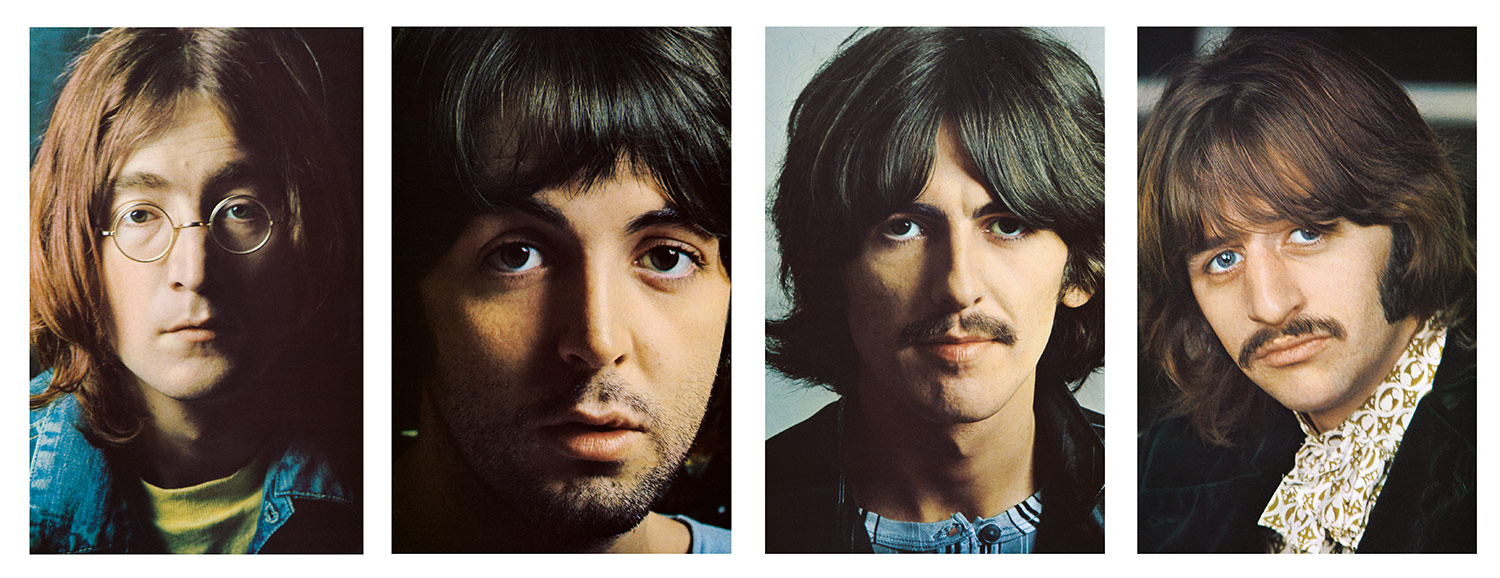 qualified to run them — brought chaos and a drain on finances. Most important, each Beatle was becoming more of an individual with priorities that often conflicted and/or superseded the band’s overall interests. Prime case in point: Yoko Ono.
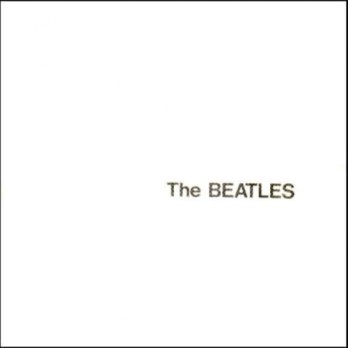 encyclopedic in its coverage of musical styles: quasi-reggae (“Ob-la-di, Ob-la-da”), country-western (“Don’t Pass Me By”), early heavy metal (“Helter Skelter”), raw blues (“Yer Blues”), proto-punk (“Why Don’t We Do It In the Road?”), solid rock (“Back in the USSR”), avant-garde sound montage (“Revolution 9”), even 1920s music hall (“Honey Pie”).
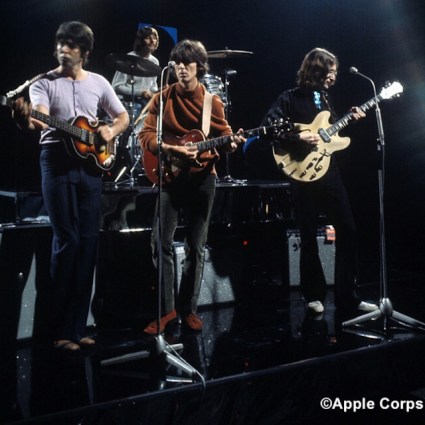 together on a take to play, the result was often spectacular. Check out the coalescing of Beatle talent heard on Harrison’s finest moment, “While My Guitar Gently Weeps” (which also includes an uncredited guitar part by Eric Clapton, by the way). Or the beautiful cacophony of “Everybody’s Got Something to Hide Except For Me and My Monkey.” Or the shimmering melody/guitar/vocal of “Dear Prudence.” Or the rollicking good fun of “Birthday.” Or the luscious slow groove behind the album version of “Revolution 1.”
 songs for the “Let It Be” project (which was shelved for over a year before finally seeing release in May 1970).
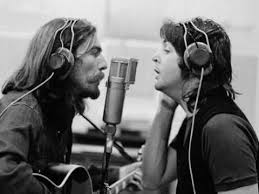 described as the album’s best song (even as it split duty on the double-A-sided single with his own “Come Together”).
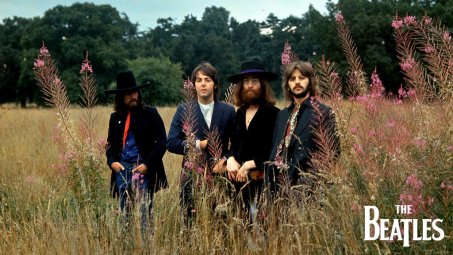 As you listen to those three songs again on Spotify, be sure to take note of the guitars near the end of “The End,” just before the denouement, “And in the end, the love you take is equal to the love you make.” It’s only nine bars long, but it perfectly showcases, and differentiates, the distinctive guitar styles of McCartney, Harrison, and Lennon, three times, in that order. Along with Ringo’s one and only drum solo which comes just before it, this exchange is a marvelous final way to feature the foursome as they wave goodbye.
 Hack's Back Pages