I say a little prayer for you
Let us all hail Jerry Wexler.
 Who?
Who?
He is the savvy producer and executive at Atlantic Records who, in 1966, recognized how the phenomenal gospel-based talent of Aretha Franklin had been used so ineffectively by Columbia Records during their five-year contract. The minute she was free to sign elsewhere, Wexler brought her into the fold at Atlantic, a hotbed of rhythm and blues artists since the 1940s, and paired her with the Muscle Shoals, Alabama, studio veterans, helped produce game-changing tracks like “Respect” and “I Never Loved a Man (The Way I Love You),” and turned her into the iconic artist we all revere, and now mourn.
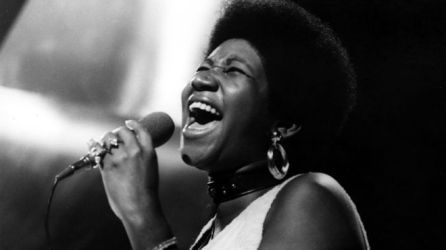
Aretha Franklin, “The Queen of Soul,” has died, a victim of pancreatic cancer at age 76.
Can you even imagine what our musical landscape would be like if Aretha had called it quits after her lackluster career singing dreary pop standards on Columbia? Thankfully, we need not do so. The wonderful chemistry between Franklin, Wexler and the Muscle Shoals crew (and, later, in Atlantic’s New York studios with some of the Muscle Shoals personnel) is well documented in the extraordinary musical works they produced:  “Baby I Love You,” Carole King’s “(You Make Me Feel Like) A Natural Woman,” “Chain of Fools,” “(Sweet Sweet Baby) Since You’ve Been Gone,” “Think,” “The House That Jack Built” and “I Say a Little Prayer for You.”
All of these Top Ten hits came in the space of only two short years, and established her as the undisputed star of female soul singers, and among the best in American popular music in general. Critic Ritchie Unterberger of AllMusic recently wrote, “Aretha is one of the true giants of soul music and, indeed, of American pop as a whole. More than any other performer, she epitomized soul at its most gospel-charged.”
Franklin’s story, sadly, is riddled with early trauma. She was born in 1942 to a Baptist preacher father and a pianist/vocalist mother, and they both influenced her love of gospel music. But their marriage was tempestuous and ultimately doomed by infidelity on both sides, and Aretha stayed with her father when her mother moved out. Aretha was only 10 years old

The Reverend C.L. Franklin and Aretha
when her mother died of a heart attack.
As her father became a renowned traveling preacher on the Southern circuit, Aretha tagged along, singing solos on numerous hymns, sharing her amazing vocal range and impressive piano skills, which she had picked up on her own. Her father helped her secure her first recording contract at age 14, covering gospel favorites on the little-known “Songs of Faith” LP.
By the time she reached 18, possessed of a powerful four-octave voice packed with emotional intensity, Franklin moved to New York City, hoping to follow the path of Sam Cooke, another spectacular vocal talent who had evolved from gospel to secular music and become a chart-topper (“You Send Me” and others).
The legendary John Hammond signed her to Columbia in 1960. But he made the tactical error of envisioning her as a jazz singer tinged with blues and gospel, and he steered her toward middle-of-the-road fare like “Over the Rainbow,” “Ol’ Man River,” “Skylark,” “People” and “You Are My Sunshine.” Franklin’s then-husband, Ted White, became her manager, who wanted her to try a little of everything, from Dinah Washington standards to remakes of recent pop hits, which consequently left radio stations and audiences confused.
The passion and spirit in Aretha’s voice finally surfaced at Atlantic once Wexler found the right  environment and accompaniment. “I basically took her to church, sat her down at the piano, and let her be herself,” as Wexler put it in Craig Werner’s book Higher Ground, an illuminating exploration of how Franklin, Stevie Wonder and Curtis Mayfield launched the soul music revolution of the 1960s.
Her defining moment, then and ever since, was when she took Otis Redding’s great 1966 song “Respect,” changed the arrangement and a few of the lyrics, and made it something else altogether. If you listen to Redding’s original version now, it sounds positively lame without Franklin’s signature chorus “R-E-S-P-E-C-T, find out what it means to me, R-E-S-P-E-C-T, take care of T-C-B,” which helped turn it into a feminist and civil rights anthem just as those movements were coalescing in 1967.
When The Beatles’ “Sgt. Pepper” ruled the album charts in the summer of ’67, it was “Respect” that was the Number One song in the country, her second of six consecutive Top Ten hit singles in 1967-68. What’s more, her first four albums on Atlantic (“I Never Loved a Man the Way I Loved You,” “Aretha Arrives,” “Lady Soul” and “Aretha Now”) all  reached the Top Ten, an unprecedented feat at a time when urban audiences weren’t buying LPs yet. Clearly, there was no stopping her over the next three years.
As Time wrote in its cover story on Franklin in June 1968, “Aretha’s vocal technique is simple enough: a direct, natural style of delivery that ranges over a full four octaves, and the breath control to spin out long phrases that curl sinuously around the beat. But what really accounts for her impact is her fierce, gritty conviction. She flexes her rich, cutting voice like a whip.”
Aretha herself said at that time that she chose songs she could sing with sincerity because they frame her own perspective on life. “If a song is about something I’ve experienced, or that could have happened to me, then it’s good. But if it’s alien to me, then I can’t lend anything to it. That’s what soul music is — just living and having to get along.”
 While her career was on fire, her marriage was in ashes, as White publicly berated her and physically abused her. By 1970, she was on her own again, and another set of hits kept her all over the airwaves. The great Paul Simon has said he wrote “Bridge Over Troubled Water” with Aretha in mind, and he got his wish when her version followed his into the Top Ten in 1971, followed by the major pop hits “Spanish Harlem” (#2), “Rock Steady” (#9) and “Day Dreaming” (#5).
Even as her “Amazing Grace” album (1972) sold two million copies and became the best-selling gospel album ever, the disco era was on the rise, and curiously, Franklin’s light began dimming somewhat. She still had the occasional minor hit, and she scored big on the more limited R&B charts, but her albums stiffed, and she found herself out of favor for a spell.
Aretha endured more heartbreak in 1979 when her father was shot during a home invasion and remained in a coma for five long years until his death in 1984. As the dutiful daughter, she flew back and forth from L.A. to Detroit numerous times during

The diner scene from “The Blues Brothers” (1980)
that period, and one particularly turbulent flight in 1983 affected her so traumatically that she refused to ever fly again.
Things had started improving again for Aretha when she did an incredible turn as a diner waitress singing and dancing to a frantic version of “Think” in the 1980 blockbuster film “The Blues Brothers.” When she signed with Arista Records, she eventually re-emerged on the charts in 1985 with a huge album, the “Who’s Zoomin’ Who?” LP and the #3 hit single, “Freeway of Love.” This also began a string of hugely popular duets with the likes of The Eurythmics’ Annie Lennox (“Sisters Are Doing  It For Themselves” was #18 in 1985), George Michael (“I Knew Your Were Waiting For Me” was #1 in 1987), plus lesser numbers with Elton John, Whitney Houston, James Brown and Michael McDonald.
Another fallow period came in the 1990s, but she rallied again in 1998 with a noteworthy appearance at the 1998 Grammy Awards, substituting at the last minute for the ailing Luciano Pavarotti by singing a Puccini aria that met with mixed reviews (opera folks were appalled). On a VH1 special called “Divas Live,” she made mincemeat of newer-generation stars in duets, among them Mariah Carey and Celine Dion.
Aretha battled weight problems much of her life, which led to other medical issues, but she was always very private about them. Even today in the wake of her death, little is known about the specific ailments that made her life difficult in the 1990s and beyond.
 Still, she was able to overcome them well enough to make several seismic public showings in more recent years. She was awarded the Presidential Medal of Freedom, the nation’s highest civilian award, by George W. Bush in 2005. When Barack Obama stood before America for his inauguration in January 2009, he made history, but it was Aretha Franklin who pretty much stole the show. Obama may have been sworn in as America’s first black president, but when Aretha stood to sing “My Country, ‘Tis of Thee,” she was, without a shadow of a doubt, its first Queen.
Rolling Stone ranked her #1 on its 2010 list of “The 100 Greatest Singers of All Time,” and Mary J. Blige had this to say about that: “Aretha is a gift from God. When it comes to expressing yourself through song, there’s no one who can touch her. She is the reason why women want to sing.”

At Obama’s inauguration in 2009
Music journalists didn’t care for how Franklin tended to maintain a very strict discipline over her career message, but I think it’s likely she insisted on that control because she didn’t want her life story to follow the weary stereotype of strong black women. You know what I mean: the tale of a lifelong struggle against demons within and without, culminating in an exhilarating victory over hard times.
In my mind, Aretha’s story is more one of incalculable influence, spine-tingling recordings, a voice unmatched by anyone anywhere. As someone once said, “That woman could sing the phone book, and I’d buy it.”
Here’s what her contemporaries said in the wake of her passing a week ago:
“Aretha was a rare treasure whose unmatched musical genius helped craft the soundtrack to the lives of so many.” — Patti LaBelle
“I was fortunate enough to witness her last performance — a benefit for the AIDS Foundation. She sang and played magnificently, and we all wept. We were witnessing the greatest soul artist of all time.” — Elton John
“Let us give thanks for the beautiful life of Aretha Franklin, the Queen of our souls, who inspired us for many, many years. The memory of her greatness as a musician and fine human being will live with us forever.” — Paul McCartney
“A salute to the Queen. The greatest vocalist I’ve ever known.” — John Legend
 “Aretha, the power of your voice in music and in civil rights blew open the door for me and so many others. You were my inspiration, my mentor and my friend.” — Mariah Carey
“The greatest voice in popular music has been stilled. For me, she was a musical lighthouse, guiding and inspiring with every note.” — Bette Midler
We will miss her majestic voice and her reassuring presence. And we can all be grateful there are so many of her recordings available for us to crank up when we need a little pick-me-up. Below is my Spotify playlist of “Essential Aretha.” Turn it up!
 entirely from the public consciousness.
 never achieved further success on the charts. (Poor management/promotion, radio station indifference, record company blackballing, etc.). A few examples of this sad phenomenon are: Karla Bonoff, Argent, Sanford and Townsend, Rickie Lee Jones, Golden Earring, Steve Forbert, Free.
 “Fire,” Crazy World of Arthur Brown, 1968
 “Black is Black,” Los Bravos, 1966
 “All Right Now,” Free, 1970
 “Magic,” Pilot, 1974
 “99 Luftballons,” Nena, 1984
  “Ooh Child,” The Five Stairsteps, 1970
 “Hocus Pocus,” Focus, 1973
 “Little Girl,” Syndicate of Sound, 1966
 “867-5309/Jenny,” Tommy Tutone, 1982
 “I Fooled Around and Fell in Love,” Elvin Bishop, 1976
 “Ride Captain Ride,” Blues Image, 1970
 “One Toke Over the Line,” Brewer & Shipley, 1971
 “Hold Your Head Up,” Argent, 1972
 “What I Am,” Edie Brickell & New Bohemians, 1989
 “Pictures of Matchstick Men,” Status Quo, 1968
 Hack's Back Pages