I just wanna bang on the drum all day
“Drummers are like the foundation of a building. They are the girders, and the other musicians are going to add the doors, the windows, the floors, the roof and all the shiny details everybody notices. But without the drums, there’s no building.”
 The speaker is Jack White, the eccentric, multitalented guitarist/singer/producer behind The White Stripes and a burgeoning solo career. He has succinctly put into words the fundamental importance of drummers to the success of any band’s overall sound. Or, put another way, “If you have an OK singer or an average guitarist, you might still have a great band, but if you have a mediocre drummer, your band will never be anything more than mediocre.”
I used to be as guilty as any rock music fan when it comes to failing to appreciate how crucial a good drummer can be. Lead singers, lead guitarists, even flashy keyboardists or sax players grab my attention almost every time I see bands perform, or listen to their recordings. But drummers? Not so much. With most listeners, they barely register. They’re kind of like the center in football, or the catcher in baseball. Nobody notices them until they make a mistake, and yet their consistent stellar play is the glue that holds the team together.
 Why are drummers so underappreciated? Part of it, says my drummer friend Ted Molter, is because drummers “are sitting down, and sequestered from the rest of the band, hidden behind a wall of brass, chrome and wood. If they were replaced, most fans wouldn’t even notice, because they couldn’t distinguish any of them from Adam.”
Naturally, this disrespect annoys the hell out of drummers. Aerosmith’s Joey Kramer recalled once overhearing a conversation between a manager and other band members where it was clear they felt the drummer was only a sideman, an accessory, rather than an integral part of the group. “He’s just the drummer” is the usual putdown they hear.
Drummers suffer in other ways besides lack of respect. Financially, they lose out because they rarely, if ever, share the songwriting royalties. As far as copyright law is concerned, drumbeats — no matter how creative or catchy or integral to a song they may be — are not recognized for royalties, as a guitar riff or keyboard passage might (or lyrics, of course). “It’s crazy,” noted the great Ginger Baker, the manic wild-man drummer behind Cream. 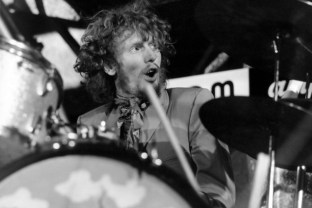 “One of the most important things in pop music, any music, is the beat. But in the eyes of the law, it’s melody, harmony, and lyrics that matter. I added the 5/4 time introduction to Cream’s hit ‘White Room,’ and I suggested to Jack Bruce that the tempo for ‘Sunshine Of Your Love’ was way too fast and should be much slower. These were both important contributions to those tracks, but I got no credit whatsoever.”
Faced with these sorts of indignations, why would anyone choose to play the drums? In Tony Barrell’s marvelous book “Born to Drum,” which takes an exhaustive, entertaining look at the world of drumming, the author recalls asking a drummer friend that very question. He pondered it for a while and then said, “I didn’t choose the drums. They chose me.”
And that’s the crux of it, evidently. Many drummers say they seemed to recognize at an early age that they were driven by, obsessed with, addicted to an innate desire to keep a beat. They attacked household objects — oatmeal boxes, coffee cans, pots and pans, books, tables — in a percussive manner. The Rolling Stones’ Charlie Watts, for instance, couldn’t master how to play the cheap banjo his parents bought for him, so he took it apart and played on it like a drum instead!
 Dave Grohl, drummer for Nirvana, recalls, “At our tiny house, we had no room for a drum kit, nor money to buy one. But I knew the configuration of a drum kit from watching drummers play, so I’d put a pillow between my legs as the snare drum, I’d use my bed as the tom, and a chair as my hi-hat, and I’d just play along to records in my room all day long. I was so into it.”
Little Richard Starkey was a very sick child, spending months at a time in hospital beds with various ailments. In order to relieve the boredom, nurses gave him various percussion instruments to try — wood blocks, triangles, tambourines, drum pads. By the time he emerged at age 15 after a bout with tuberculosis, he knew where his future would be: Behind a drum kit. And sure enough, within seven years, he was Ringo Starr, drummer for the most famous band in the world.
There also seems to be a certain masochism inherent among drummers. It’s physically demanding, far more than any other musical instrument. Guitarists and singers may run around the stage, but that’s just theatrics; they don’t need to do that to perform their musical parts. A drummer needs to be in shape, and he needs stamina. His shoulders, arms and hands are in almost constant motion for long periods of time, while his legs and feet are simultaneously pounding away at pedals.
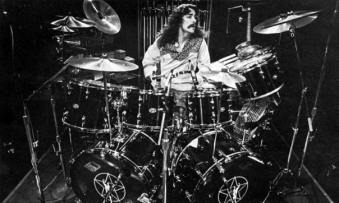 Neil Peart, drummer for the Canadian progressive rock band Rush, had this to say: “I give everything I can, sweating and pounding and thinking as hard as I can, and all of that hurts. Apart from the mental exertion and anguish, my muscles, joints and tendons are jolted and jangled by that ceaseless pounding on tightly tuned heads and metal pedals. I hit those cymbals and drums as hard as I can throughout the entire show, because I like the sound that can be produced by such an impact. So yeah, that hurts. My mother has always complained that I don’t smile enough on stage. Perhaps you’ll now know why that’s true.”
There are tales of drummers who have had to cope with injuries and chronic aches and pains associated with performing or recording for hours on end. Here are some comments from Barrell’s book: “A couple of times, I’ve hit my left hand with my right stick, really hard. It’s like hitting your thumb with a hammer.” “I’ve slammed my finger on the rim of my snare drum, and it swelled up like a golf ball.” “I smacked myself in the face with a drumstick and gave myself a black eye.”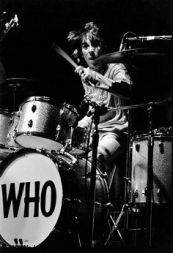 “I’ve caught my knuckles on the edges of my cymbals now and then. You get a nice little spray of blood from that.” And remember Ringo’s scream at the end of “Helter Skelter”? “I GOT BLISTERS ON MY FINGERS!!”
The drummers who are not anonymous but are in fact widely known and recognized (at least by other musicians) tend to fall into two categories. First are the showy types who are powerful and lightning-fast — the late Keith Moon of The Who, or Mitch Mitchell of The Jimi Hendrix Experience, for example. Check out “Bargain” from “Who’s Next,” or “Fire” from “Are You Experienced.” They were so forceful in their delivery that they made the drums almost a lead instrument, carrying a song every bit as much as a dynamic singer, an electric guitar, Hammond organ or saxophone.

Hal Blaine
The second group includes the drummers known for their finesse and their ability to “play to the song.” There’s Steve Gadd (listen to Steely Dan’s “Aja” or Paul Simon’s “50 Ways to Leave Your Lover”), Jeff Porcaro (Toto”s “Rosanna” or Boz Scaggs’ “Lido Shuffle”) or Hal Blaine (hundreds of ’60s and ’70s hit singles as a member of the group of LA studio musicians known loosely as The Wrecking Crew).
My drummer friend Paul Vayda believes the latter category may be more important. “What makes a great percussionist? In a word, taste. In this sense, taste is the ability to choose the proper percussive sounds for the song. Taste is the rhythmic sense to find the right sequence of sounds to form a perfect counterpoint to the melody. It’s also the feel to locate just the right moments to produce a creative ‘fill.’ And it’s having the ear to find the correct dynamics during the flow of a song.”

Buddy Rich
Nearly all drummers — in particular, those who mastered the complicated drumming required by progressive rock and jazz-rock outfits — owe a debt of gratitude to legendary jazz drummers like Buddy Rich and Gene Krupa, who were the pioneers of drums virtuosity in the ’50s and ’60s. I’m speaking of jazz-rock greats like Billy Cobham, Tony Williams, Lenny White and Antonio Sanchez, and prog-rock wizards such as Bill Bruford (Yes), Doane Perry (Jethro Tull), Phil Collins (Genesis), Michael Giles (King Crimson) and Nick Mason (Pink Floyd).
Also deserving of special note are Jai Johanny “Jaimoe” Johanson and Butch Trucks, who BOTH played drums for The Allman Brothers Band simultaneously, a rare thing in music. They shared an uncanny ability to play in tandem, complementing each other rather than competing for time and space within the group’s sound.
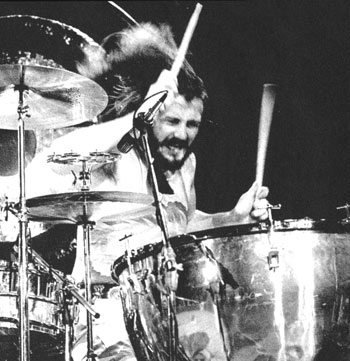 And then there’s the late great John Bonham, who is mentioned most often by other drummers as the best rock drummer of all time. It is testament to his astonishing skills, both in sheer power as well as touch, that when he died in 1980, the remaining members of Led Zeppelin knew they couldn’t possibly replace him, and instead chose to disband.
“For pure rock drumming, no one has ever surpassed Bonham and probably never will,” said Frank Desmarais of the LA band Angels of Mercy. “He had raw power but was also a very musical drummer. The beats and fills he came up with were off the charts. As a drummer, I can’t do any of his beats in a song because people would simply point it out as Bonham’s. That’s how original and lasting his work will always be.”
Interestingly,  after Bonham, the name mentioned as the most influential drummer was Ringo. “Super underrated, so inventive, and the perfect drummer for The Beatles’ repertoire, which was all over the map,” said Desmarais. “Listen to ‘Ticket to Ride,’ or ‘Rain,’ or ‘Come Together.’ Just phenomenal.”
“Mighty” Max Weinberg, drummer for Bruce Springsteen’s E Street Band, vividly recalls watching The Beatles’ American debut on “The Ed Sullivan Show” in 1964. “I can still see Ringo in the back, moving the beat with his whole body, right hand swinging off the sock cymbal while his left hand pounded the snare. What got me most was his smile. I knew he was having the time of his life. And I knew that’s what I was going to do.”
When I asked drummers I know, and readers of this blog, to cite the names of drummers they considered the best in the business, they mentioned the people already mentioned here in bold, and these others:

Mick Fleetwood
Mick Fleetwood (Fleetwood Mac); Stewart Copeland (The Police); Carter Beauford (Dave Matthews Band); Ian Paice (Deep Purple); Michael Shrieve (Santana); Bernard Purdie (Steely Dan and others); Nigel Olsson (Elton John); Jim Keltner (Lennon, Harrison and countless others); Levon Helm (The Band); Aynsley Dunbar (David Bowie, Jefferson Starship); Lenny Mullen Jr. (U2); Steve Jordan (John Mayer Trio); Joey Jordison (Slipknot);
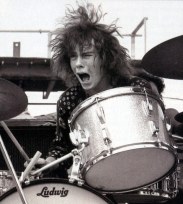
Michael Shrieve
Jim Gordon (Eric Clapton and countless others); Ed Cassidy (Spirit); Richie Hayward (Little Feat); Kenny Aronoff (John Mellencamp, John Fogerty); John Densmore (The Doors); Bartholomew “Frosty” Smith (Lee Michaels); Kenny Buttrey (Bob Dylan, Chet Atkins, many others).
Drummers are overwhelmingly male, but there have been a few females who’ve made their mark playing the skins. Mentioned most prominently is “The Queen of Percussion,” Sheila E. (Escovedo), followed by Meg White of The White Stripes, Maureen Tucker of The Velvet Underground, Gina Schock of The Go-Go’s, Cindy Blackman of Lenny Kravitz’s band, and yes, the late Karen Carpenter, who, in addition to being a fantastic singer, was a pretty mean drummer as well.
Lastly, as much as I’d like to, I can’t ignore the subject of drum solos. It’s been said that the only people who like drum solos are other drummers, and even most of them aren’t wild about solos because they tend to be self-indulgent, way too long, and more showy than

Tommy Lee
substantive. (Ginger Baker’s workout on “Toad” and John Bonham’s “Moby Dick” could go on for 20 or 30 minutes in concert.) Indeed, drummers like Carl Palmer of Emerson, Lake and Palmer, Ralph Johnson of Earth Wind & Fire and Motley Crue’s Tommy Lee went so far as to have their drum kits nailed to the risers and themselves strapped tightly to their stools while the whole platform rose up, tilted, spun around and turned upside down as they continued bashing their way through their solos.
As Barrell puts it in “Born to Drum”: “Potentially, a drum solo at its best can resemble an athletic feat, an endurance test, a dance routine and the creation of an abstract painting all rolled into one. Expert drumming uses all four limbs at once, like a circus acrobat juggling balls while riding a unicycle.” Ridiculous and unnecessary? Perhaps, but certainly a spectacle to remember.
 These Top Ten lists can be great fun, provocative, irritating, satisfying, or silly, but most of all, they get the conversation started. Pretty much all these categories involve highly subjective choices, based as much on emotion as empirical quality, so there’s plenty of room for disagreement.
 which track (or tracks) to choose from their catalogs. Do you select the one that brings back the best memories, or the one that has the best musical chops?
 Many people said “some Motown” had to be on their list. Getting the most mentions were
 In honor of my wife’s birthday today, I asked her to come up with her 20 essential songs. Clearly, they reflect her love for the music of the ’60s and ’70s, but there are a few newer ones thrown in there too. In no particular order, here they are:
 Since this is MY blog, I figured I can list my 20 songs as well. In no order:
