He could play guitar just like ringin’ a bell

“This old guitar ain’t mine to keep,
Just taking care of it now,
It’s been around for years and years,
Just waiting in its old case,
It’s been up and down the country roads,
It’s brought a tear and a smile,
It’s seen its share of dreams and hopes
And never went out of style,
The more I play it, the better it sounds,
It cries when I leave it alone,
Silently it waits for me,
Or someone else I suppose…”
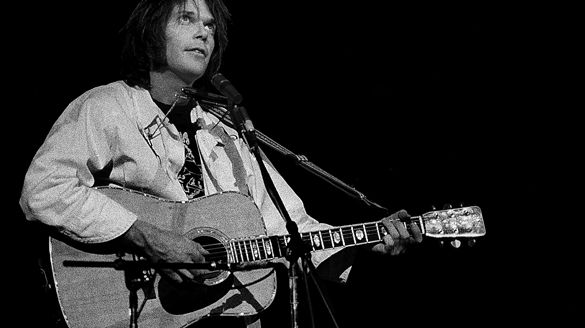
Neil Young wrote these heartfelt lyrics in 2005 for his excellent “Prairie Wind” LP after a brush with death from a brain aneurysm and complications from neurological surgery. The experience humbled him and had a profound effect on the songs he wrote next, particularly this one about how he cherishes his guitar but acknowledges he is only its caretaker for a while.

A number of famous guitarists have had such a symbiotic relationship with their chosen instruments that they have given them nicknames. B. B. King famously named his Gibson guitar “Lucille” after rescuing it from a fire in a club that had been started by two men fighting over a woman named Lucille. Eddie Van Halen came up with the guitar he called “Frankenstrat” by combining a Gibson sound with a Fender appearance and painting it red with black and white stripes. Willie Nelson’s acoustic guitar “Trigger” has been played for so long it has holes where the pick guard is supposed to be.

From rock music’s beginnings, the guitar has been the primary instrument, and the guitarist has been the focal point, so it’s not surprising that songwriters would eventually be composing songs about playing the guitar. I’ve gathered a dozen representative tunes that sing the praises of the guitar/guitarist bond, and you can hear them on the Spotify playlist at the end. (I would’ve most certainly included Young’s “This Old Guitar” among them, but he refuses to allow his music to be played via Spotify.)

As a guitar player myself, I’ve memorized most of these tracks, but a few I have only recently come to know. I can say this without reservation: If you’ve ever thought about learning to play guitar, I wholeheartedly recommend it!

************************
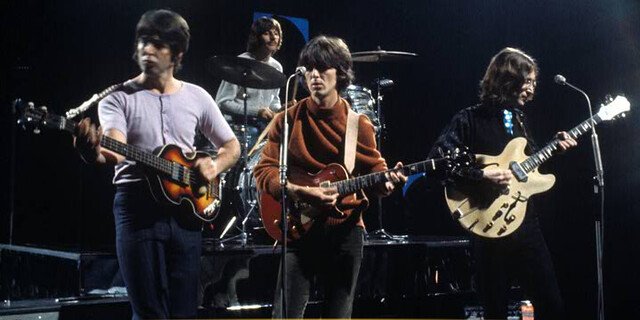
“While My Guitar Gently Weeps,” The Beatles, 1968

Any list of guitar-related songs has to start with this magnificent piece, perhaps the finest track on the band’s legendary “White Album.” When Harrison demo’ed it for the others, they showed an appalling lack of interest in it, so he took the unprecedented step of inviting his friend Eric Clapton to join the session at which it would be recorded, which put the others on their best behavior and resulted in an inspired studio effort from everyone present. Two other renditions of the song are worth mentioning here and are included on the Spotify playlist. On Carlos Santana’s 2010 LP “Guitar Heaven,” he collaborated with singer India Arie and cellist Yo-Yo Ma on a superb treatment. Even more impressive was when Tom Petty teamed up with Jeff Lynne, Steve Winwood and Dhani Harrison at the Rock and Roll Hall of Fame induction ceremony in a tribute to Harrison in 2004, where Prince dropped jaws around the world with a guitar-shredding performance at the end.

“Guitar Man,” Elvis Presley, 1967

This infectious tune was written and originally released in 1967 by Jerry Reed, a then-new country artist who later had a few successful crossover hits (“Amos Moses,” “When You’re Hot, You’re Hot”).  His version stalled at #53 on country charts, but when Elvis Presley took a stab at it (with Reed brought in to handle guitar duties), his rendition made it to #43 on the US pop charts.  Three years after Presley’s death, the song was remixed and re-released in 1980, reaching #16 on pop charts and #1 on country charts.  Its lyrics tell the story of an aspiring guitar player who tries in Memphis and other cities to find gigs, but without much luck until he reaches Mobile, Alabama and becomes the frontman for a popular local band.
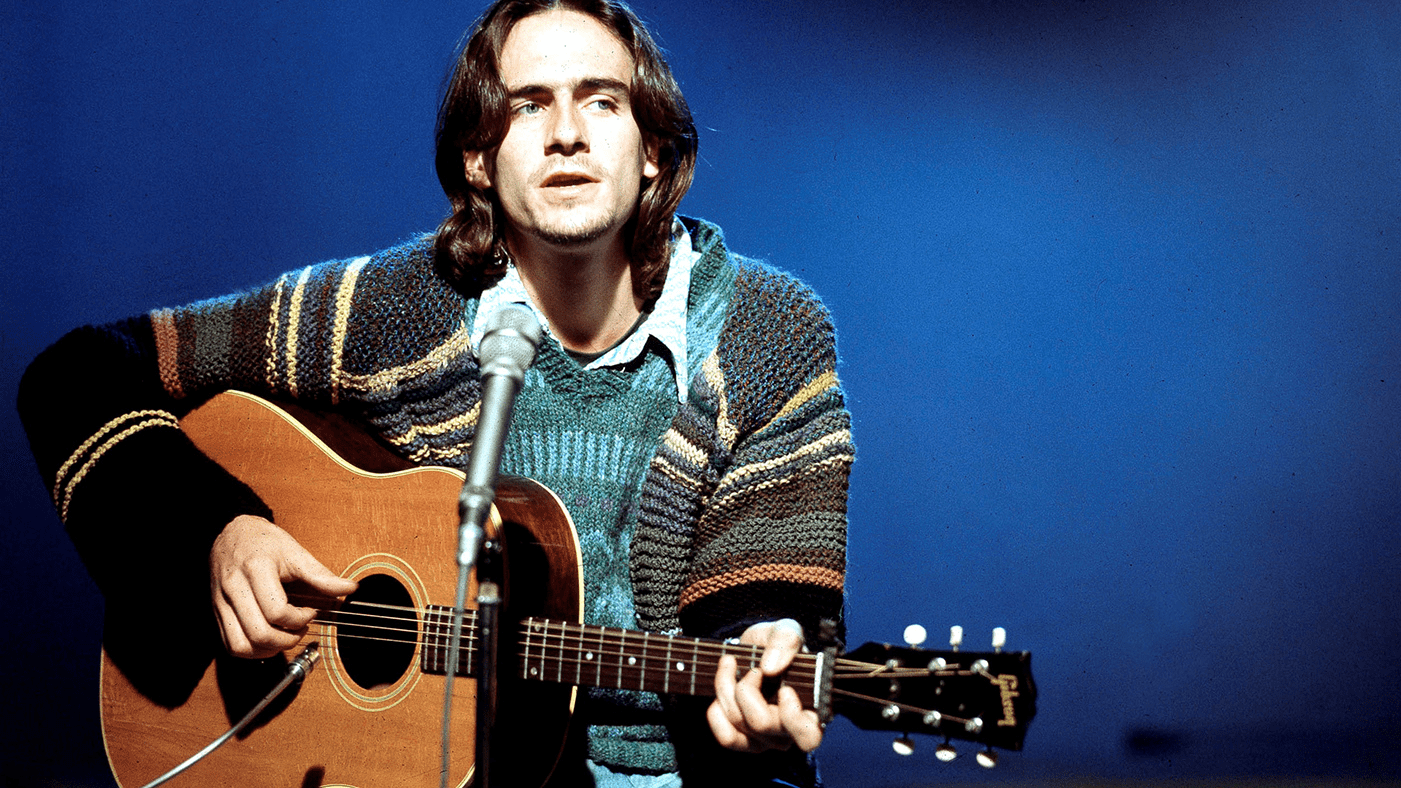
“Me and My Guitar,” James Taylor, 1974

Since his debut, Taylor positioned himself as a singer-songwriter and acoustic guitar picker, with many of his early classics offering lyrics that reference his love for singing and playing.  This was perhaps never more evident than in “Me and My Guitar,” a whimsical track from his overlooked 1974 LP, “Walking Man.”  The song describes the intertwined relationship between the man and his instrument:  “Me and my guitar. always in the same mood, /I am mostly flesh and bones and he is mostly wood…  Any fool can easily see that we go back a long time, /Feel something like fine to me, there’s no such thing as the wrong time, /He hops up on my knee, singing, ‘Get down, Pops, it’s song time’…”

“Shut Up and Play Yer Guitar,” Frank Zappa, 1981

As the iconoclastic leader of The Mothers of Invention and on his own, Zappa was about as prolific as anyone during his 30-year career (1966-1993), writing bizarrely original music and lyrics that brutally satirized American culture.  Often overlooked through it all was Zappa’s proficiency on electric guitar, on which he performed with improvisational virtuosity.  In particular, there’s “Shut Up and Play Yer Guitar,” a three-LP set from 1981 that compiled many solos and guitar instrumentals taken mostly from live performances.  The title track is indicative of what you’ll find throughout the box set.  Said critic Sean Westergaard in 2010, “Zappa was one of the finest and most under-appreciated guitarists around, and this is album that should be heard by anyone who’s into serious guitar playing.”
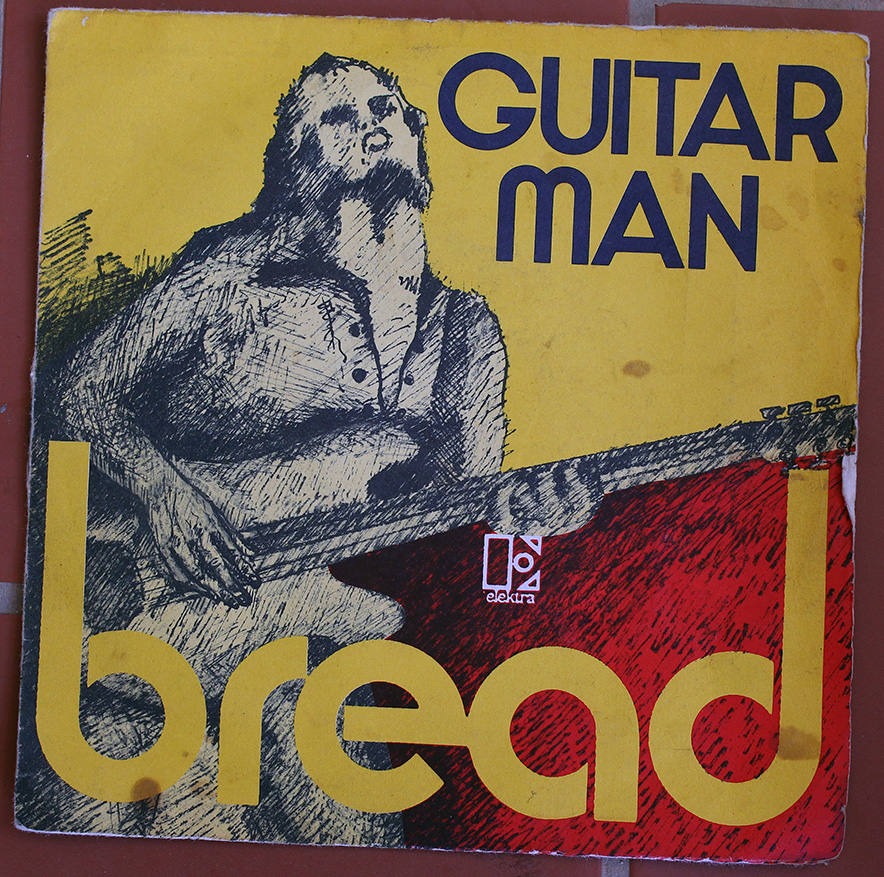
“The Guitar Man,” Bread, 1972

David Gates, chief songwriter for the 1970s group Bread, came up with this wistful, dreamy song about the lonely nature of the guy who is compelled to get up on stage and perform on guitar every night.  Most of Gates’s hit songs are wispy ballads (“If,” “Diary,” “Everything I Own”), but “The Guitar Man” is dominated by a wah-wah guitar part (played by keyboardist Larry Knechtel) and uses the sound effects of an adoring crowd.  The lyrics paint a riveting picture:  “Who’s gonna steal the show, you know, baby, it’s the guitar man, /He can make you love, he can make you cry, /He will bring you down and he’ll get you high, /Something keeps him going miles and miles a day to find another place to play…”  It reached #11 on US pop charts in 1972 (#6 in Canada and #16 in UK).
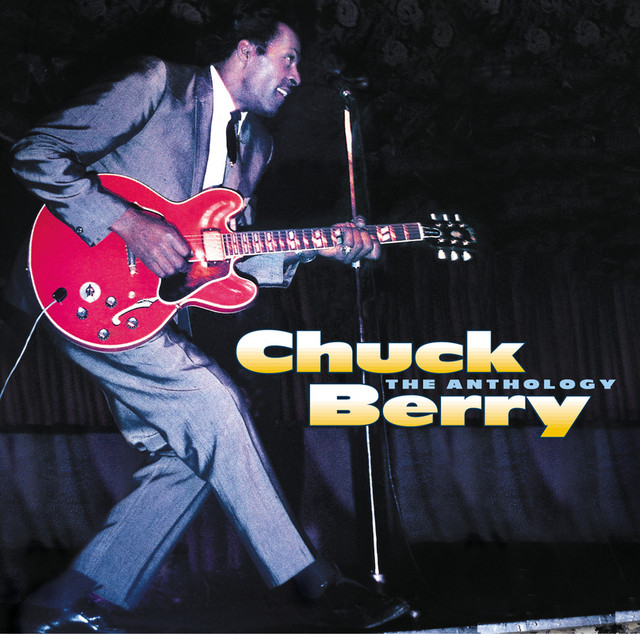
“Guitar Boogie,” Chuck Berry, 1958

Known quite accurately as “the father of rock and roll,” Berry took rhythm and blues music, and refined and developed them into the major elements that defined the new genre, exemplified in iconic tracks like “Maybellene,” “Rock and Roll Music,” “Roll Over Beethoven” and “Johnny B. Goode.” Each of these is anchored by original guitar riffs that are forever identified with Berry and have been copied endlessly ever since. Less well known, perhaps because of the absence of lyrics, is a deeper album track called “Guitar Boogie,” a blistering instrumental that features Berry’s guitar work as prominently as any piece he ever recorded. Even without lyrics, the track seems to show how much the man and the instrument work together to make magic.

“They Call Me Guitar Hurricane,” Stevie Ray Vaughan, 1980

Vaughan was the younger brother of guitarist Jimmie Vaughan, who had founded The Fabulous Thunderbirds in the early 1980s.  Stevie Ray Vaughan came up through the same Austin, Texas blues scene, and ended up being even more highly regarded than his older brother.  His career was cut short when he died in a helicopter crash in 1990 at age 35.  Some of his earliest live recordings were unearthed and released posthumously on the 1992 album “In the Beginning.” One of the best tracks found there is this whirlwind guitar workout, in which his reputation as a guitar virtuoso precedes him:  “Yeah, they call me hurricane, and I’ve come to play in your town, /Yeah, they call me hurricane, and I’ve come to play in your town, /If I can’t play this guitar, I’m sure gonna drive to your town…”
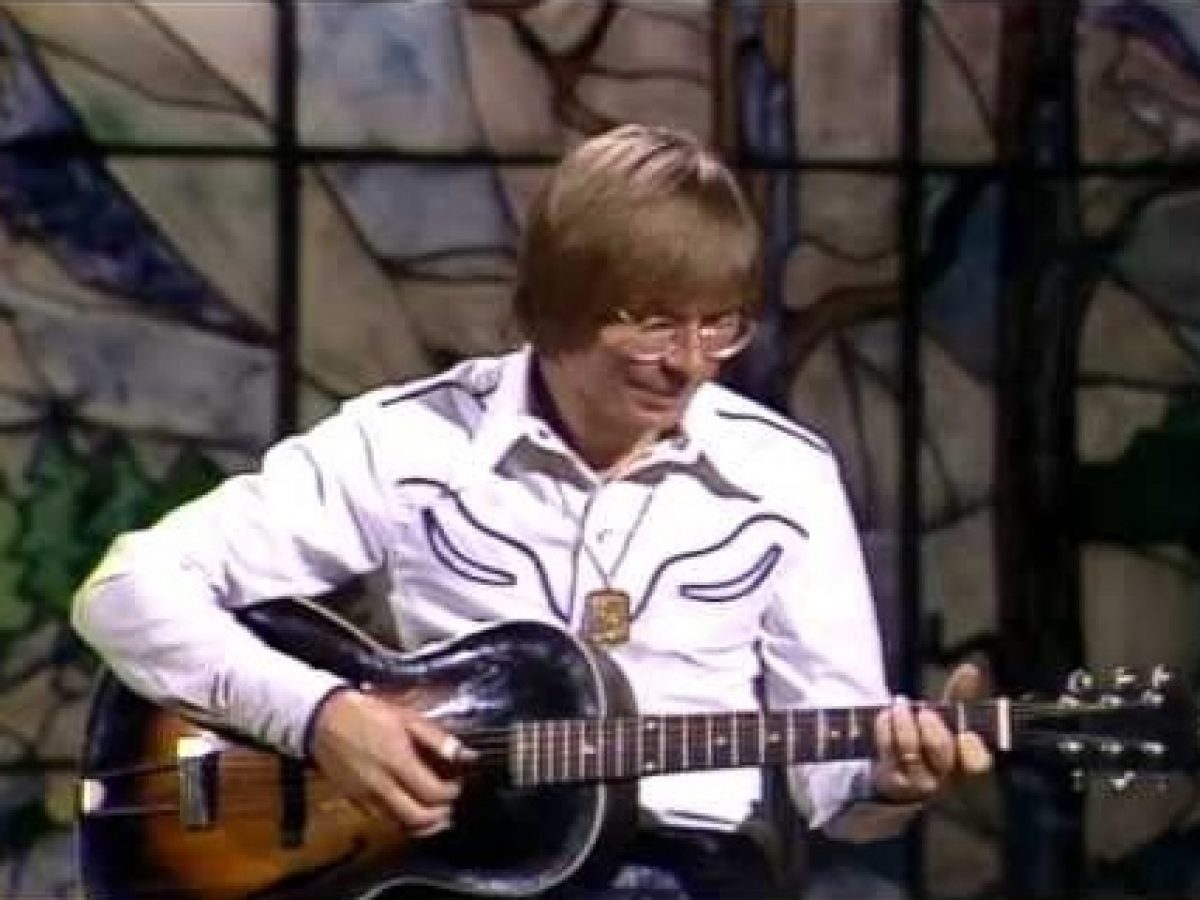
“This Old Guitar,” John Denver, 1974

During his impressive run from the late ’60s well into the 1990s, Denver wrote and recorded more than 200 songs, performing primarily with an acoustic guitar as he sang about his love of nature and his enthusiasm for music. On his #1 album “Back Home Again” in 1974, Denver condensed his raison d’être into the lyrics for “This Old Guitar,” in which he thanked his instrument for bringing him the good things in life, including his success he had as a performing artist and songwriter: “This old guitar taught me to sing a love song, /It showed me how to laugh and how to cry, /It introduced me to some friends of mine and brightened up some days, /It helped me make it through some lonely nights, /What a friend to have on a cold and lonely night…”

“Guitar Man,” J. J. Cale, 1996

Although he shunned the limelight, Cale is mentioned by numerous guitarists as a major influence on their style. He is one of the originators of the “Tulsa Sound,” a loose genre the draws on blues, rockabilly, country and jazz, and has written classics like “After Midnight,” “Call Me the Breeze” and “Cocaine.” In 1996, the title track of his “Guitar Man” LP touched on the mystery of his art: “Your fingers move so swiftly across those silver strings, /It looks so nice and easy, how you make it sing, /Guitar man, tell me what your secret is, /Tell me please, can you put my mind at ease, /Guitar man, in a guitar jam, playing low, playing slow, /Playing loud, working the crowd, /Playing high, you seem to fly… (Hey man, have you seen my Stratocaster? Hand me that Gibson over there, will you? /Let my try your Martin, man, do you mind? /Plug it in that Marshall, turn it up a little bit louder!…)”
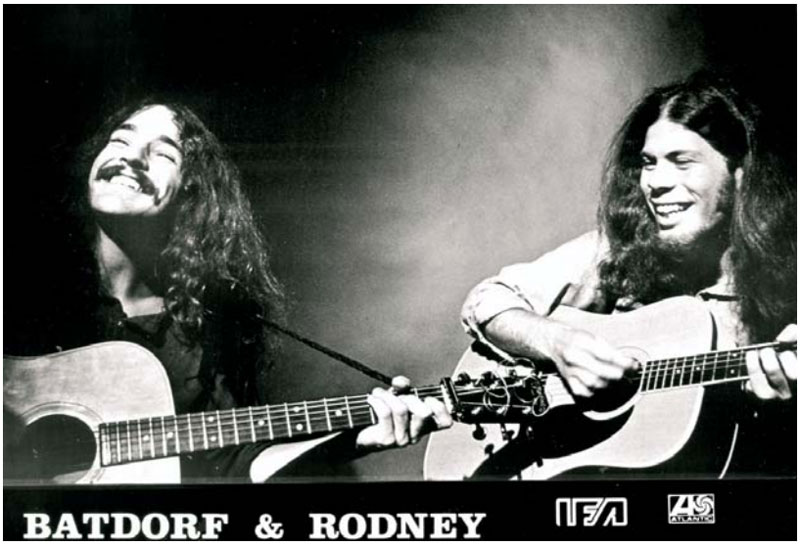
“Me and My Guitar,” Batdorf and Rodney, 1971

Singer-songwriter John Batdorf was only 19 when he took a batch of delightful acoustic-based originals, teamed up with guitarist Mark Rodney and released what, to me, was one of the finest LPs of that era, 1971’s “Off the Shelf.”  I’ve raved about this album many times on this blog, but I may not have focused before on this particular song, which has no relation to James Taylor’s tune of the same name (mentioned above).  In Batdorf’s song, he talks about how much he relies on his guitar to bring him the success in the music business he’s striving for:  “Oh, me and my guitar, keep our wheels a-turning, /Trying hard to find the perfect style….  /I play all day and sing the song that I wrote yesterday, /Hoping it will be the one that gets me on my way, /How long will it take?  How soon will it break?…”

“This Guitar (Can’t Keep From Crying),” George Harrison, 1975

Harrison’s post-Beatles solo debut LP, “All Things Must Pass,” was such an unqualified success that everything released afterwards seemed to be a comedown.  In particular, when he toured in 1974 in support of his ho-hum “Dark Horse” album, reviews were not kind, which soured Harrison on the music business for years to come.  One of the first songs he wrote in the aftermath of that episode was this moving track from his 1975 LP, “Extra Texture.”  Modeled somewhat after his stellar Beatles song “While My Guitar Gently Weeps,” this tune made it clear that his feelings were hurt by the criticism:  “This here guitar can feel quite sad, /Can be high strung, sometimes get mad, /Can’t understand or deal with hate, /Responds much better to love, /I thought by now you knew the score, /But you missed the point, just like before, /And this guitar can’t keep from crying…”

“Just Playing My Axe,” Buddy Guy, 1968; “Born to Play Guitar,” Buddy Guy, 2015

At 86 and still going strong, Guy has been cranking out Chicago blues since the late 1950s, inspiring generations of guitarists ever since. On his second LP in 1968, he recorded a tune called “Just Playing My Axe” that succinctly summed up his mission and his passion in just three lines: “I just wanna play my axe, /Let me play my axe one time, /Let me play my axe again.” Then he shut up and did exactly that. Nearly 50 years later, his song “Born to Play Guitar” offered a more detailed perspective on his life’s work: “I got a reputation, everybody knows my name, /I was born to play my guitar, I got the blues running through my veins, /I got six strings loaded on my bad machine, /Show me the money and I’ll make this damn thing scream, /I’m gonna keep on playing, and on my dying day, a polka-dot guitar will be resting on my grave…”

***************************

Honorable mention:

Play Guitar,” John Mellencamp, 1983; “Somebody Stole My Guitar,” Deep Purple, 1996; “Little Guitars,” Van Halen, 1982; “Scars on This Guitar,” Bon Jovi, 2018; “Guitar Boogie,” Tommy Emmanuel, 2010; “Close But No Guitar,” Toby Keith, 2018; “This Guitar,” Def Leppard with Alison Krauss, 2022; “Driving Guitars,” The Ventures, 1962.

If there’s a rock ‘n’ roll heaven, they’ve got a hell of a band

We can’t begin the New Year until we pay our respects to the folks we lost in 2022. It’s always tough to say goodbye to those who made an impact in our lives, be they precious family members, longtime friends, or celebrities whose musical achievements touched our hearts at some point on life’s journey.

At Hack’s Back Pages this week, I am doing what I traditionally do for the final post of the calendar year — offering well-deserved appreciation for the classic rock artists who died in 2022. I have also included a Spotify playlist of 32 songs, two from each of the 16 artists profiled here.

Rest In Peace to these talented people…

****************************

Marvin Aday, better known the world over as the unforgettable Meat Loaf, passed away January 20th at age 74. “Bat Out of Hell,” the over-the-top album he created with songwriter Jim Steinman in 1977, remains one of the biggest sellers in rock music history. His larger-than-life persona helped him pack arenas and concert halls for decades, spurred on by the success of “Bat Out of Hell II” in 1993, with its #1 hit single “I’d Do Anything For Love (But I Won’t Do That).” Meat Loaf also did many dozens of cameos and acting gigs in mostly forgettable films and TV shows, although his appearances in “Rocky Horror Picture Show” and “Wayne’s World” were quite memorable.

Gary Brooker, keyboardist and lead singer for the British progressive rock band Procol Harum, died February 19th at age 76. It was Brooker’s vocals, songwriting prowess and piano talents that defined the group’s music, most notably on their game-changing debut single, “A Whiter Shade of Pale,” the first major work that effectively merged rock with classical music. Brooker remained the constant in the band’s lineup throughout the late ’60s and ’70s, playing a prominent role on albums like “A Salty Dog” and “Grand Hotel” and hit singles like “Conquistador,” recorded live with a symphony orchestra. He shepherded a successful reunion LP in the ’90s, participated in the “Concert For George” (Harrison) tribute concert and album in 2002, and recorded and toured as Procol Harum with new material as recently as 2017.

The rock music world was stunned when Taylor Hawkins, the mightily talented drummer of Foo Fighters, died suddenly in Brazil when his heart gave out on March 25th at age 50. He had been a session drummer and toured with Alanis Morrisette in the mid-’90s before joining up with Dave Grohl’s band in 1999, becoming a fixture on eight albums and numerous tours. He also formed a side project, Taylor Hawkins and The Coattail Riders, in 2004, who released three albums of their own. While he had been a recreational drug user in the past, it was a combination of prescribed meds that proved too much for Hawkins. He was inducted with the Foo Fighters into the Rock and Roll Hall of Fame in 2021.

Veronica Yvette Bennett Greenfield, known worldwide as Ronnie Spector, died of cancer January 12th at age 78. She was the pivotal member of the early ’60s “girl group” The Ronettes, who had several Top Ten hits in the US and the UK, most notably the iconic “Be My Baby,” and “Baby I Love You” and “Walking in the Rain.” She endured a stormy, controlling marriage to unstable record producer Phil Spector, who sabotaged her career by refusing to let her perform and threatening her life on multiple occasions. Her attempts at a solo career never amounted to much, but in the ’70s, she recorded vocals on tracks by Southside Johnny and performed with Bruce Springsteen a few times. In 1986, Spector added guest vocals on Eddie Money’s #4 hit, “Take Me Home Tonight.”

Since 1970, Christine Perfect McVie was a crucial member of Fleetwood Mac, a stable influence when so many others in the band’s lineup went spinning out of control. Hired to play keyboards and background vocals, she soon began writing and singing lead on her own songs (“Just Crazy Love,” “Heroes Are Hard to Find”). By the time Lindsey Buckingham and Stevie Nicks joined in 1975, McVie was writing compelling pop symphonies like “Over My Head” and “Say You Love Me,” and huge hit singles such as “Don’t Stop” and “You Make Loving Fun.” Her songs from Fleetwood Mac’s 1987 gem “Tango in the Night” tore up the airwaves that year (“Little Lies,” “Everywhere”). Christine suffered from severe scoliosis and died on November 30 at age 79.

Alan White, drummer extraordinaire with Yes for nearly 40 years, 15 albums and 30 tours, died May 26th at age 72. White was recruited by Yes to take over on skins when original drummer Bill Bruford left unexpectedly for King Crimson, leaving them in a quandary just before their 1972 opus “Close to the Edge” US tour, and White made the most of the great opportunity. Prior to joining Yes, White played numerous sessions in British studios, went on tour with Joe Cocker, and participated on several high-profile projects with John Lennon and his Plastic Ono Band, including the “Live Peace in Toronto” appearance and album, and the #1 “Imagine” LP.

Ronnie Hawkins, who died May 29th at age 87, is credited with kickstarting the Canadian rock music scene in the mid-’60s, bringing his infectious blend of gregarious rock ‘n’ roll and R&B. He was born in Arkansas USA, where he developed a love for “a sort of rockabilly/soul mix,” as he put it, which became the format for his group The Hawks. They sought and found some fame in Ontario, but The Hawks disbanded and later evolved into The Band. Hawkins moved to Toronto in the mid-’60s and. became a fixture in the clubs there and in Hamilton for 40 years, both as a flamboyant performer and a talent scout. He also appeared in Bob Dylan’s “Renaldo and Clara” film and The Band’s legendary “The Last Waltz” concert and film.

Jimmy Seals, one half of the popular 1970s soft rock duo Seals and Crofts, died June 6th at age 80. His songwriting, vocals and acoustic guitar playing anchored the albums and hit singles that marked the duo’s career, especially during their 1972-1973 peak with four Top 20 hits (“Summer Breeze,” “Hummingbird,” “Diamond Girl” and “We May Never Pass This Way Again”). Seals was a deep believer in the Baha’i faith, which regards abortion as a sin, and when he and Crofts recorded the controversial “Unborn Child” album and single in 1974, the duo fell out of favor for a while. They managed one more hit in 1976 with the #6 “Get Closer,” then retired from the business in 1980 except for occasional one-off reunions in the 1990s and 2000s.

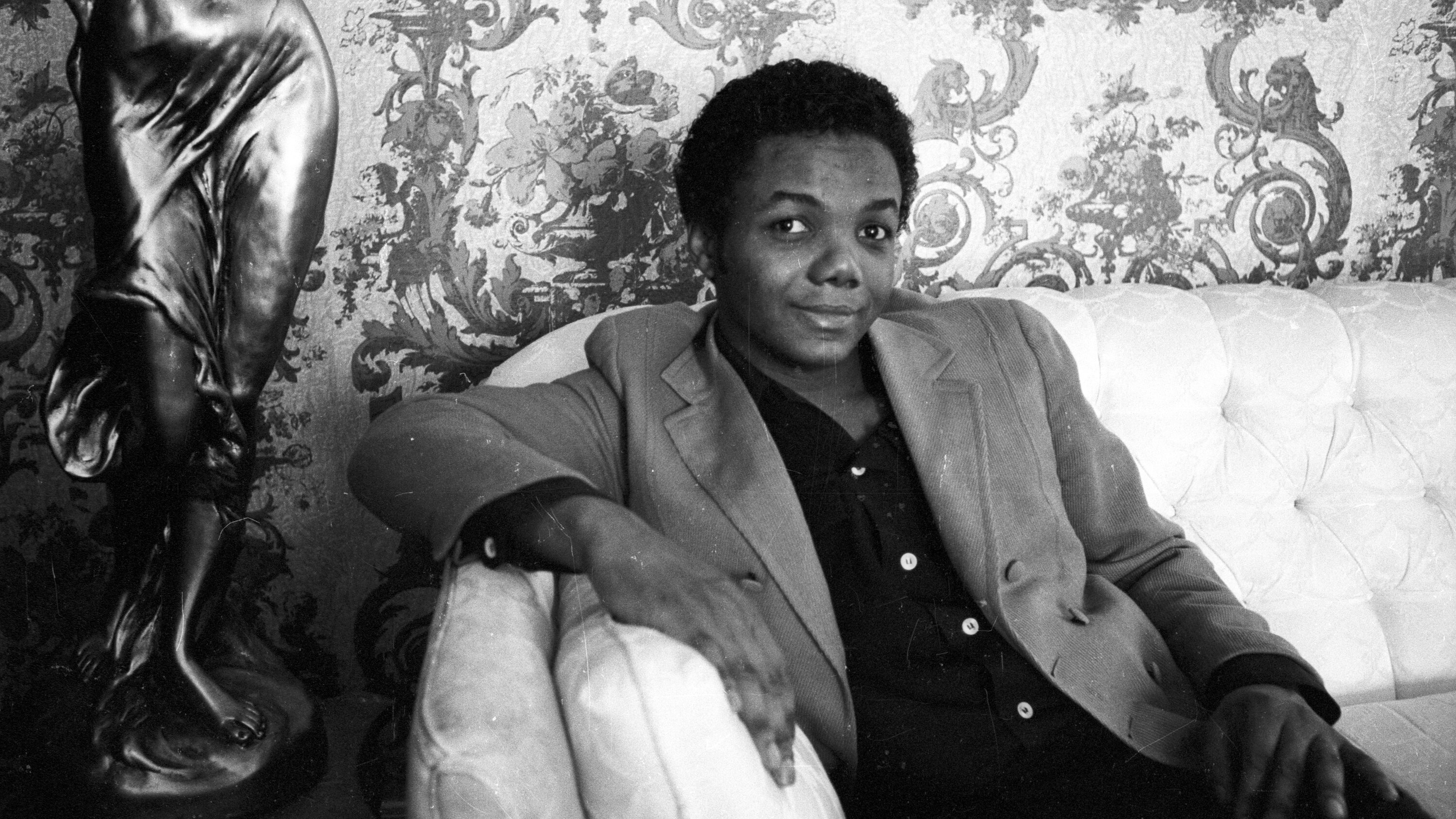
Lamont Dozier, one third of the incredibly prolific Motown songwriting team of Holland-Dozier-Holland, died August 8th at age 81. With his partners, Dozier came up with hit after hit after hit in the 1964-1970 period, writing TEN #1 singles for The Supremes (“Stop! In the Name of Love,” “You Keep Me Hangin’ On,” “Baby Love”) and many iconic tunes for The Four Tops (“I Can’t Help Myself,” “Reach Out I’ll Be There”), Marvin Gaye (“How Sweet It Is”) and Martha Reeves (“Heat Wave”). He tried his hand as a recording artist himself, charting at #15 with “Trying to Hold On to My Woman” in 1974, and continued achieving as a songwriter into the ’80s and ’90s.

When it comes to riveting lead vocals in the British New Wave arena, few came close to Terry Hall, who served as front man in The Specials and Fun Boy Three, two of the most successful bands of the early ’80s in the UK. The Specials scored two Top Five LPs and six Top Ten singles, including “Gangsters,” “A Message to You Rudy,” Rat Race” and “Stereotype.” Hall left that band after only three years to form Fun Boy Three, again making a huge chart impact with two Top 20 albums and four Top Ten singles. Curiously, neither band made a dent in the US charts, so Hall’s name is known primarily here to discerning American rock fans. Hall died December 18 of pancreatic cancer at age 63.

Olivia Newton-John — wholesome songstress, iconic actress, sexy pop star, committed activist — passed away August 8th at age 73 after a lengthy battle with cancer. She established herself as a purveyor of sugar-sweet pop/country songs in the 1971-1976 period, but that all changed when she was cast as Sandy in the film version of “Grease” in 1978, in which she eventually transformed from innocent lass to aggressive vixen. The platinum “Grease” soundtrack was dominated by Newton-John singles (“You’re the One That I Want”) that influenced her next few rocked-up records, including the ubiquitous “Physical,” a #1 single for 10 weeks in 1981. By 1985 she was a wife and mother and got her first cancer diagnosis, so she switched gears to a less stressful career championing environmental causes.

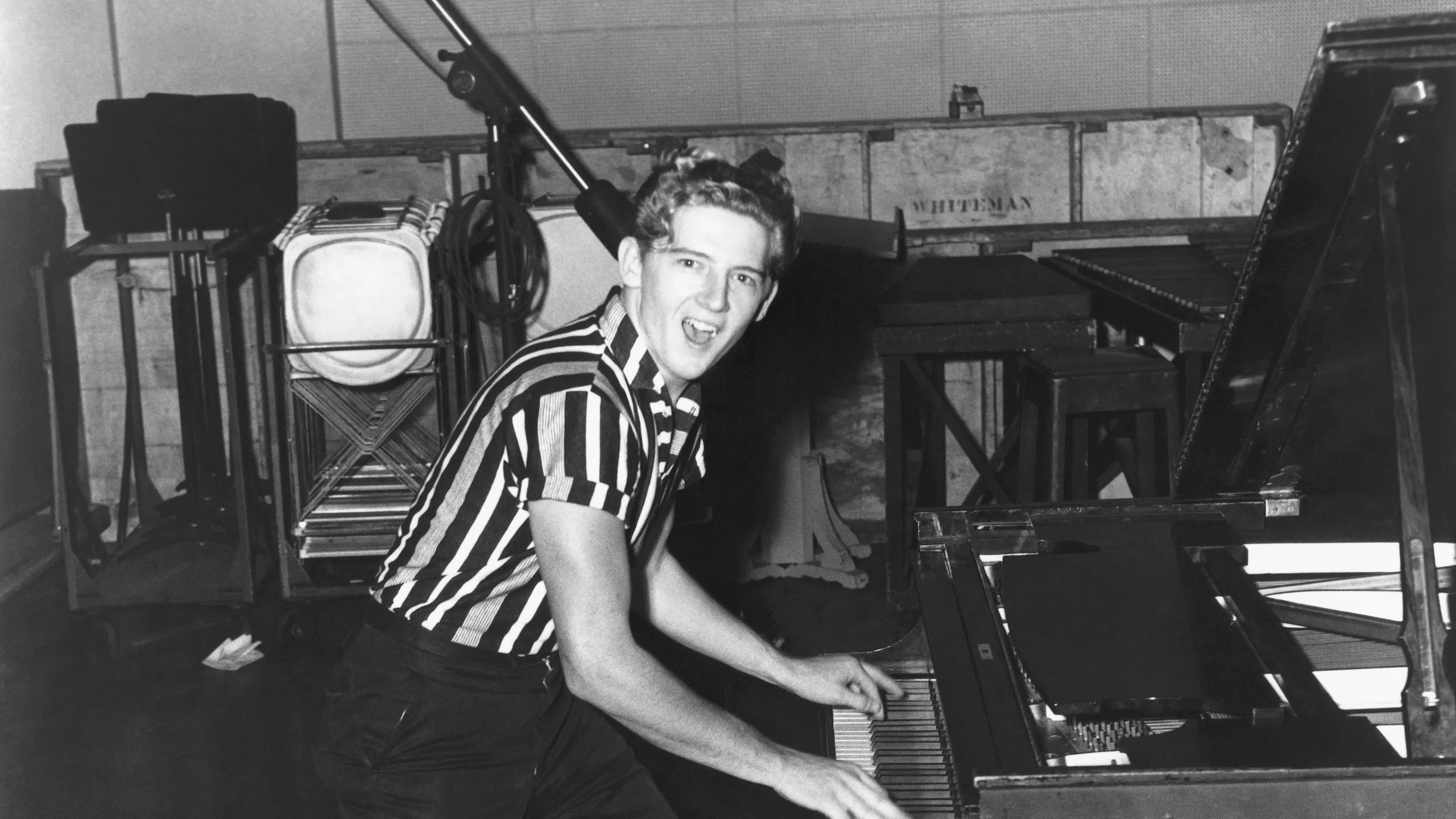
Jerry Lee Lewis, the original bad boy among the influential pioneers of rock and roll, died October 28th at age 87. Parents in the ’50s found his brand of untamed rock (“Whole Lotta Shakin’ Going’ On,” “Great Balls of Fire”) unsettling, especially on stage, where he sang with unbridled passion and played piano like a man possessed. His cocky attitude was part of his persona, but it didn’t serve him well when, at age 22, he defiantly married his 13-year-old cousin, and the public outcry derailed his career for nearly a decade. In 1968, he recorded a traditional country LP that went to #3 on country charts, kicking off an impressive eight-year run as a country music artist. Lewis was deservedly inducted into the Rock and Roll Hall of Fame in its inaugural class.

Aaron Carter was only nine years old when his debut LP sold a million copies in 1997 and made him one of the most successful teen pop singers in recording history, with three more multi-million-selling albums over the next seven years. At his peak in 2000-2001, Carter’s LPs “Aaron’s Party” and “Oh Aaron” made him almost as huge a concert draw as his brother Nick’s band, The Backstreet Boys. Carter was found dead in the bathtub of his California home on November 5th at age 34, and the jury is still out on whether it was accidental overdose or suicide. Carter’s story is a sad one. He suffered from bipolar disorder and opiate addiction, necessitating ongoing rehabilitation attempts, and he endured parents who grossly mismanaged his finances.

The most awarded female country music recording artist of all time, Loretta Lynn scored an incredible 24 #1 hits on the country charts and 11 Number One LPs over the course of her six-decade career. Her 1970 #1 autobiographical single “Coal Miner’s Daughtrer” became her signature song and was turned into a popular biopic film in 1980 starting Sissy Spacek. Another crossover success came in 1993 when she collaborated with Dolly Parton and Tammy Wynette on “Honky Tonk Angels,” which reached #42 on the pop charts. Her 50 years of touring came to an end in 2017 when she suffered a stroke, then broke her hip the following year. She died October 4th at the age of 90.

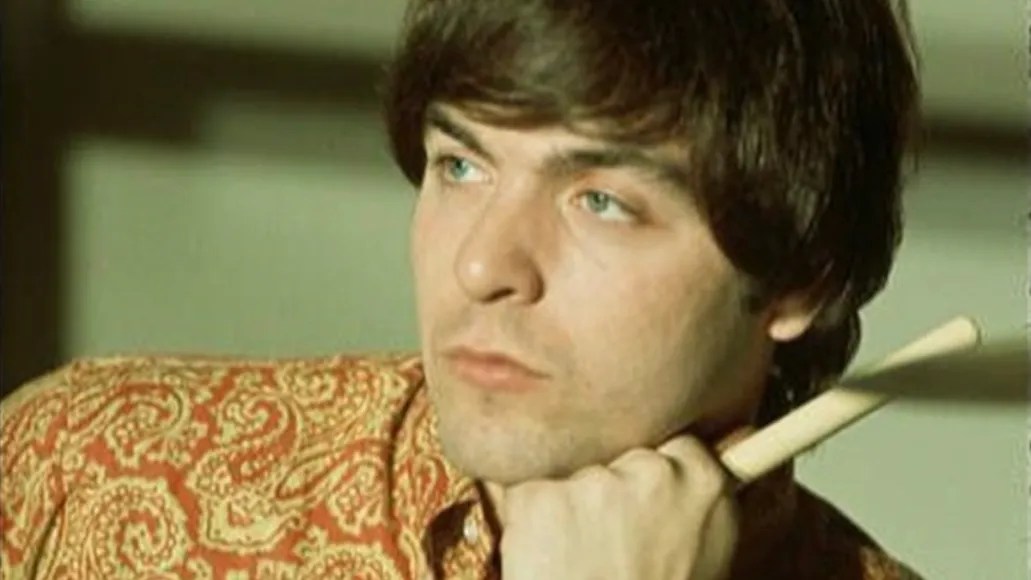
Dino Danelli, the talented drummer of The Young Rascals (later The Rascals), died December 15th at age 78. Danelli has been described as “perhaps the most underappreciated drummer in rock history.” If you check out video clips of The Rascals in performance (notably “Good Lovin'” on “The Ed Sullivan Show”), it’s clear how vital Danelli was to the band’s dynamic sound. The Young Rascals had six Top Ten hits between 1966-1968, including three #1 classics — “Good Lovin’,” “Groovin'” and “People Got To Be Free” — as well as “A Girl Like You,” “A Beautiful Morning” and “How Can I Be Sure.” Danelli was a Jersey boy with jazz drum training who jammed with the likes of Lionel Hampton before meeting Eddie Brigati and Felix Cavaliere to form The Rascals. Later in life, he collaborated with Leslie West and then Little Steven & The Disciples of Soul.

Kim Simmonds, the founder and longtime guitarist of the venerable British blues band Savoy Brown, died on December 13th at age 75. Like so many of his young British compatriots in the mid-’60s, Simmonds was enamored by American blues and formed Savoy Brown in 1965. While they didn’t really catch on much in their native England, the group enjoyed modest success with US audiences thanks to constant touring. Simmonds, who wrote the majority of the band’s repertoire, tended to rule the group with an iron fist, which partly explains the revolving door of nearly 70 different members over the years. The group charted six LPs in the Top 100 here, with 1972’s “Hellhound Train” peaking at #34.

****************************

Honorable mentions:

Bobby Rydell, early ’60s pop idol, died April 5th at 79; Alec John Such, bassist for Bon Jovi, died June 5th at 70; Billie Dale “C. W. McCall” Fries, singer/writer of the CB radio #1 novelty hit “Convoy,”died April 1 at 93; Jerry Allison, drummer for Buddy Holly and The Crickets, died August 22nd at 82; country singer Naomi Judd died April 30th at 76; Depeche Mode keyboard player Andy Fletcher died May 26th at 60; and Irene Cara Escalera, singer/actor in “Fame” and “Flashdance (What a Feeling),” died November 25th at 63.

****************************