Doggone, how I love them old songs
No one can claim that Dodger Stadium, or any stadium, has the best acoustics for rock music, or any music. But this is 2017, and the sound technicians these days are capable of wondrous things.
If the musicians involved still have the chops to offer convincing live performances, there’s no reason why such events can’t be an overwhelming success.
Witness the universally acclaimed “Desert Tour” three-day event out on the Coachella grounds in Indio, CA, last October. Loads of money — $160 million — was made on that baby, a fact that didn’t escape the attention of other promoters.
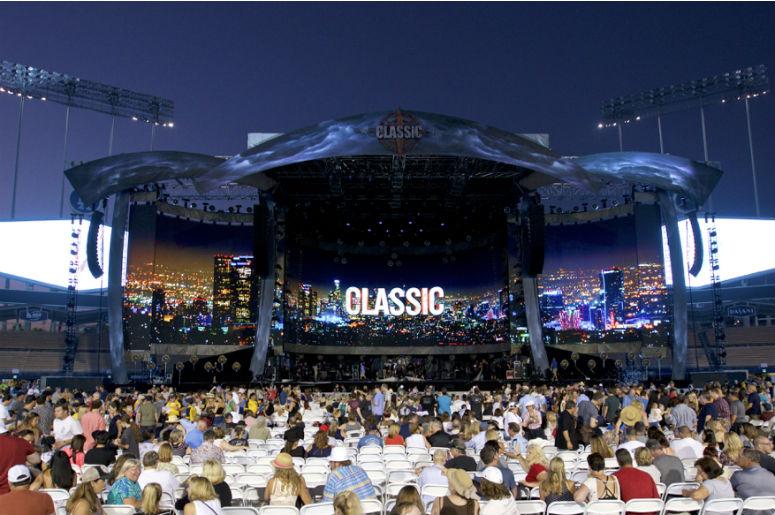 Irving Azoff, the scrappy multi-millionaire who got his start micro-managing The Eagles in their heyday, sure as hell noticed. He saw an opportunity to copycat that success with “The Classic,” a two-day event featuring six major classic rock bands (all of whom he manages, by the way). He would one-up things by staging his concerts on BOTH coasts — July 15-16 in L.A. and July 29-30 in New York.
He was right, of course. The LA extravaganza last weekend was a huge win commercially and, luckily for him, it was a dramatic artistic success as well. Not perfect, mind you, but really friggin’ awesome.
As usual, the cynics (and there were many) raised questions. How many of the original members were still on stage in the lineup? Could anyone still hit the high notes? Would they be a shadow of their former selves? Let’s take a look.
Night #1
The Doobie Brothers
There have been more than two dozen musicians over the years who could claim to have been a Doobie Brother at some point. And the group has always been something of a dichotomy: The rock and roll boogie music of the original 1972-1975 Tom Johnston era, 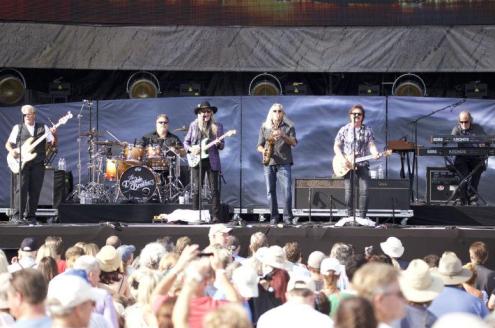 and the softer R&B-laced music of the 1976-1982 Michael McDonald period. But this gig was all about the early stuff; McDonald was nowhere to be seen, choosing to remain a solo artist. And that was fine with me, if not with a segment of the audience.
Johnston was the founder, the singer/songwriter/guitarist behind the classic rock warhorses like “Listen to the Music,” “China Grove,” “Long Train Runnin’,” “Rockin’ Down the Highway,” “Sweet Maxine,” “Take Me In Your Arms” and “Jesus is Just Alright,” and he led the band through spirited versions of all of these. Just as important, however, is the great Pat Simmons, the singer/songwriter/guitarist who served in both versions of The 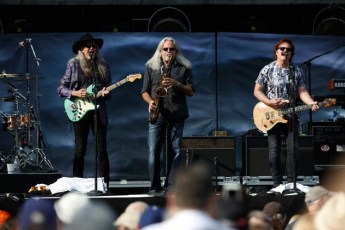 Doobies. His songs have played an important roll in the group’s legacy, from sleepers like “Clear as the Driven Snow” to perhaps their most popular track, the southern/country staple “Black Water.”
Multi-instrumentalist John McFee, who joined the band back in 1979 and has been pretty much a steady member ever since, was on hand to contribute some fine guitar, vocals, fiddle and harmonica as needed. And it was a pleasant surprise to see the great Bill Payne (from Little Feat) holding court on keyboards. Otherwise, the stage was filled with new faces providing drums, percussion and bass.
The sound quality was rather erratic, sad to say; sometimes the guitar solos rang out clear as a bell, yet in other instances the mix was rather muddy. Primarily for this reason, I give them a grade of 7.5 on a 1-10 scale. Not bad, not bad at all, but I’ve heard them much sharper in previous shows.
Steely Dan
Except for its first year or two of existence, Steely Dan is, in fact, not really a band at all, but the brainchild of Donald Fagen and Walter Becker. These two musical wizards  wrote all of the wondrous songs in the repertoire, and have assembled an ever-changing gang of crack session musicians to capture the guitar, keyboard, sax and background vocal parts they envisioned for their quirky but irresistible material.
Becker was absent at this gig, apparently with some sort of undisclosed illness, but his shoes were capably filled by jazz guitar virtuoso Larry Carlton on guitar, who had  played the key guitar solos on Steely Dan recordings like “Kid Charlemagne,” “Don’t Take Me Alive” and “Josie.” The rest of the lineup included the mostly anonymous types Fagen has employed for decades who deserve our attention, especially the dominant four-man horn section, and the young drummer (not identified) who mastered the difficult time signatures and drum fills of numbers like “Aja” and “Bodhisattva.”
Fagen, meanwhile, did his usual admirable job on vocals and keyboards, leading the band through its tricky paces on “Green Earring,” “Time Out of Mind” and “Babylon Sisters.” The Steely Dan catalog is such an extraordinary cornucopia of fabulous songs, from the oldies “Dirty Work” and “Reelin’ in the Years” to later work like “Hey Nineteen” and “Black Cow,” which allow ample room for the various musicians to stretch out.
A great, although brief, set; they were ushered off far too quickly, in my opinion. Still, I give their gig an 8.5, leaning toward 9.
The Eagles
This was the one everyone was talking about. It was the first time the band attempted a full-blown live show since Glenn Frey‘s death 18 months ago, and plenty of people wondered about the wisdom of staging an Eagles show without him. Hell, Led Zeppelin disbanded when they lost their drummer. Shouldn’t this band hang it up without their co-founder/co-songwriter/co-singer?
 For this special concert, they came up with a clever way to fill the void: They invited Frey’s talented son Deacon Frey to play guitar and sing with them, AND they recruited country music giant Vince Gill to offer his vocals and guitar as well. The result was a thoroughly satisfying, emotional, energetic performance of 20 songs from The Eagles’ enviable catalog of sweet ballads and kickass rockers, carried by stellar harmonies throughout.
Appropriately, the setlist leaned mostly toward material that Frey had sung and/or written — “Take It Easy,” “Peaceful Easy Feeling,” “Tequila Sunrise,” “Already Gone,” “Lyin’ Eyes,” “New Kid in Town,” “Heartache Tonight” — with either Gill or young Frey leading the way. The latter song was marked by a surprise appearance by Frey’s old Detroit friend Bob Seger, although his vocals were largely hidden under the thick harmonies.
Don Henley, of course, played a crucial role as ringleader, drummer, occasional guitarist and singer of classics like “One of These Nights,” “Witchy Woman” and “The Best of My Love,” and a rare performance of “The Last Resort,” the dramatic closer on their “Hotel California” album. I was pleased they still made room for Timothy B. Schmidt‘s warm moment in the sun, “I Can’t Tell You Why,” a huge crowd favorite.
 But here’s the thing about Saturday night’s show: The crowd was actually treated to not three attractions, but four. The irrepressible Joe Walsh, a mighty solo artist in his own right, hijacked the final third of the show with a six-song set that featured his amazing guitar work and immediately identifiable voice, cranking up the energy level a few notches in the process. There was “In The City,” his tune from “The Long Run”; there were “Life in the Fast Lane” and “Hotel California,” both highlighted by Walsh’s searing guitar riffs and solos; there were his two biggest solo hits, “Rocky Mountain Way” and “Life’s Been Good”; and there was even a welcome dip back into his James Gang days with 1970’s “Funk #49.”
Grade: 9.5
It’s not at all clear whether The Eagles will tour (or record) with this lineup after these two Classic appearances. Henley hedged the subject by thanking the fans for their decades of support: “In case this is our last dance, I want to thank all our fans in Southern California. It all started right here with you in Los Angeles 46 years ago…and we’re very grateful.”
Night #2
Earth Wind and Fire
It’s a testimony to this band’s founder and visionary, Maurice White, who died last year, that they are able to continue on without him in such a vibrant, polished way. Anchored by the vocals and on-stage leadership of Philip Bailey, the ensemble that makes up Earth  Wind & Fire did the impossible: They got 50,000+ aging rock fans to get up off their asses and dance in the hot sunshine.
“Sing a Song,” “Shinin’ Star,” “Getaway,” “September,” “That’s the Way of the World,” “Fantasy,” “Got to Get You Into My Life,” “After the Love Has Gone” — you all know the hits, and boy, did they play them. The 10-man assembly, which included original members Verdine White on bass/vocals and Ralph Johnson on drums/vocals — gave a well choreographed, dynamic performance that included a heartfelt tribute to White in a photo montage during “Serpentine Fire,” and the stadium crowd responded enthusiastically. Grade: 8.
Journey
For me, this was the puzzle piece that didn’t fit in The Classic’s six-band roster. Journey was a mid-’70s progressive rock/fusion band born from the breakup of Santana’s original lineup who then made the switch to power ballads and high-volume rock with the addition of Steve Perry in 1978. Perry chose to part company years ago, and although he was happy to show up for induction into the Rock and Roll Hall of Fame a few months back, he declined to participate in this high-profile event.
No matter: The group discovered — through YouTube — an uncanny Steve Perry imitator  named Arnel Pineda, who is already approaching 20 years with the group, and he can (and did) convincingly belt out every Journey track you could possibly want. And he jumped around the stage like a mischievous chimp, despite being almost 50 himself, making most of the 60+ folks who walked this stage over the weekend look like geriatrics in comparison.
Not sure why, but the sound crew for Journey felt the need to crank the sound levels way beyond tolerable — many decibels beyond every other band we heard over the weekend — and that made their set a bit of an endurance test. I won’t lie, I’m not much of a Journey fan to begin with, and I sure didn’t need to hear their setlist at rocket-launch volume. But I was 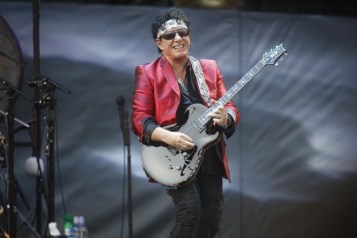 certainly impressed by Neal Schon‘s incendiary guitar work, Jonathan Cain‘s keyboards, and Pineda’s exuberance.
The crowd absolutely loved Journey, and their greatest hits set list: “Open Arms, “Wheel in the Sky,” “Who’s Crying Now,” “Separate Ways,” “Any Way You Want It,” “Lights,” “Faithfully,” “Don’t Stop Believin’,” “Lovin’, Touchin’, Squeezin'”… so I guess I’m in the minority, but these guys were by far my least favorite of the six acts. I give them a 7.
Fleetwood Mac
With the bar set pretty high by The Eagles’ impressive headliner show the previous evening, expectations were fairly lofty for the kings and queens of LA classic rock to come through with a memorable performance to close out the proceedings on Sunday night.
 Some critics, most notably the LA times reviewer, lambasted them for “phoning it in” with a setlist identical to other recent gigs. While I agree the band could’ve juggled the agenda a bit with a couple less-often-heard album tracks (“Over My Head”? “Sisters of the Moon”? “Blue Letter”?), it’s my view that the band stepped up with a solid show that thrilled the faithful and demonstrated their popularity remains sky-high. I can confidently give it a solid 9.
Stevie Nicks and Christine McVie — the two ladies whose beautifully constructed songs of cunning mystery and sunny pop, respectively, have put Fleetwood Mac on the charts for so many years — didn’t disappoint. From the warm melodies of McVie’s “Everywhere”  and “You Make Loving Fun” to the compelling dramas of Nicks’ “Gold Dust Woman” and “Rhiannon,” the balance struck between them provided a satisfying mix of light and dark, made clearer by visuals and lighting that complemented the work at hand.
But make no mistake about it: Lindsey Buckingham is the guts and the genius of this group. His astonishing acoustic guitar on 1987’s “Big Love” and sizzling electric guitar on the amazing “I’m So Afraid” and the encore, “Go Your Own Way,” reminded one and all who holds the baton in this Mac symphony. Any list of the premier guitarists in the  business should include Buckingham in the Top Twenty. And his songwriting and vocals are crucial as well.
Buckingham said in a recent interview that he agreed to do this gig only as a favor to manager Azoff, because otherwise, his attention is focused, as always, toward the present and the future, not the past. He and Christine McVie, in fact, have just released an excellent “duo” album of accomplished tracks that, with Mick Fleetwood on drums and John McVie on bass for most of the recordings, essentially amounts to a new Fleetwood Mac album…if only Nicks would have contributed 3-4 songs from her latest in-the-works solo project.
***********
And that begs the question: Why aren’t these bands trying to challenge their audiences, even just a little, by playing some of the songs they’ve written and recorded recently? In the case of Buckingham/McVie, they’re heading out on the road soon to support the new album, and apparently chose to hold the new stuff for those shows. But what about The Eagles? They put out a remarkably great album, “Long Road Out of Eden,” in 2007 that has several great tracks worthy of inclusion in a 2017 setlist. Journey, too, released a top 5 album, “Revelation,” in 2008 but ignored it on Sunday. And Steely Dan had a Grammy-winning LP, “Two Against Nature,” in 2000, and another, “Everything Must Go,” in 2003. Why not give us a taste?
I’ll tell you why: This was, after all, “The Classic (West),” and the idea, clearly, was to offer classic rock bands playing exclusively classic rock music. Of the 97 songs performed by these six artists, only two are more recent than thirty years old (The Doobies’ “The Doctor” from 1989, Fleetwood Mac’s “Bleed to Love Her” from 1997). These bands know what their bread-and-butter fans want: a trip down the proverbial memory lane that these love fests provide.
They delivered, and then some. And I guess it’s kind of hard to argue with that.
 Gregg Allman, keyboard player/singer/songwriter, was still under the thumb of a record company in L.A., where the brothers had been pushed into recording two unsatisfying albums as The Hour Glass. Duane had bailed on the contract in favor of session work back in Alabama, leaving Gregg to appease the label.
 The Allmans, whose father was killed when the boys were very young, grew up in Nashville and Daytona Beach, attending military school while their mother worked to achieve a CPA degree. Both boys were exposed first to surf music and then rhythm and blues, and they fought over the one guitar the family owned until their mother bought them new ones for Christmas. As they started playing in local Florida bands in the mid-’60s, focusing on Top 40 and and R&B, Duane would sing, unsuccessfully, which led to Gregg cultivating his own vocal talents.
 Gregg’s contributions to the band’s overall style couldn’t be overestimated, said Jaimoe last week. “His voice and his lyrics were like two more instruments in the group mix, which had a huge impact on how we played and what we sounded like. And he came in with all these great, great songs. My wife would ask me, ‘How does someone so young write songs so mature?’ His music was based on rhythm and blues, but his songwriting was influenced by people like Jackson Browne and Bob Dylan, who wrote poems. For years I didn’t pay that much attention to the lyrics, but then they hit me! So powerful.”
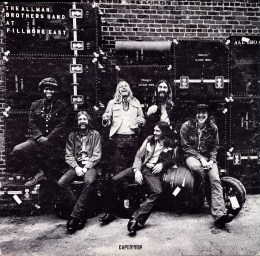 “The Allman Brothers Band At Fillmore East,” a double album culled from shows in March 1971, changed everything. It reached #13 that summer, and set the new gold standard for live recordings, both in terms of production quality and the sheer brilliance of the group’s performances. Blind Willie McTell’s “Statesboro Blues” became a signature tune; “Whipping Post” evolved into a 23-minute tour de force; the instrumental “Liz Reed” (as it is affectionately known) is regarded by many as one of the greatest live tracks ever recorded. Nearly a half-century after its release, the album still sounds fresh and original. The band quickly outgrew the regional Southern club circuit and became a top draw nationally. Duane’s vision was finally coming true.
 Gregg, who regarded Duane as a father figure, was devastated. Many observers predicted the group wouldn’t survive without their fallen leader. Indeed, even though the band regrouped only three weeks later and soldiered on (“The only way to deal with it was to play,” Gregg said), and Gregg rebounded by writing “Ain’t Wasting Time No More” in tribute, some still feel the band was never as good after Duane’s passing.
 reject, which he resented, causing him to record his impressive solo debut, “Laid Back,” that same year. It did well, peaking at #13, with outstanding tracks like “Queen of Hearts,” “Multi-Colored Lady,” a reworking of “Midnight Rider” and a remarkable cover of Jackson Browne’s “These Days.” During a break in the Allman Brothers’ tour, Gregg assembled his own touring band, complete with orchestral section, and even put out a live album afterwards to help recoup some of the touring costs.
 Cher in 1975, which turned him into a paparazzi target and subject of ridicule by the rock press. The marriage proved short-lived, although it spawned a son, Elijah Blue, and a forgettable LP.
 the Allman Brothers’ brand of music had fallen out of favor (although Gregg enjoyed a surprise solo hit in 1987 with “I’m No Angel,” carried by his distinctive vocals).
 Although the band called it quits in 2009 after a 40-year run, Allman continued to record and tour. His 2011 effort, “Low Country Blues,” performed better than any of the latter day Allman Brothers LPs, and his “Live: Back to Macon, GA” double CD featured a full horn section that offered surprisingly unusual takes on new blues and old classics.
 doing that a long time ago. He could play a solo that was just eight bars, but it was perfect. He played exactly what needed to be played, every time.”
 Hack's Back Pages