Hey dude, don’t make it bad
The premise is preposterous, but intriguing.
There’s a film out there at the moment called “Yesterday” that asks us to suspend our disbelief something fierce. We’re supposed to go along with the fantastical notion that a struggling young musician who is hit by a bus during a 12-second worldwide blackout regains consciousness and discovers that no one except him has ever heard of The Beatles nor their legendary catalog of songs.
Okay, folks, I gotta say: For me, this is a bridge too far.
Ever since February 9, 1964, when The Beatles appeared on “The Ed Sullivan Show” and upended my world, I confess that I have been obsessed with this incredible band, and more to the point, their music.
I bought all their albums (sometimes more than once), saw all their movies and learned how to play many of their songs on guitar. After their breakup in 1970, I followed their solo careers, but with far less enthusiasm because, frankly, their solo work simply wasn’t  as good (with a few exceptions). Instead, I found myself going back to The Beatles’ catalog over and over and over again.
I attended performances of “Beatlemania on Tour” in 1979-80; I bought and devoured many books about the band, particularly “The Beatles Recording Sessions,” with its detailed account of every single studio session; I watched, and bought on DVD, “The Beatles Anthology,” the official documentary of the group, and the three 2-CD packages of alternate takes and unreleased rarities; and I bought, again, all the original albums in CD format, and the remastered versions, and the Cirque du Soleil “Love” soundtrack.
Ask my friends and family, and they’ll wholeheartedly agree I am pretty much a walking encyclopedia of all things related to The Beatles’ music and career.
So the idea of a movie based on the idea that the group never existed is, for me, rather impossible to swallow. And yet, the plot of “Yesterday” hinges on that contrivance.
Hmmmm.
Okay, I thought, I’ll go along with this, just to see how badly they screw it up.
To my surprise and delight, I found the movie charming, clever, quite funny in parts,  bittersweet in others. It’s essentially just a simple love story, using Beatles tunes to advance the tale of two 20somethings who eventually find their way to each other.
All you need is love, indeed.
If you’re looking for a logical treatise, you won’t find it here. For instance: Are they saying Lennon and McCartney never met? And if they hadn’t, wouldn’t they have each written, on their own, some of the songs we know as Beatles tunes anyway? Surely a song like, oh, “Yesterday” would have made its way to the public consciousness just the same?
Sorry, this movie is not about pondering those kinds of questions, for it’s ultimately just a silly, amusing romantic comedy. If you drop any expectation or preconceived bias and accept “Yesterday” for what it is, you’re in for an entertaining couple of hours.
Going in, I was most concerned about whether the 16 Beatles songs you hear would be butchered in their re-execution. Incredibly, lead actor Himesh Patel, playing the central character Jack Malik in his debut role, does quite a fine job handling lead vocals as well. Granted, he’s singing the songs as if they’re his, and his audiences have never heard 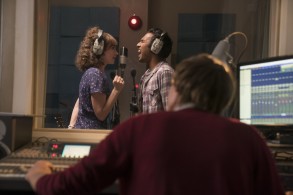 them before, so he isn’t trying to precisely duplicate the original recordings. His renditions come across convincingly.
Jack quickly sees that if no one knows The Beatles’ songs except him, he can pass them off as his own compositions and make a fortune. He plays “Yesterday” for his friends, and they compliment him for writing “the most beautiful song I’ve ever heard.” He tries “Let It Be” for his parents, who disrupt him with inane comments, and they keep thinking it’s called “Leave It Be.” In a just-for-fun songwriting competition with Ed Sheeran, he performs “The Long and Winding Road,” leaving Sheerhan gobsmacked, adding, “Jack, you are Mozart, and I am Salieri.”
 Much of the humor in the film comes from Jack’s inability to remember all the lyrics. He can’t go look them up on Google (although he tries to!), so he’s seen wracking his brain, jotting down bits and pieces on Post-It notes as the words come to him, and he even travels to Liverpool to visit Penny Lane, the Strawberry Field orphanage and Eleanor Rigby’s grave to see if that helps to jog his memory.
Then there’s the over-the-top performance by SNL’s Kate McKinnon as Debra Hammer, a stereotypically greedy, insincere, manipulative music agent urging Jack to “drink from the poisonous chalice of money and fame.” She has the audacity to suggest changing “Hey Jude” to “Hey Dude” because she thinks it will have more appeal to today’s market. She’s so wrapped up in her own agenda that  she can’t see how much Jack is wrestling with the dishonesty of what he’s doing.
Beneath all this, though, is Jack’s simmering relationship with Ellie, a friend since childhood who has had a crush on him since he sang Oasis’ “Wonderwall” in a school talent show as a boy. She supports his dreams of becoming a successful musician, managing his foundering career and giving him hope when he’s ready to give up.
It takes him a while, but eventually he sees that he can’t live with the guilt of fraudulently claiming Beatles tunes as his own. He has nightmares about appearing on James Corden’s show and being exposed as a phony by Paul McCartney and Ringo Starr. At his album release event before a throng of cheering fans, he freezes in panic, and then  belts out a truly terrifying rendition of “Help!”, singing, “Won’t you pleeeeease help me!!” at a breakneck tempo.
The movie’s most moving scene comes when he is sent to visit a reclusive John Lennon, living his life as a 78-year-old painter in a remote coastal village. Lennon reminds him of the two most important things in life, and they’re not fame and fortune: “Tell the truth to everyone, whenever you can. And be with the one you love.” This sound advice leads him to confess, after a performance of “All You Need is Love” before an enormous audience, that “his” songs actually belong to four guys named John, Paul, George and Ringo, and he directs his manager to download all the music for free for the world to hear.
The film ends with Jack, now a music teacher, leading a group of school kids singing “Ob- la-di, Ob-la-da.” Jack and Ellie have found happiness as Desmond and Molly Jones with a couple of kids running in the yard.
A bit too sweet for its own good? Sure. But hey, “Yesterday” is well worth your attention. It’s beautifully shot, smartly scripted and sensitively acted, and it serves to remind us all, as two Liverpudlians remind Jack near the film’s end, “a world without The Beatles is one that is infinitely worse.”
Even though I, for one, knew that already.
****************
Here’s a Spotify playlist of selections from the “Yesterday” soundtrack:
 Much as films were heavily censored in the ’30s, ’40s and ’50s to remove any scenes or dialog considered by industry watchdogs to be immoral, popular music in the first decades of the rock and roll era often came under the same sort of scrutiny by record company executives and radio programmers.
 Van Morrison’s beloved 1967 classic “Brown-Eyed Girl” raised eyebrows at the time because of the obvious sexual lyric “making love in the green grass behind the stadium with you” in the third verse. Most stations were reluctant to ban the whole song, so they simply removed that line and replaced it by repeating “laughing and a-running, hey hey” from the first verse, despite Morrison’s heated protestations.
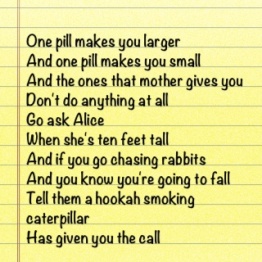 Many
Many 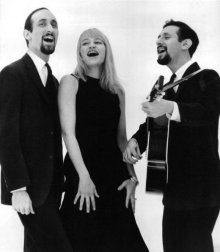 Sometimes the censors were totally off-base, interpreting an innocent children’s fairy tale like Peter, Paul & Mary’s “Puff the Magic Dragon” as a veiled reference to smoking weed. “Oh, for crying out loud,” said Peter Yarrow in 1963 when the song was released. “It’s just a children’s song, a story about a boy and a dragon.” But some stations in conservative areas blackballed it anyway, at least for a while.
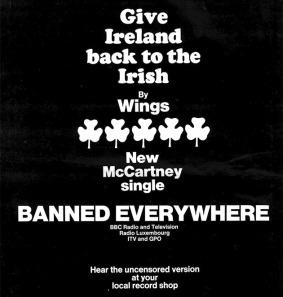 McCartney’s “Give Ireland Back to the Irish” (1972) were banned from the BBC for their perceived anti-government opinions.
 The BBC even had a firm rule against any
 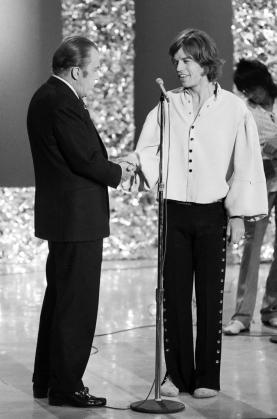 edgier acts to appear. First he booked those bad British brats, The Rolling Stones, and demanded that their brash young singer, Mick Jagger, change the words of “Let’s Spend the Night Together” to “Let’s Spend Some Time Together.” Jagger went along, but rolled his eyes at the camera each time he sang it.
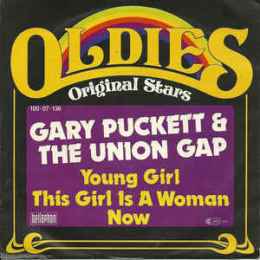 A couple of Gary Puckett songs in the late ’60s — “Young Girl,” “This Girl is a Woman Now” — focused on a creepy infatuation of a young girl by an older guy that, looking at it now, clearly bordered on pedophilia, but they somehow escaped the censors’ attention at the time. Even more curious was the case of The Buoys, a one-hit wonder group who had the sheer chutzpah to release a single in 1971 called “Timothy” that told the disturbing tale of three poor souls who were trapped in a caved-in mine, and two of the boys ate the third boy in order to survive!
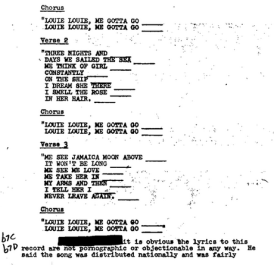 Perhaps the most extreme response to a supposedly objectionable lyric came in 1963 when a team of agents from J. Edgar Hoover’s FBI spent months investigating whether the words to The Kingsmen’s “Louie Louie” were obscene. Teens had furtively talked about how the lyrics were allegedly about a sexual liaison, but in fact, the song (written in 1957) was a rather bland ode from a sailor to his girl back home. Thanks to a marble-mouthed vocalist and less-than-optimum recording techniques, the words were pretty much impossible to decipher, even when studied at different speeds under headphones, and the FBI eventually threw up their hands.
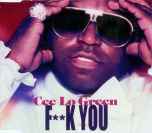 But that was then, this is now. In 2010, R&B artist CeeLo Green had an enormous hit with a song called, believe it or not, “F–k You.” They released a cleaned-up version called “Forget You” to satisfy radio programmers, but most listeners, to no one’s surprise, preferred the original.
