We’re bringin’ you back down home
Poor Poco.
When I mentioned to a few friends that I would be writing about Poco this week in memory of the passing of founding member Rusty Young last week, I was met with blank stares.
“Haven’t heard of them,” said one. “I know the name but don’t know a thing about them,” said another.
These were folks in their sixties, pretty music-savvy, and yet, they didn’t know Poco.
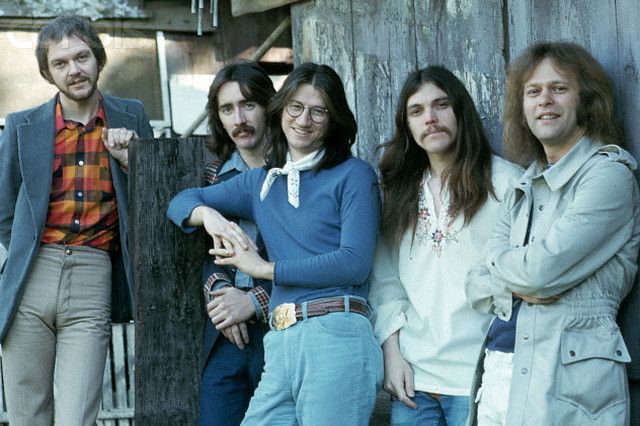
The band that can rightfully claim the title as one of the pioneer groups of country rock had a strong pedigree, a devout following, recorded many albums, and toured relentlessly. But the commercial success they chased remained, for a long time, elusive. That’s a damn shame, for Poco’s catalog includes some truly memorable songs and impressive musicianship, and they were known for turning in some exhilarating performances in concert.
If you’re a fan of country rock, perhaps this piece will reaffirm your appreciation of a talented band. If you’re new to Poco, let this be an opportunity to learn about a group that’s more than worthy of your attention.
*************************
Poco’s story begins among the ashes of the late, great Buffalo Springfield. Here was a Southern California band that played its rock and roll with more than a hint of country influence. Its members included Stephen Stills, Neil Young and Richie Furay, all multi-talented singers/songwriters/guitarists who offered up a dizzying array of uptempo electric folk (“Rock and Roll Woman,” “Sit Down I Think I Love You”), harmony-rich ballads (“Sad Memory”), spirited hit-single anthems (“For What It’s Worth”), esoteric rockers (“Bluebird,” “Mr. Soul”) and country-pickin’ ditties (“Go and Say Goodbye,” “A Child’s Claim to Fame”) in a dazzling stew that filled two strong LPs in 1966 and 1967.
But all was not well. Neil Young was a difficult maverick who quit and rejoined the band and quit again, eager to blaze his own trail, and bassist Bruce Palmer was deported to his native Canada for marijuana possession. Stills grew frustrated by the band’s instability and found himself drawn to making music with ex-Byrd David Crosby.

Jim Messina, Neil Young, Richie Furay, Stephen Stills
The group’s third and final album, released to fulfill a contractual obligation even though the group had essentially disbanded, included only one song that featured the whole group. If not for the efforts of engineer Jim Messina, who became the group’s bass player in the waning days, the album might have never seen the light of day. Among the strong gems on this underrated LP (“Last Time Around”) is a wonderful country ballad by Furay called “Kind Woman,” which featured pedal steel guitar by contributing musician Rusty Young.
In late 1968, Furay and Messina decided they enjoyed each other’s company and musical leanings, and recruited multi-instrumentalist Young (pedal steel, banjo, dobro, guitar) to form a new band. Said Young, “It seemed natural to think, “What if we take this in a country direction? We’ll take rock and roll songs, but the palette that we’ll add to it will be with country instruments. We’ll be using traditionally country instruments to play rock and roll, and not playing the typical country thing.”
With the addition of Randy Meisner on bass and George Grantham on drums, Poco was born. Furay wrote virtually every song on the new group’s debut album, appropriately titled “Pickin’ Up the Pieces” (from the Springfield’s demise). Originally calling themselves Pogo, the band was faced with a cease-and-desist order from cartoonist Walt Kelly (creator of the comic strip “Pogo”), so they altered their name to Poco, just in time for their first concert at the famed Troubadour in Hollywood. Critical praise came immediately — “Poco is the next big thing,” said the L.A. Times — but on the charts, there were no singles and only a modest #63 peak for the album.
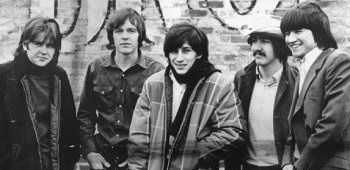
While one critic called it “a great record, a landmark in country rock,” I tend to agree with The Village Voice‘s Robert Christgau, who wrote, “Nice and happy, but, considering the personnel, a disappointment.” To my ears, the production sounds thin, and many of the songs just don’t grab me, especially when compared to what Furay’s former band mates were releasing at about the same time in mid-1969 (the “Crosby, Stills and Nash” LP and Young’s “Everybody Knows This is Nowhere”).
Meisner was unhappy with what he felt was Furay’s dictatorial manner and split Poco early, heading first for Rick Nelson’s Stone Canyon Band and eventually becoming a founding member of The Eagles, who had instant commercial and critical success with their 1972 country rock debut. Meisner’s replacement in Poco was Timothy B. Schmit, whose strong tenor voice bolstered the three-part harmonies that were so integral to Poco’s sound.
In 1970, the band’s second effort, entitled simply “Poco,” should’ve been the one that made them stars. Messina’s spunky “You Better Think Twice,” which stiffed at #72 on US pop charts, was one of the great shoulda-been hits of that era. “These songs represent Poco’s blend of country and rock at its finest and brightest,” said Allmusic critic Bruce Eder, “with the happy harmonies of ‘Hurry Up’ and ‘Keep on Believin” totally irresistible.” Most notable to me is the startling 18-minute “El Tonto de Nadie, Regresa,” a top-notch instrumental jam featuring Rusty Young’s unparalleled pedal steel guitar, played through a Leslie speaker to make it sound more like an organ.

But the album managed only #58, while Crosby, Stills, Nash and Young were topping the charts with their “Deja Vu” album featuring Nash’s sweet countryish hit “Teach Your Children.” This gnawed at Furay and made him unpleasant to deal with, according to Messina. “With Poco, Richie wanted to be as big as Crosby, Stills & Nash. I’m not saying that’s right or wrong, but there were, and are, no guarantees in the music business. To think that way was a sabotage of every aspect of what we were trying to do.”
The radio stations said they weren’t sure about Poco. “Too country for rock stations, too rock for country stations” was the knock on Poco that seemed to limit airplay. Although the live album “Deliverin'” in 1971 broke the Top 40 and reached #26, Furay’s expectations continued to place a strain on the band, Messina said.
“I became frustrated because Richie was frustrated. This was the guy in the band who I loved and I still do love, who I looked up to and admired, and I just could not understand his behavior. It scared me, and I had to get out of the way.” And with that, Messina was gone, returning to producing, eventually partnering with singer-songwriter Kenny Loggins as Loggins and Messina for a successful run (1971-1977).

and Young (seated)
Taking over lead and rhythm guitar duties was Paul Cotton, a strong singer and songwriter as well, who became a mainstay in the group’s lineup pretty much ever since. His song “Bad Weather” was one of the highlights of the next LP, “From the Inside,” which, along with Furay’s pretty “What If I Should Say I Love You,” showed a lighter, more reflective approach. Still, the album peaked in the mid-50s on the charts, and again, no single.
Ardent fans, sometimes known as “Poconuts,” argued, “Who cares if there’s no single? We love Poco’s albums, all of them, every track.” But the bitter fact of the music business is you need a hit single to earn your keep, sell more albums and tickets, and survive.
Furay, growing more and more disconsolate, stuck around for two more albums (1972’s “A Good Feeling to Know” and 1973’s “Crazy Eyes”) but their inability to improve the band’s standings in the charts were the last straw. Poco would have to soldier on without him, for he had agreed to mogul David Geffen’s offer to sign him to a new trio called Souther-Hillman-Furay Band with songwriter John David Souther and ex-Byrd Chris Hillman. (That outfit lasted only two modestly successful albums, during which Furay converted to evangelical Christianity and essentially quit the music business.)
I first saw Poco in concert right after Furay left, in 1974. Admittedly, I’d gone to see fellow country rockers Pure Prairie League, who were the warmup act, but I left with a solid appreciation for Poco’s musicianship. I saw them a second time in 1976 when they were the warmup for the fleeting project known as Stills-Young Band. Neil Young was in an ornery mood and Stills seemed out of it, which meant Poco pretty much stole the show that night.

Poco was now Rusty Young’s and Paul Cotton’s band, with Schmit and Grantham as the rhythm section and on backing vocals, and this quartet lineup made some of the best music in Poco’s catalog. “When Richie exited the group, it left room for another songwriter,” said Young. “I had always been just an instrumentalist, but I really thought I could write songs too, so I started writing then. Paul and Timothy were better at it, I think, but I enjoyed it, and a few of mine made it onto those Poco albums, which I’m proud of.”
They still struggled in the singles market, and the albums never fared better than the mid-40s, but the songs were getting more interesting, more accomplished instrumentally, more melodious, more richly produced. Listen to the warm feeling of Schmit’s “Find Out in Time,” or Cotton’s acoustic guitar-driven “Too Many Nights Too Long,” or two of Young’s first attempts at songwriting, “Sagebrush Serenade” and “Rose of Cimarron.” Really great stuff.


Epic Records had dropped the group in 1975, and ABC-Dunhill stepped in to keep Poco afloat through this period. Then fate intervened in 1977 when, following the release of the fine “Indian Summer” album, Schmit announced he had accepted an offer to join The Eagles, coincidentally replacing Meisner again. Poco decided the time was right to take a break, with Young and Cotton choosing to collaborate as a duo called the Cotton-Young Band. Once the material was written and recorded, however, ABC execs changed their minds and insisted the album be released as the latest Poco album, entitled “Legend.”

Lo and behold, ten years after Poco’s formation, they finally had a hit single with “Crazy Love,” written and sung by Young. “When Timothy left to join The Eagles, it left room for me to also sing the songs I was writing. So the funny thing is when we started the band, I didn’t sing and I didn’t write, and we never had a hit, but by 1978, it was a song I wrote and sang that became a hit. Unbelievable.”
“Crazy Love” reached #17 on the pop charts, and also was #1 for five straight weeks on the new Adult Contemporary chart, which helped push the album into the Top 20, peaking at #14. A follow-up single — Cotton’s tribute to New Orleans, “Heart of the Night” — also cracked the Top 20. Poco had arrived.
As Young put it 30 years later to an interviewer, “The only reason you and I are talking now is ‘Crazy Love.’ It’s a classic, and it still pays the mortgage.”
Young added, “At first, Poco always wanted to take the idea of country rock further, and for a while, we were popular on FM radio, but we didn’t cross over to AM with hit singles like The Eagles did. They were a lot smarter, writing songs tailored for that market. They really captured the country rock sound. ‘Crazy Love’ finally gave us a hit, but it was more light pop rock than country rock.” Indeed, how strange that Young’s tasty pedal steel guitar, a trademark of Poco’s sound through the years, is glaringly absent from their biggest hit.
The 1980 follow-up LP, “Under the Gun,” cracked the Top 50, as did two Cotton-written singles, the sweet “Midnight Rain” and the rockified title track, but from there, each album performed more poorly than its predecessor. Cotton and Young remained in charge, but the rest of the lineup changed several times, as did their record label. By 1982’s “Ghost Town” and 1984’s “Inamorata,” the band was using synthesizers and drum machines, which were in vogue at the time but a million miles from the traditional Poco sound. They still toured, but the venues were smaller and the gigs fewer.
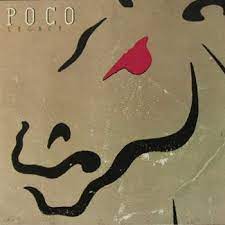
In 1989, backed by RCA Records, the original lineup of Poco (Messina, Furay, Young, Meisner and Grantham) reunited for “Legacy,” a welcome surprise that reached #40 on album charts, thanks to the #18 hit single “Call It Love,” with Young again on lead vocals. The leadoff track, “When It All Began,” was a nostalgic look back at the band’s genesis, with these lyrics by Furay: “I remember the feeling, not so long ago, /The kids came dancin’, their hearts were romancin’, and the music was live Poco, /Some called it country, some called it rock and roll, /But whatever the sound, it was sure to be found with a heart, rhythm and soul…”
The reunion turned out to be only a short-lived phase, with Furay, Messina and Meisner all returning to their individual careers again.
Through the 1990s and 2000s, Young kept the Poco name out there by assembling various touring configurations that included Cotton and guitarist Jack Sundrud, among many others. Furay and/or Messina would occasionally join them for one-off concerts. Young finally chose to retire in 2013, bringing the Poco story to an end.
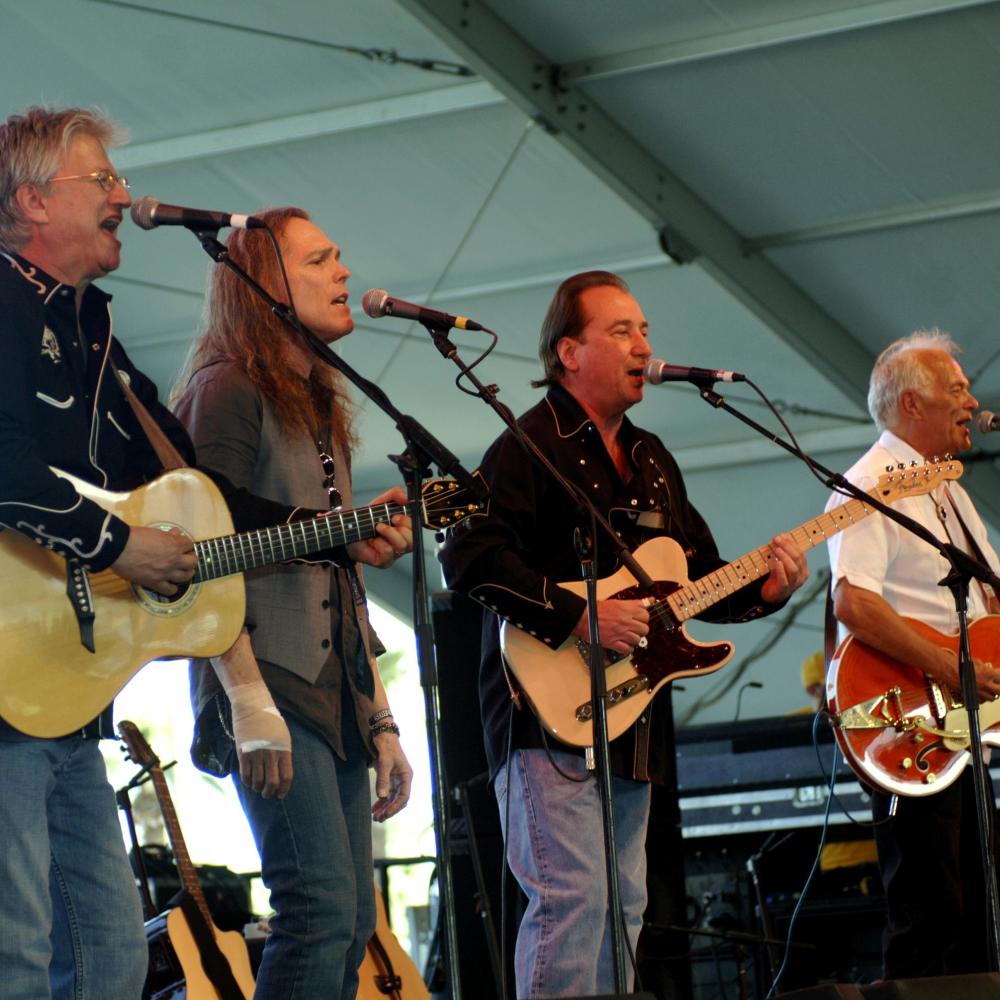
(with Young off camera) at a 2002 show
Poco may not be inductees in the Rock and Roll Hall of Fame, but the band is prominently featured in an historical country rock exhibit in the Country Music Hall of Fame in Nashville.
Young’s death last week brought Poco back into the public eye, giving me the opportunity to tell their tale, and Young’s memories of how his pioneering pedal steel guitar playing evolved.

“In a music store in Denver in the mid-’60s, I met a guy named Donny Buzzard, who was my hero,” Young recalled. “He was a brilliant musician, and he introduced me to all kinds of stuff. He said, ‘You can try playing the steel with a comb, and it will sound like a tack piano.’ Or ‘You can run it through a fuzz tone and listen to what that sounds like.’ Or ‘Run it through a Leslie speaker.’ He just opened my eyes to the fact that the pedal steel is an instrument that can do anything, and it shouldn’t be limited to just country and western music. So I decided to take off with what Donny had showed me, and the rest is history.”
*****************
Here’s a playlist I assembled of three dozen songs from throughout Poco’s admirable career. Give it a listen!




 Hack's Back Pages