He’s a dedicated follower of fashion
When they talk about Sex and Drugs and Rock and Roll, they should’ve added Fashion. The clothes you wore, the styles you presented in performances and other appearances, had a lot to do with establishing your image and reputation.

Early rockers like Elvis and Little Richard wore loose suits and shiny shoes. The Beatles wore matching suits and “Beatle boots.” By the mid-Sixties, Jimi Hendrix and Janis Joplin were wearing flamboyant sashes and boas. There was David Crosby and his fringe jacket, Creedence and their flannel shirts, Simon and Garfunkel and their turtlenecks.

Rock fashion exploded in the ’70s with ever more outlandish examples: David Bowie’s Ziggy Stardust costumes, Elton John’s platform shoes and wild eyeglasses, Donna Summer’s radiant jumpsuits, Stevie Nicks’ Welsh witch capes and top hat. The ’80s brought Michael Jackson’s one sequined glove and fedora, Madonna’s excessive jewelry and pointy bras, Prince’s head-to-toe purple outfits. The MTV culture enabled an “anything goes” approach for many artists hoping to grab attention and get airtime.

Songwriters have sometimes written about the appeal of certain fashion choices and trends, so I have taken the liberty of compiling a list of 15 songs that mention clothing of various types in the title. It’s a fun playlist I encourage you to check out.
*******************
“Blue Suede Shoes,” Carl Perkins, 1956
 In December 1955, as Perkins was performing at a dance, he noticed a couple dancing near the stage, and the guy said, “Uh-uh, don’t step on my suedes!” He thought it was amusing that the guy was more worried about his shoes than his pretty dancing partner. Two weeks later, he wrote a song about it, recorded it a couple days after that, and Sun Records released it in February 1956. It ended up at #2, kept out of the top spot by Elvis Presley’s first #1 single, “Heartbreak Hotel.” Presley also recorded “Blue Suede Shoes” and released it as the first track on his RCA debut album, which helped sales of Perkins’ version considerably.
 “You Can Leave Your Hat On,” Joe Cocker, 1986
Songwriter extraordinaire Randy Newman came up with this sexy song for his 1972 LP “Sail Away,” but he always felt he hadn’t done it justice. It took nearly 15 years, but Joe Cocker finally recorded the definitive version with an R&B piano, full horn section and backing vocals. It is considered a classic striptease song, thanks especially to the first verse: “Baby, take off your coat…real slow, /Baby, take off your shoes…here, I’ll take your shoes, /Baby, take off your dress, yes, yes, yes, /You can leave your hat on…” It never mentions a specific kind of hat, but I’ve always pictured a fedora.
 “Wet T-Shirt,” The Bellamy Brothers, 1979
This brothers duo from Florida was a big deal in country music in the ’70s and ’80s, scoring 20 #1 singles on the country charts. Rock fans may remember them from their #1 crossover hit, “Let Your Love Flow,” in 1976. On their 1979 LP, “The Two and Only,” David Bellamy came up with a crowd pleaser called “Wet T-Shirt” that whimsically summarized the “good clean fun” that went on (and no doubt still goes on) in many country bars around the country. The record features a guy named Danny Jones, who plays some mighty sweet pedal steel guitar as the brothers harmonize.
“Devil With a Blue Dress On/Good Golly Miss Molly,” Mitch Ryder and The Detroit Wheels, 1966
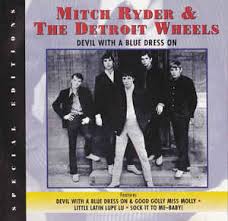 “Shorty” Long and Mickey Stevenson, a couple of singer/songwriters from one of Motown’s subsidiary labels, collaborated to write and record “Devil With the Blue Dress” in 1964, but their version failed to chart. In 1966, Ryder and his band came up with a rendition that tied “Blue Dress” together with Little Richard’s potent “Good Golly Miss Molly,” and the record made its way to #4 on the pop charts. Its position as a timeless classic was further cemented when Bruce Springsteen and The E Street Band made it a staple of their concert set list, and their live recording appears on the 1979 “No Nukes” extravaganza.
“Sucker in a 3-Piece,” Van Halen, 1988
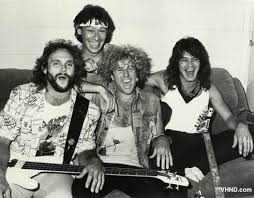 Rock musicians have always showed disdain for “the suits” — the corporate guys from the record label who try to insert their unhip ideas into rock and roll production. On “OU812,” Van Halen’s second album with Sammy Hagar on vocals instead of original singer David Lee Roth, critics hailed it as “a veritable feast of great white rock and roll wow.” One example is “Sucker in a 3-Piece,” a putdown of a “suit” who offers his girl money but little else: “I got everything you wanted, give you everything you need, /Still, you want that sugar daddy over me, /She want a sucker, a sucker in a 3 piece, /A sucker all dressed up in a 3 piece suit…”
“Long Cool Woman (In a Black Dress),” The Hollies, 1972
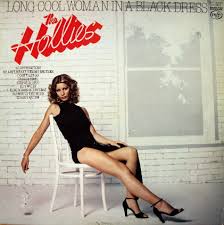 Enormously successful in the UK but less so in the US, The Hollies relied on Allan Clarke and Graham Nash, who took turns on lead vocals and songwriting. In 1971, now without Nash, they recorded “Long Cool Woman” in the “swamp rock” style of Creedence, and Clarke sang it like CCR vocalist John Fogerty. It wasn’t intended as a single, but their US label released it in the summer of ’72 and it reached #2 on the charts with great guitar and lusty lyrics: “A pair of 45’s made me open my eyes, My temperature started to rise, /She was a long cool woman in a black dress, just 5’9″, beautiful, tall,/With just one look I was a bad mess, ’cause that long cool woman had it all…”
“Coat of Many Colors,” Dolly Parton, 1971
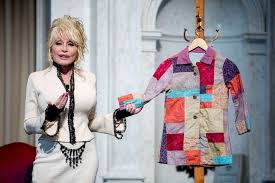 The amazing Parton has written about a thousand songs, but the one she treasures the most is this one, the title track from her third solo album after her amicable split from Porter Wagoner in 1971. The gentle tune tells of how Parton’s mother couldn’t afford to buy a new coat for her daughter, so she stitched together a coat made from rags. As she sewed, she told her child the biblical story of Joseph and his coat of many colors. Dolly, “with patches on my britches and holes in both my shoes,” rushed to school, “just to find the others laughing and making fun of me” for wearing a coat made of rags. It’s a marvelous, emotional song.
“These Boots Are Made for Walking,” Nancy Sinatra, 1966
 Regarded then and now as a song of female empowerment, this infectious hit single was written by Lee Hazlewood, who intended to sing it himself until Sinatra talked him out of it. “Coming from a guy, it was harsh and abusive, but was perfect for a girl to sing,” she noted, and she was right. Not only did it reach #1 in the US and the UK, it helped spark sales of fashionable boots for women to go with their miniskirts in the mid-Sixties. Since then, artists ranging from Billy Ray Cyrus to Megadeth have released their own radically different versions, and the song has been used in countless films and even a few ad campaigns.
“Slit Skirts,” Pete Townshend, 1982
 As The Who were winding down their careers as recording artists, Townshend was doing more on his own. He’d released his “Empty Glass” LP in 1980, then followed it up with “All the Best Cowboys Have Chinese Eyes” in 1982, in between making the final two Who studio albums (“Face Dances” and “It’s Hard”). The lyrics to tracks like “Slit Skirts” read like journal entries, full of wordy verses about his troubled personal life, broken relationships and his dread of aging: “Slit skirts, Jeanie never wears those slit skirts, /Wouldn’t be seen dead in no slit skirt, /I don’t ever wear no ripped shirts, /Can’t pretend that growing older never hurts…”
“Diamonds on the Soles of Her Shoes,” Paul Simon, 1986
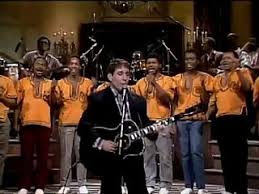 For his celebrated “Graceland” LP, Simon featured the compelling rhythms he heard from indigenous musicians in South Africa, using them to craft accessible pop songs with whimsical lyrics. On “Diamonds,” which he called his favorite on the album, Ladysmith Black Mambazo provided wonderful vocals in support of Simon’s simple tale of “a rich girl, she don’t try to hide it, she got diamonds on the soles of her shoes.” Said Simon, “That’s all there is to it, really. I came right out and said so: ‘And I could say ooh, ooh, ooh, as if everybody would know exactly what I’m talking about…’”
“Man in the Long Black Coat,” Bob Dylan, 1989
 Within Dylan’s voluminous catalog, there are few songs that match the dark mood and imagery he summons in this stunning track from his well-received 26th LP, “Oh Mercy.” In countless films and television shows, if there’s death and despair on your doorstep, it often appears as a man in a long black coat, waiting in the shadows to do you harm. Dylan called the recording “menacing,” with lyrics that paint a picture of his lover falling under the spell of this mystery man: “Crickets are chirpin’, the water is high, /There’s a soft cotton dress on the line hangin’ dry, /Not a word of goodbye, not even a note, /She gone with the man in the long black coat…”
“High Heel Sneakers,” Tommy Tucker, 1964
 Here’s another example of an early rock and roll song that mentions items of clothing to set the stage for an evening out on the town. The narrator asks his girl to wear a red dress, but also bring some boxing gloves “in case some fool might want to fight.” Most important are her high heel sneakers, evidently a good choice for dancing. Robert Higginbotham, whose stage name was Tommy Tucker, wrote and recorded the tune in 1963, and it reached #11 in March 1964, just as The Beatles began their dominance of the U.S. charts. Three decades later, Paul McCartney recorded the song on his 1991 “Unplugged” album.
“Gold-Tipped Boots, Black Jacket and Tie,” Jethro Tull, 1991
 Ian Anderson, the supreme showman who led Jethro Tull to the top of the charts in the ’70s, was still at it years later when the band released this self-deprecating tune from Tull’s “Catfish Rising” LP in 1991. As the lyrics explain, Tull was very popular, then not so much in the ’80s, but they turned things around somewhat for a four-album stretch, and he’s wearing fashionable duds now: “Well, I’ve been second to none, this horse was ready to run, /Now I’m has-been and used, disarmed and de-fused, /But I’m turning again, yes, and I’m turning again, /Wearing gold-tipped boots, black jacket and tie…”
“Bell Bottom Blues,” Derek and The Dominos, 1970
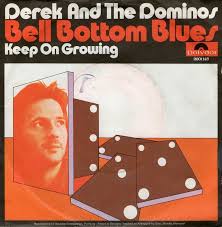 In 1970, Eric Clapton had fallen in love with Pattie Harrison, ex-Beatle George’s wife, which caused Clapton considerable angst and heartache, because his feelings were not reciprocated by her (at least not right away). He wrote several songs about it, including the iconic “Layla” and this powerful track from the “Layla” album. Pattie had mentioned to Clapton how she loved bell-bottom jeans, so when he was on a US tour, he bought her several pair. You can hear the anguish as he sings these lyrics: “Bell bottom blues, you made me cry, /I don’t want to lose this feeling, /If I could choose a place to die, it would be in your arms…”
“Itsy Bitsy Teeny Weeny Yellow Polka Dot Bikini,” Brian Hyland, 1960
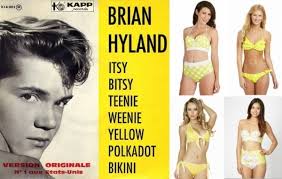 In 1946, a Paris designer came up with the skimpy two-piece women’s swimsuit that he named after the Bikini Atoll in the South Pacific where nuclear bomb tests were held, hoping his creation would have the same explosive effect on culture. That didn’t happen for another 15 years, when the wild and freewheeling Sixties arrived. But in 1960, it was still very risqué on most beaches, which is why Hyland’s bossa nova novelty tune “Itsy Bitsy” made such a big impression, reaching #1 that summer in the US and a half-dozen other countries. About a hundred artists around the world recorded cover versions in numerous languages.
*********************
Honorable mention:
“Zoot Suit Riot,” Cherry Poppin’ Daddies, 1990; “Those Shoes,” The Eagles, 1979; “Saturday Clothes,” Gordon Lightfoot, 1970; “Leopard Skin Pillbox Hat,” Bob Dylan, 1975; “Famous Blue Raincoat,” Leonard Cohen, 1971; “I Love My Shirt,” Donovan, 1969; “Raspberry Beret,” Prince, 1983; “Leather Jackets,” Elton John, 1986; “Forever in Blue Jeans,” Neil Diamond, 1971.



 Hack's Back Pages