In 1949, a gifted singer from Queens who was working under the stage name Joe Bari was invited to perform as a warm-up act for comedian Bob Hope. Before the curtain went up, Hope asked the young man his real name. “Anthony Dominick Benedetto,” he replied, to which Hope responded, “Then let’s call you Tony Bennett. And may I offer you some advice? Always take the stage with a smile.”

Five, six, even seven decades later, this man was still smiling whenever he performed or recorded the timeless songs he cherished from the Great American Songbook, and it helped him attract a new generation of fans who seemed to embrace him as enthusiastically as the audiences in the ’50s and ’60s had.
Bennett, perhaps the last of the original group of song stylists from that bygone era of popular music, died last week at age 96. His expressive voice came wafting out of the speakers of my father’s hifi in the early ’60s right next to Frank Sinatra and Nat King Cole, and, at the age of seven or eight, I came to appreciate the songs he sang and, particularly, the way he sang them — with rare gusto and extraordinary control.
Because this blog focuses on rock music of the ’50s through the ’80s, you might think Bennett isn’t the sort of artist to whom I would pay tribute. Bennett (like Sinatra) didn’t care for rock music when it arrived and didn’t mince words about it. But he was a devotee of swing and Big Band, two exhilarating genres that helped give birth to rock and roll, and I’ve never been one to shy away from paying respect to rock’s early influences.

In an appreciation published in The New York Times, Jon Pareles succinctly captured Bennett’s approach: “He wasn’t an old-fashioned crooner; his sense of swing was just as strong. He understood that pure virtuosity can keep listeners at a distance. He soon revealed a grain in his voice that made it earthy and approachable, downplaying his precision. Very often, there was a jovial savvy in his phrasing; he’d punch out a note ahead of the beat, as if he couldn’t wait to sing it.”
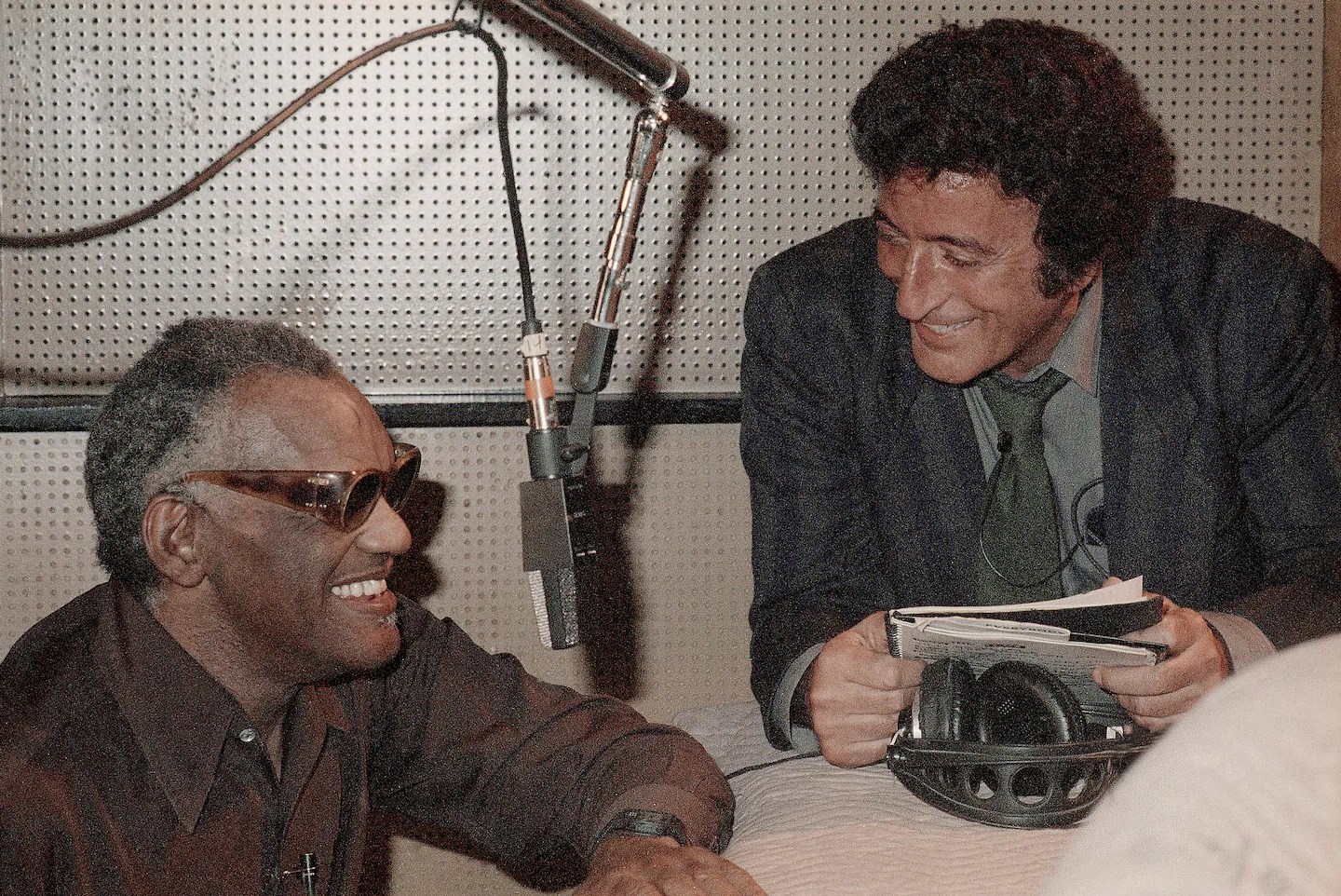
That’s what has appealed to me and, apparently, to dozens of other popular singers as well, who lined up for the chance to sing duets with Bennett on a half-dozen albums he recorded between 2001 and 2021. Ray Charles, Paul McCartney, B.B. King, Bonnie Raitt, Billy Joel, k.d. lang, Barbra Streisand and others added their vocals to tracks on Bennett’s releases of that period. Improbably, his 2006 LP “Duets: An American Classic,” released to commemorate his 80th birthday, reached the Top Five on the US album chart and won a Grammy for Best Traditional Pop Vocal Album. It featured 20 collaborations with not only modern-day crooners like Diana Krall and Michael Bublé but bonafide rock/R&B singers such as Bono, Elton John, Stevie Wonder and Sting.
He topped that effort with “Duets II” in 2011, which reached #1 and included pairings with an even broader range of singers, from Queen Latifah to Willie Nelson, from Amy Winehouse to John Mayer. Perhaps Bennett’s most impressive achievement came at age 88 with 2014’s “Cheek to Cheek,” another chart-topper, this time exclusively with Lady Gaga. He became the oldest artist to score a #1 album.
How did this happen? In the 1970s, it appeared Bennett’s career was on an inexorable downslide, viewed by many as unhip and passé. His misguided attempts at singing Beatles songs and other contemporary fare did poorly on the charts and were ridiculed by critics. Even though critics praised his partnership with noted jazz pianist Bill Evans on some challenging material in the mid-’70s, both LPs failed to chart at all. By 1980, struggling with divorce and cocaine addiction, Bennett’s professional and personal life were in crisis.
Enter son Danny Bennett. He too had taken a stab at a career in music, but he quickly concluded that his head for business and finance would not only serve him better but would also make him a savvy manager to help right his father’s foundering ship. The younger Bennett got his father’s expenses and IRS debts under control, moved him back to New York City, and began booking him in colleges and small theaters to get him away from the dreaded “Vegas” image. He also aided in forging a reunion between Bennett and his longtime pianist and musical director Ralph Sharon, and got his father re-signed to Columbia Records in 1986.

Danny Bennett lobbied hard on his dad’s behalf, getting him booked on late night TV shows like David Letterman and Conan O’Brien, which appealed to younger audiences. These appearances led, famously, to a starring spot on the “MTV Unplugged” series in 1994, and the accompanying album actually won Album of the Year, one of the most prestigious Grammy awards. Bennett recalled years later, “It began to dawn on me that young people had never heard the songs of Cole Porter, Gershwin, Johnny Mercer —they were like, ‘Who wrote that?’ To them, it was different, and they loved that. If you’re different, you stand out.”
Younger artists like Linda Ronstadt and Carly Simon had sparked a revival of the Great American Songbook with tenderly rendered albums in the ’80s, but Bennett was the real deal. Just as important was his relentlessly joyous stage presence. He always, always, seemed to be having such a great time, and audiences respected his cool nonchalance and refusal to give in to newer styles and fads. He was “OG” before that was a thing.
Artists who have had storied careers inevitably have what is considered their “signature song,” one tune for which they’re best known and identified, and they sometimes come along unexpectedly. For Bennett, this happened in late 1961, when his pianist Ralph Sharon suggested he try an appealing song he’d come across. It was by an unknown songwriting team from San Francisco who had relocated to New York with big dreams but grew homesick for their West Coast home town. Bennett recorded “I Left My Heart in San Francisco” in one take, and it was placed on the B-side of a single that was mostly ignored…but disc jockeys took notice and began playing the B-side instead. As luck would have it, Bennett sang the song on the debut show of “The Tonight Show Starring Johnny Carson” in 1962, and it became a best-selling hit and the Record of the Year Grammy winner.

Sinatra, who had been Bennett’s role model in his early days, had this to say in 1965: “For my money, Tony Bennett is the best singer in the business. He excites me when I watch him. He moves me. He’s the singer who gets across what the composer has in mind, and probably a little more.”
Country singer Tim McGraw, who sang a Hank Williams song with Bennett on the “Duets” LP, said, “I know the words to ‘Cold, Cold Heart’ by heart, but I was shaking so bad standing three feet from him that I had to hold on to the lyric sheet to try to steady myself. He was such a gentleman and such a presence. It was the thrill of a lifetime for me.”

There’s no better evidence of what an icon Bennett became in his 70s and 80s than the fact that actor Alec Baldwin did a spot-on parody of Bennett’s nonstop optimism in several appearances on “Saturday Night Live,” once with Bennett standing right there next to him.
A side of Bennett not as well known was his belief in and quiet participation in the civil rights movement of the 1960s. He had been a witness to the way black entertainers like Duke Ellington and Nat King Cole were treated in many places at that time, “and it enraged me,” he said. “I’d never been politically inclined, but these things went beyond politics. Nate and Duke were geniuses, brilliant human beings who gave the world some of the most beautiful music we’ve ever heard, and yet they were treated like second-class citizens.”
Bennett was also a talented painter, whose work fetched impressive sums and kept him busy crerating when he wasn’t on tour or in the recording studio. What did he paint? “My friend Bill Evans told me, ‘Just think truth and beauty. Forget about everything else.’ I took that advice to heart in song and in art, and it has served me well. I’ve seen both go out of style but they always come back in vogue again.”

Lady Gaga recalled how Bennett offered her some invaluable advice of his own. In 2014, she admitted to Parade Magazine that she had felt like giving up on music because some people in her inner circle had become “irrational” with regard to money and what they expected from her. “I was so sad. I couldn’t sleep. I felt dead. But then I spent a lot of time with Tony, and he wanted nothing but my friendship and my voice,” she said. “Tony said to me, ‘I’ve never once in my career not wanted to do this. Not once.’ It stung at first, and it made me defensive. But his words renewed my purpose. I told Tony many times since that day that he saved my life.”
R.I.P., Tony. We’ve all shed a tear at your passing, but the whole world smiles with you.

***********************************
The Spotify playlist below includes 15 songs from Bennett’s early years of success, but I thought it instructive to focus more heavily on the many duets he cut in the later, even more impressive chapter of his life.
 Hack's Back Pages
An excellent recap, Bruce, of a singular talent with a voice for the ages. Although is gone, thankfully he gave humanity a rich library of his achievements.
LikeLike
Great description of how he inspired, collaborated, and was admired by contemporary artists.
Get Outlook for iOShttps://aka.ms/o0ukef ________________________________
LikeLike