I love the night life, I’ve got to boogie

I’ve mentioned it in passing. I’ve alluded to it. I’ve, um, danced all around it. Now the time has come to give it its due, to address it head on.
Disco.
From roughly 1974 to 1980, nothing was more polarizing on the popular music scene than disco. If dancing was your thing, disco was just about the greatest thing ever invented. If not, well, “Disco Sucks,” as the t-shirts and bumper stickers said.
(Full disclosure: I was and still am a rock ‘n roller and have little use for disco…except on those very rare occasions when I’m actually on a dance floor cutting a rug with a lovely lady. I concede that certain great disco tracks bring back great memories and are fun to hear, but as a genre, well, it just isn’t for me.)
Love it or hate it – and there seemed to be almost no middle ground – disco brought about a mini-revolution, however brief, that affected a broad swath: The Top 40 charts (both albums and singles), the dating scene, fashion, recreational drug use, the perception of gay life, films, even exercise and health.
In many ways, disco music wasn’t all that revolutionary. It naturally evolved from rhythm and blues, and Motown, and soul, and funk. It was music you could dance to. It was music you HAD to dance to. It was not music you sat around and listened to.
 Disco is actually an abbreviation for discotheque, a French term meaning “phonograph library.” In 1950s Paris, nightclubs began eliminating live bands and instead laid down dance floors, suspended colored lights, and replaced the jukebox with two turntables on which a deejay would continuously play pre-selected dance music with no breaks, keeping the clientele dancing all night long. During the ’60s in major US cities, this concept morphed into New York clubs like The Peppermint Lounge, where go-go dancing was the hot new thing, and Arthur’s, generally regarded as the first and foremost discotheque in town.
By the early 1970s, when a majority of the rock ‘n roll generation seemed to prefer less danceable forms of music (hard rock, psychedelic blues, country rock, singer-songwriter acoustic rock), a burgeoning underground movement was born on backstreets in converted warehouses and lofts, where oppressed groups like gays, Blacks and Latinos could push the boundaries of what was acceptable on and off the dance floor. Essentially, these discos were exciting escapes where fantasies, sexual and otherwise, could be explored away from public scrutiny.
 Most observers agree disco music entered the mainstream in 1973 or 1974, with songs like George MacRae’s “Rock Your Baby,” Barry White’s “Can’t Get Enough of Your Love Babe,” The Hues Corporation’s “Rock the Boat,” Gloria Gaynor’s version of the Jackson 5 hit “Never Can Say Goodbye” and especially Donna Summer’s “Love to Love You Baby,” a 16-minute, multi-part extravaganza that took dancers on an emotional groove ride. Also key were two instrumental tracks that reached #1 in 1974: “Love’s Theme” by Love Unlimited Orchestra and “TSOP (The Sound of Philadelphia)” by MFSB, which served as the theme song for the hugely popular TV dance show “Soul Train.”
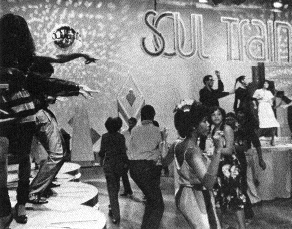
So what exactly differentiated disco music from the early ’70s soul and funk practiced by The O’Jays, Curtis Mayfield, The Staples Singers and others? The defining characteristic was over-the-top production with layers of lush strings and synthesizers, with heavy use of high-hat drums and a bass line so prominent it often served as the main melody. Lead guitar, which ruled the roost in almost all hard rock tracks, was almost non-existent, replaced by chunky rhythm guitars and a horn section. The final element was a soaring vocal with grand backing harmonies, singing repetitive lyrics usually focusing on dancing and romance. And sex.
 The promise of sex went hand in hand with disco. It always was either implied or blatantly stated, from KC and the Sunshine Band’s relentless chorus “Do a little dance, make a little love, get down tonight” to the sensual grooves reinforcing the message in Johnnie Taylor’s “Disco Lady”: “Move it in, move it out, shove it in, round about, disco lady…”
 Momentum continued to build in 1975 and 1976: Van McCoy’s “The Hustle,” Silver Convention’s “Fly Robin Fly,” Labelle’s “Lady Marmalade,” and Kool and the Gang’s “Hollywood Swinging,” and KC’s string of #1 hits (“Get Down Tonight,” “That’s the Way I Like It,” “Shake Your Booty”). It wasn’t long before half of the Top Ten songs in
  the nation each week were disco, written expressly for DJs to spin in the discos, which began sprouting up in more and more cities, giving city dwellers and suburbanites alike a compelling reason to dress up and go out on the town for an evening of nightlife.
The hits were endless: “Rose Royce’s “Car Wash,” Donna Summer’s “Bad Girls,” The Commodores’ “Brick House,” Thelma Houston’s “Don’t Leave  Me This Way,” A Taste of Honey’s “Boogie Oogie Oogie,” Glory Gaynor’s “I Will Survive” and Chic’s cringeworthy “Dance, Dance, Dance (Yowsa, Yowsa, Yowsa).” Even soul music divas like Diana Ross were successfully crossing over with tracks like “Love Hangover” and “Upside Down.”
There were weird amalgams like Walter Murphy’s “A Fifth of Beethoven,” which put a disco spin on the structure of Beethoven’s 5th Symphony. There were even novelty tracks like Rick Dees’ #1 hit “Disco Duck,” which crystallized the disco experience thusly: “Went to a party the other night, all the ladies were treating me right, moving my feet to the disco beat, how in  the world could I keep my seat…Everybody’s doing the disco duck…”
Almost all of the major disco artists were Black, but white artists got in on the action as well. We’ve already mentioned KC (Harry Kasey) and his band, and other monster hits like Leo Sayer’s “You Make Me Feel Like Dancing” and Abba’s “Dancing Queen” became major anthems as the multicolored disco balls spun above the crowded dance floors nationwide.
By 1977, there were 50,000 clubs in existence in the United States alone. Ladies wrapped 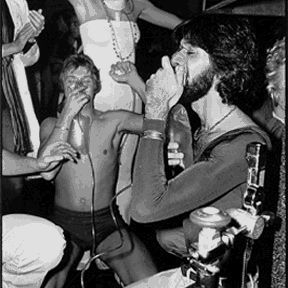 themselves in sexy flowing Halston dresses and high heels, and men donned wide-lapel leisure suits with open shirts revealing hairy chests and gold medallions…and coke spoons. In addition to the casual sex that went on in and around the clubs, recreational drug use was rampant there as well, particularly cocaine, amyl nitrite and other designer drugs intending to provide the blasts of energy needed to keep on dancing.
New York City’s Studio 54 was the epicenter of disco at its most fashionable, if not most decadent. Celebrities flocked the place and were ushered right in, while average folks lined up in their finest sexy threads in hopes of gaining entrance. The dance floor was packed from dusk literally ’til dawn. There were sex and drugs but no rock ‘n’ roll there — exclusively disco music, one song after the other.
The apex came in late 1977 with the release of the film “Saturday Night Fever.” Its  producers had read an article in New York Magazine about the disco scene occurring not only in Manhattan but Brooklyn and outlying areas as well. The ultimately tragic tale of a kid who hated his job but fancied himself the king of the dance floor each Saturday night was little more than a vehicle for the hugely successful soundtrack album, which sold 25 million copies and included the Bee Gees hits that have defined the disco era ever since (“Stayin’ Alive,” “Night Fever,” “More Than a Woman,” “You Should Be Dancing”). It’s interesting to note that the producers rush-released the movie because they had already spied “Disco Sucks” bumper stickers in LA and feared that disco’s peak had come and gone.
Indeed, even as disco continued its domination for another year or two, there was a simmering disenchantment in some circles with how thoroughly it seemed to have infiltrated popular radio and nudged aside mainstream rock. When even The Rolling Stones felt compelled to try their hand at disco with dance-friendly tracks like “Miss You” and “Emotional Rescue,” the 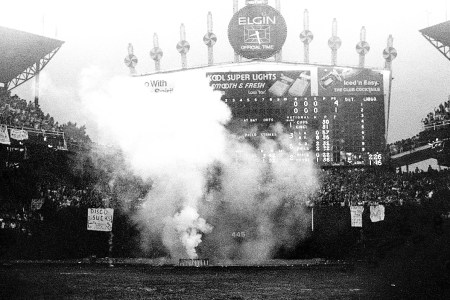 rockers grew desperate. Finally, in July 1979, when a Chicago rock radio DJ lost his job when his station switched to an all-disco format, he organized a “Disco Demolition” promotion at Comiskey Park, ostensibly to boost tickets sales to a White Sox doubleheader. Anyone with 98 cents and a disco record could gain admittance, and between games, the DJ detonated a huge pile of discarded disco LPs, sparking a near riot as 10,000 rock fans poured onto the field in celebration, resulting in a forfeit.
Although its proponents didn’t want to admit it, disco’s bubble had burst. The proliferation of disco dance classes at the mall and at senior community centers was certainly a bad omen. One of the final #1 hits of that period, ironically, was Donna Summer’s and Barbra Streisand’s duet, “Enough is Enough.” By the end of 1980, the very word “disco” seemed to have been banished and replaced with “dance music” and techno. Clubs were closing left and right, and popular music moved ahead with New Wave, ’80s pop, grunge and hip hop, and other genres, leaving disco to the time capsules and nostalgists.
Barry Gibb of The Bee Gees, who had been around for decades and offered a much broader repertoire than just disco, has said the trio grew tired of it and regretted being labeled as the genre’s poster boys. “Our secret desire was to create a video with us  dressed like Rambo, using machine guns to mow down the guy in the white suit on the colored dance floor.”
But perhaps not so surprisingly, the best music of that era has survived to the present day. At just about every wedding reception or major gala event where dancing occurs, you’ll hear “YMCA” or “Celebration” or “Hot Stuff” or “Play That Funky Music White Boy.”
Disco has assumed its rightful place of honor among all the other dance-oriented music of the last century, from jitterbug and cha-cha to Big Band and swing, from roots rock to Motown, from funk to techno, from EDM to hip hop.
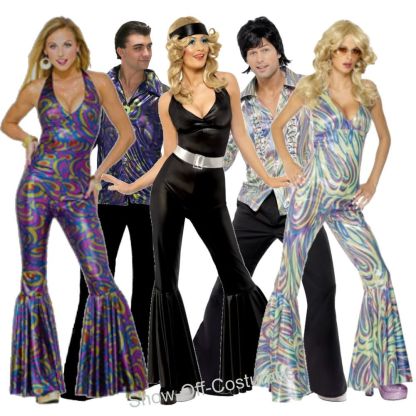 Many folks who were pre-teens, teens, or in college during the disco years have said they look back very fondly on that time. “It was fun, it was exciting, we dressed up,” said my friend Kathy. “It was kind of like a fantasy life for a few hours. For most people I knew, we weren’t doing much drugs or having sex in the clubs. We were drinking and dancing to the music all night long.”
When I asked her if she liked disco music outside of the clubs, she said, “Sure I did. If it came on the radio, I really didn’t want to just sit and listen to it, I had to get up and dance even if it was with just a couple of friends in my living room, or even by myself as I was getting dressed. I have to admit if it came on the car radio, I would sometimes switch the channel because I didn’t want to hear it unless I could dance!”
********************
The Spotify playlist you’ll find here is nearly three hours of some of the classic disco tracks from that late ’70s era, perfect for any disco theme party. You’ll never catch me playing it at my house (well, maybe a song or two), but for disco enthusiasts, have at it!
 deep into your memory and staying there forever.
 Joni’s first hit as a recording artist came on her third LP, “Ladies of the Canyon.” She wrote it while on tour in Hawaii, when she looked out her hotel window and saw the awesome natural beauty, then looked down to see an enormous parking lot. The lyrics point out how we have spoiled the environment, and our relationships, leaving us to bemoan, “Don’t it always seem to go that you don’t know what you’ve got ’til it’s gone?”
 I remember a lot of people were puzzled by the title of this hit single from Chicago’s second album. Some thought it was just nonsense syllables that sounded good, but songwriter Robert Lamm said he was up all night trying to write these lyrics, and at one point, he looked at the digital clock and had trouble making out the numerals. “Was it 3:35 am or was it 3:54 am?” he recalled. “So I thought I’d use that.” It reached #1 in August of 1970.
 The melody of this song was written by Stevie Wonder back in 1966. He brought it to Robinson and asked him for help with the lyrics. “I thought the distinctive calliope motif sounded like a circus,” he said, so he decided to write about a clown who was sad about the breakup of a romantic relationship. “Now there’s some sad things known to man, but ain’t too much sadder than the tears of a clown.” It went to #1 in October of 1970.
 David Gates, who wrote and sang most of the dozen hit singles that Bread released in the 1970-1977 period, said he wrote this tune about a woman he’d met at a Hollywood party. It turned out to be the group’s breakthrough hit, peaking at #1 in August 1970. Gates recalls his mother telling him she thought it was a fine song, “but she wished I hadn’t called it ‘Naked With You.’ We all got a laugh out of that!”
 The Dead’s 1970 song, hugely popular in concert, pays tribute to Clarence “Casey” Jones, a locomotive engineer whose expert maneuvering averted a disastrous train wreck in Jackson, Mississippi in 1900. Although he saved the lives of dozens of passengers, Jones died in the incident, blamed on the high rate of speed he’d been traveling. Jerry Garcia and lyricist Robert Hunter collaborated on the song, which appears on the band’s “Workingman’s Dead” album.
 The combination of piano, guitar, sax, flute and walking bass, set to a soft jazz swing beat, makes “Moondance” one of Morrison’s most celebrated songs. He wrote it while living in Cambridge, Mass., and recorded it in New York City. “I wrote the melody first, playing it on sax, then wrote lyrics about autumn, which is my favorite season,” he said. “I think it’s pretty sophisticated. Frank Sinatra wouldn’t be out of place singing that one.”
 All the colorful, dream-like imagery (“tambourines and elephants,” “giants doing cartwheels”) in the lyrics led some folks to presume John Fogerty was writing about an acid trip. In fact, he wrote it as a fun singalong song for his three-year-old son, and was partly inspired by the Dr. Seuss book And To Think That I Saw It On Mulberry Street. It was the fifth of five Top Ten singles from Creedence’s fifth LP “Cosmo’s Factory.”
 The vivid, anti-racist lyrics in this Young classic from his “After the Gold Rush” LP touched a raw nerve among rock music fans across the American South. Most people think Lynyrd Skynyrd’s 1974 hit “Sweet Home Alabama” was written in angry retaliation, with these words: “I hope Neil Young will remember, Southern man don’t need him around anyhow.” Actually, the artists liked and respected each other. “I’m proud to have my name in one of their songs,” Young said.
 This slab of hard rock, one of Zeppelin’s biggest commercial hits, is a loving tribute to Iceland, where the band performed for the first time in 1970. Robert Plant’s lyrics make reference to Norse mythology, war-making and Valhalla. “We were invited to play a concert in Reykjavik and the day before we arrived all the civil servants went on strike. The university prepared a concert hall for us, and the response from the kids was phenomenal. ‘Immigrant Song’ was about that trip.”
 According to bassist “Geezer” Butler, the song “Paranoid” was written at the last moment during the recording sessions for the band’s second album. “It was written as an afterthought. We basically needed a three-minute filler for the album, and Tony (Iommi) came up with the riff. I quickly wrote some lyrics, and Ozzy (Osbourne) was reading them over my shoulder as he was singing. The whole thing took half an hour from start to finish.”
 This warm, folksy follow-up to his breakthrough hit “Fire and Rain” is one of several songs from his “Sweet Baby James” LP that offer insight into Taylor’s past. He had a troubled adolescence marked by severe depression, and “Country Road” was one of several tunes he wrote that, according to guitarist Danny Kortchmar, “captures the restless, anticipatory, vaguely hopeful feeling that plays a large part in his character.” For me, it has always been one of my favorites to sing and play on guitar.
 The Doors weren’t known for blues tunes in their classic rock repertoire, but this is a powerful exception. Robby Krieger’s guitar work on this track is particularly ferocious (egged on by Jim Morrison’s “Do it, Robby, do it!”), and ex-Lovin’ Spoonful frontman John Sebastian chipped in a spirited harmonica part. Alice Cooper, a drinking buddy of Morrison, claims he was the inspiration for the line “Well, I woke up this morning and I got myself a beer…”
 The band’s drummer and manager had frequented a few drag queen shows and underground clubs where transexuals often met, and one night they brought Ray Davies with them. He thought the scene was perfect fodder for a pop song if he kept the lyrics relatively vague: “she walked like a woman but talked like a man,” “I’m glad I’m a man, and so is Lola.” It turned into a huge hit and one of The Kinks’ signature songs.
 Many of rock’s biggest hits were written quickly, and “All Right Now” is a prime example. Free’s drummer Simon Kirke said, “We had just finished a bad gig, and the audience hadn’t responded at all. It was obvious that we needed a rocker to close our shows. All of a sudden the inspiration struck, and (bassist) Andy Fraser and (singer) Paul Rodgers started bopping around singing ‘All Right Now’. They wrote it right there in the dressing room. It couldn’t have taken more than ten minutes.”
 The sessions for the “Deja Vu” album had been tense and difficult, and CSN&Y struggled to come up with a catchy, spirited song as the opening track. Stephen Stills wrote “Carry On” about the need to buckle down and work together and, in a larger sense, to finish what you start. The song developed from a riff he had been toying with for a while, and then he segued it into “Questions,” a song he’d recorded with Buffalo Springfield. The result was one of the band’s best group efforts.
 Gregg Allman used traditional blues/folk themes of desperation and determination as he fashioned the lyrics to this classic cut. One of the band’s roadies, who had listened to Allman play the unfinished song relentlessly, came up with the line “I’ve gone by the point of caring, some old bed I’ll soon be sharing…” Allman has referred to “Midnight Rider” as “the song I’m most proud of in my career.” The Allman Brothers’ 1970 version failed to chart as a single, but Allman’s 1973 solo version reached #20.
 McCartney took the breakup of The Beatles particularly hard, hiding himself away in his Scotland farm with expectant wife Linda and family. He survived bouts of depression and nights of heavy drinking, thanks to Linda’s love and support. Paul began work on a solo album which was anchored by “Maybe I’m Amazed,” his loving tribute to Linda. He’d actually written it in 1969 as a candidate for The Beatles’ next single, but after the band dissolved, he made it the centerpiece for his “McCartney” LP.
 There are multiple interpretations of this classic tune by California band Spirit. Some say it’s a reference to the band’s drummer Ed Cassidy, who was bald and “played the skins.” Others insist that “Mr. Skin” is a euphemism for a penis (“I can bring you pain, I can bring you sudden pleasure”). Either way, it’s an infectious track that’s fun to dance to or sing along with, from Spirit’s best LP, “Twelve Dreams of Dr. Sardonicus.”
 Singer-songwriter Justin Hayward said he wrote “Question” about the conversations he was having with American college students who approached him after concerts. “I heard their anti-war sentiments and their fears of being drafted, and I was expressing anger and frustration that after all that peace and love, we hadn’t been able to make a difference. The slower section became more of a quiet reflection about this, and a bit of a love song too.” It reached #21 on the US charts and a regular in their concert set list.
 Lyricist Bernie Taupin has said the words he wrote for “Your Song” are “one of the most naïve and childish lyrics in the entire repertoire of music, but I think the reason it still stands up is because it was real at the time. That was exactly what I was feeling. I was 17 years old and it was coming from someone whose outlook on love or experience with love was totally new and naïve.” It became Elton’s breakthrough hit single and one of his most beloved songs.

