Ah, things ain’t what they used to be
Periodically, I use this space to pay homage to artists whom I believe are worthy of focused attention — artists with an extraordinary, influential, consistently excellent body of work and/or a compelling story to tell. In this essay, I delve into the work of a man with one of the most stunning voices the world has ever known, a man who played a pivotal role in defining the Motown Sound, a man troubled by inner demons and a broken relationship with his father that ultimately killed him: Marvin Gaye.
***************
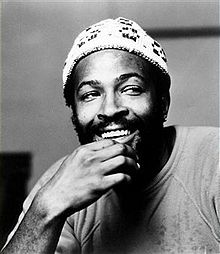 The lively world of popular music — rock, rhythm & blues, country, jazz, you name it — has been plagued by intermittent chapters of tragedy. Abuse of drugs and alcohol have caused the self-destruction of far too many talented musicians; plane crashes have prematurely taken a dozen or more giants from us; cancer and other diseases have claimed the lives of a few major artists as well.
Among the most tragic deaths are those involving violence. Most prominently, John Lennon’s death was especially shocking for many of us because it was essentially an assassination. The gruesome end of the great Marvin Gaye came just as suddenly, and just as shockingly: He was fatally shot by his own father.
****************
To try to make some kind of sense out of such an unconscionable act, you have to understand the complicated mind of Marvin Gay Sr. A preacher in the Hebrew Pentacostal Church, Gay was a strict disciplinarian who ruled his household with an iron fist that included regular incidents of physical abuse of his four children. Gay was also known to be a cross-dresser with repressed homosexual feelings, and his inability to deal with this apparent contradiction was often taken out on his wife and children.
Gay was a heavy drinker and eventually lost his preaching position, ending up chronically unemployed. He never approved of his son’s decision to become a singer, and when Gaye became successful, he emerged as the de facto breadwinner in the family, making the father-and-son relationship ever more tense and uneasy.
Gaye had his own problems, including depression, paranoia, cocaine abuse and an addiction to various kinky sex activities, all of which exacerbated the lifelong psychological battle between the two men. Insiders say they felt it was only a matter of time before the father or the son would do irreparable harm to the other.
*****************
In between the stormy childhood and horrendous end, Marvin Gaye achieved dizzying heights that won him international fame as a recording artist and performer.
He first sang publicly in his Washington, D.C. church at age four, where he developed a 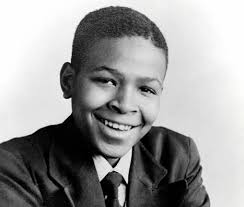 deep love of singing gospel music. He was encouraged to think about pursuing a career as a professional singer when, at age 11, he brought the house down at an elementary school play with a exhilarating performance of Mario Lanza’s “Be My Love.” He was a featured soloist of his junior high glee club and also sang in several doo-wop groups during his high school years.
When life in his parents’ home became unbearable, Gaye left school and enlisted in the Air Force, but his refusal to follow orders made him a poor candidate for military life, resulting in a general discharge. Upon his return to D.C., he formed The Marquees, a vocal quartet with his friend Reese Palmer, working periodically with rock and roll pioneer Bo Diddley. The Marquees were then hired by Harvey Fuqua to be his backing group in Harvey and the New Moonglows, relocating to Chicago in 1959, where they
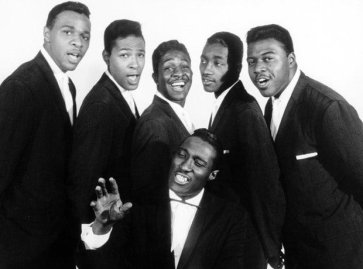
Gaye (second from left) with The Moonglows
recorded several tracks on Chess Records, including “Mama Loocie,” Gaye’s first lead vocal recording. He also sang backing vocals on a few Chuck Berry records including “Back in the U.S.A.” and “Almost Grown.”
Gaye had also learned drums and piano, which won him some session work, and he began dabbling in songwriting as well. In 1960, he moved to Detroit with Fuqua and ended up singing at a party at Motown founder Berry Gordy’s house, which resulted in Gordy offering Gaye a contract. (It was around this time the singer officially added the “e” to his last name, to silence the rumors of his sexuality and to further distance himself from his father.)
Gaye, blessed with a four-octave vocal range, envisioned himself a singer of jazz and Nat King Cole-type standards, with little interest in the R&B music Gordy wanted him to sing. They eventually negotiated a compromise, and his 1961 debut album, “The Soulful Moods of Marvin Gaye,” contained both genres. Nothing came of his first few singles, and he soon concluded that R&B would in fact prove more lucrative for him. His first hit was not as a singer but as co-writer of The Marvelettes’ “Beechwood 4-5789.” That same year, he had his own first chart hits with the prescient “Stubborn Kind of Fellow” and “Hitch Hike” (#8 and #12 on the R&B charts) followed by his first Top Ten pop hit, “Pride and Joy,” in 1963.
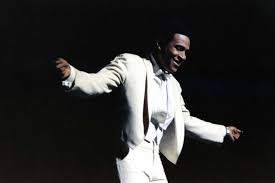 For the next seven years, Gaye enjoyed a nearly non-stop residence at or near the top of the R&B charts, scoring 25 singles in the Top Ten and earning the moniker “The Prince of Motown.” He was a major presence on the Motown performing circuit, sharing the stage with Smokey Robinson, The Supremes, The Temptations, Stevie Wonder and others. He did almost as well on the pop charts during this period, securing 13 Top Ten hits between 1964 and 1969.
Gaye’s voice, which songwriter-producer Eddie Holland called “one of the sweetest, most versatile I’ve ever worked with,” was perhaps the most distinctive of the many soul artists to dominate the pop airwaves, vying for chart success against The Beatles, The Beach Boys and a multitude of imitators. His biggest single yet, “How Sweet It Is (To Be Loved By You),” was in regular rotation across the country in 1965, as were “I’ll Be Doggone” and “Ain’t That Peculiar.”
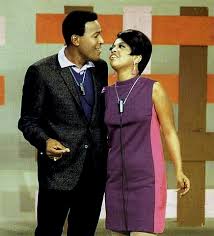
Gaye and Terrell
I think my first exposure to Gaye’s music came in 1967 when he began recording duets, first with Kim Weston and then Tammi Terrell. My older sister bought all these 45s and played them incessantly: “It Takes Two,” “Your Precious Love,” “If I Could Build My Whole World Around You,” “Ain’t Nothin’ Like the Real Thing,” “You’re All I Need to Get By” and, most notably, Ashford & Simpson’s brilliant song/arrangement “Ain’t No Mountain High Enough.” I was only 12 then, but that marvelous tenor voice, alternately smooth and gospel raspy, grabbed my attention and held it for years to come.
My family always had “The Ed Sullivan Show” tuned in on Sunday nights, and I have a vivid memory of being completely floored as I watched Gaye, in a voice almost desperate with angst, sing a riveting rendition of his 1969 #1 hit “I Heard It Through the  Grapevine.” Holy smokes, what a performance. The record held a vise grip on the #1 slot for six weeks, and its followup, “Too Busy Thinking ‘Bout My Baby,” proved to be another classic.
This kind of success, curiously, didn’t sit well with Gaye. He loathed touring but was required to be on the road constantly, which triggered what became a long struggle with cocaine. He also grew disillusioned with Gordy and the business side. “He felt like a puppet in the Motown circus, and he wanted more freedom in determining his creative direction,” said his late brother Frankie Gaye in his 1998 memoirs.
Gaye thought the next single, “That’s the Way Love Is,” was way too derivative of “Grapevine,” but he was intrigued when Gordy approved his release of a cover version of Dion’s socially relevant “Abraham, Martin and John.” When it reached #4, he had something of an epiphany. The time had come, he determined, to make a major shift in his perspective.
The world was in a period of profound upheaval in 1970 and Gaye wanted to be part of the growing voices of dissent and commentary. “With the world exploding around me, how am I supposed to keep singing love songs?” he asked. Gordy, who had little use for material with a political edge, was angry when Gaye told him he wanted to make a protest record. “Marvin, don’t be ridiculous. That’s taking things too far. Your fans aren’t going to like it.” Gaye held firm. “I realized that I had to put my own fantasies behind me if I wanted to write songs that would reach the souls of people. I wanted them to take a look at what was happening in the world.”
Otis Benson of The Four Tops had collaborated with Al Cleveland on a powerful piece called “What’s Going On,” and when the other Four Tops said no thanks, they offered it to Gaye. He put his own stamp on it, adding a few lyrics, modifying the arrangement, and ended up producing the song himself, with bassist James Jamerson and percussionist Eddie Brown from Motown’s Funk Brothers and recruiting a few others like sax man Eli Fontaine. Gaye also invited a few friends to the recording sessions, giving the place a chill party vibe that was recorded and used in the background.
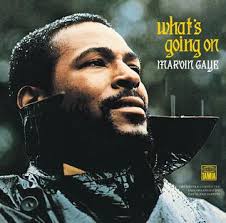 Gordy’s reaction to the finished track was blunt: “It’s the worst thing I ever heard in my life.” When he declined to release it, Gaye went on strike, refusing to record any other material until Gordy relented. Gaye enlisted the help of sympathetic sales guys, who forwarded copies of “What’s Going On” to key radio stations and record stores in defiance of Gordy, and the result was almost immediate. It vaulted to #1 and became Motown’s fastest selling single ever at that time. Convincingly persuaded, Gordy gave the green light to the album, and Gaye and company assembled eight more tracks written or co-written by Gaye, including the pointedly political hits “Mercy Mercy Me (The Ecology)” and “Inner City Blues (Makes Me Wanna Holler).”
To say it was well received is a gross understatement. If you look it up today, you’ll find Gaye’s “What’s Going On” LP is ranked in the Top 100 Albums of All Time in numerous publications and websites. Some rank it in the Top Five. Reviewers were and still are rightly ecstatic about it. Critic David Simon called it “a creative and commercial triumph 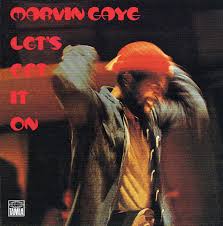 and one of the greatest albums ever attempted by a popular artist.”
Having won creative control, Gaye grabbed the brass ring again in 1973 with the suggestive “Let’s Get It On,” another #1 smash commercially and critically. Almost concurrently, he gave in to requests for “Diana & 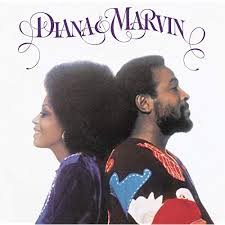 Marvin,” a more conventional collection of Ashford & Simpson songs on a duet LP with Diana Ross. By 1976, when disco began influencing just about every artist who put out a new record, Gaye countered with “I Want You,” which rivals anything Barry White ever released as a soundtrack for lovemaking. “Gaye seems determined to take over as soul’s master philosopher in the bedroom,” said Rolling Stone‘s Vince Aletti. “This is an adult album of private intimacy and sensuality.” Cliff White of New Musical Express called it “a voyeur’s delight… like peeking through the windows of the Gaye residence in the wee hours.”
His private life, meanwhile, was unraveling. He endured a messy divorce from his first wife Anna, who happened to be Gordy’s daughter, and dove ever deeper into drug abuse to help him with crippling stage fright and periodic suicidal tendencies. The stress of a 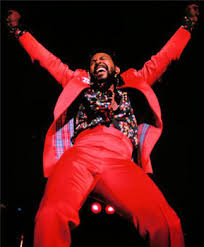 huge tax debt to the IRS also weighed heavily on him, eventually causing him to relocate to Europe for a spell. Although American listeners started to look elsewhere for new sounds, British audiences still clamored for Gaye, which resulted in a timeless performance and hugely popular concert LP, “Live at the London Palladium,” and yet another #1 hit, the influential “Got to Give It Up.”
During his European stay, and with the help of his mother Alberta, he made significant progress in curbing his addiction issues in 1981 and earned some renewed confidence and self-esteem from the rabid response to a tour of Europe. He turned in his final album owed to Motown and promptly severed ties with Gordy. Approached by several labels, Gaye went with CBS Records, who agreed to settle his back debts and heavily promote his next LP, “Midnight Love” (1982). The platinum, Grammy-winning single, “Sexual Healing,” put him back on the radio in a big way.
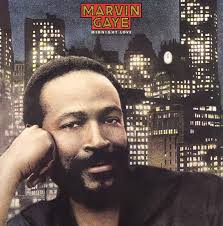 Now back in the States, he appeared in high-profile events like the “Motown 25: Yesterday, Today, Forever” TV special, and sang an iconic rendition of the National Anthem at the NBA All-Star Game in L.A. After one final U.S. tour, marred by illness and drug-fueled attacks of paranoia, Gaye moved into his parents’ L.A. home to care for his mother, who was recovering from kidney surgery.
Gaye and his father struggled to keep their distance from one another, but the writing was on the wall. Gay and his wife had been estranged for years, sleeping not only in separate bedrooms but separate houses located a few blocks apart. He resented the fact that his son was much closer to his mother and had also become their primary source of financial support.
Gaye, meanwhile, had continued to contemplate suicide and, perhaps to that end, he gave his father a .38-calibre pistol as a Christmas gift, ostensibly for his own protection. To his sister, it appeared more like a way to provoke his father into doing what Gaye couldn’t bring himself to do on his own.
On April 1, 1984, after Gaye shoved his father into a wall to prevent him from approaching Alberta, Gay took out his pistol and shot Gaye twice in the chest at close range. As he lay dying in his brother Frankie’s arms, Gaye whispered, “It’s good. I got what I wanted. I ran my race. There’s no more left in me.”
He would have turned 45 the next day.
****************
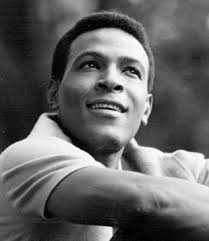 Despite his inner struggles, despite the hideous way his life ended, Gaye’s musical legacy remains intact. All those Motown classics, the brilliance of “What’s Going On,” the provocative music that followed and, most of all, That Voice are what we all want to remember about this man. His reputation as a maker of sensual bedroom songs earned new life when, in 2015, award-winning pop singer-songwriter Charlie Puth made his debut with the single “Marvin Gaye,” with these lyrics: “Let’s Marvin Gaye and get it on, you got the healing that I want, just like they say it in the song, until the dawn, let’s Marvin Gaye and get it on…”
*************

 In the rock era, songwriters in the ’60s, ’70s and ’80s made ample use of rivers in dozens of songs, be they #1 hits or obscure deep tracks. The Doobie Brothers’ “Black Water” and Tina Turner’s “Proud Mary,” while not using “river” in their titles, aptly describe life on the paddleboats that navigate the Louisiana waterways.
 Influenced by the forlorn music of Hank Williams’ “Long Gone Lonesome Blues,” Springsteen wrote his 1980 title song “The River” as the story of a young couple whose hopes for the future must take a back seat to the realities of life. The river, once the scene of romantic interludes, has now run dry, much like their dashed dreams: “Now those memories come back to haunt me, they haunt me like a curse, is a dream a lie if it don’t come true, or is it something worse that sends me down to the river, though I know the river is dry…”
 England’s Simple Minds was a hugely popular band in their native UK (five #1 albums), but they struggled to make much chart success here beyond “Don’t You Forget About Me” in 1985. Too bad; US listeners have missed out on many choice tracks on their other dozen album releases. The opening tune from “Good News From the Next World” does a sweet job of pointing out how rivers and people’s lives both take many turns as they progress: “Shadow let go, there’s something you should know, I just found my new direction and I hope you like the key, she’s a river and she’s turning there in front of me…”
 Eager to set a new course for himself and his music, Dylan contacted Leon Russell in 1970 to help him produce his next album. He had been struggling with writer’s block as he tried to avoid the political lyrics of his early work, and then during a recording session covering older songs, he had a epiphany about how a river’s current could be likened to the creative muse when it kicks in. “Right now I’ll just here so contentedly and watch the river flow…” The result was a spirited blue tune carried by Russell’s piano, which stalled at #41 when released as a single that year.
 Soul singer Al Green wrote this fine tune in 1974 while visiting Hot Springs, Arkansas, located along the Ouachita River. The lyrics make reference to the time-honored tradition of cleansing one’s soul by immersion in the river like a baptism, which Green evidently felt he needed after entertaining lustful thoughts of his first girlfriend. Once he became a pastor, he deleted the song from his performance repertoire for many years. The Talking Heads used a slower tempo and a swampy arrangement in their cover version of the song, which reached #26 in 1978.
 “I was raised by a river, weaned upon the sky, and in the mirror of the waters, I saw myself learn to cry…” Fogelberg was born in Peoria, Illinois, which sits on the banks of the Illinois River. Among the songs found on his 1972 debut LP “Home Free” is this tune that presaged the many tunes he wrote about nature and environmental concerns. Fogelberg was best known for the ballads that did well on the charts, but each album had deeper tracks (like this one) that showed he knew how to rock out as well. He died of prostate cancer in 2007 at age 56.
 For three or four years, Creedence could do no wrong. Everything John Fogerty wrote and everything the band released turned to gold, albums as well as singles. They came up with a funky rock sound that came to be known as swamp rock, bringing a bayou vibe to rock ‘n roll roots. I’ve always thought “Green River” epitomized the CCR groove, with lyrics that paint an evocative picture of carefree rural life: “Well, take me back down where cool water flow, let me remember things I love, stoppin’ at the log where catfish bite, walkin’ along the river road at night, barefoot girls dancin’ in the moonlight…”
 “Exile on Main Street” was viewed unfavorably upon its release but now is considered one of their top three albums. I find it technically sloppy, and I don’t think the songs are as strong as they could be. They could’ve deleted a throwaway like “I Just Want to See His Face” and inserted the sublime “Following the River,” which had been shelved and didn’t surface until the 2010 re-issue as a bonus track. “Oh, if I can’t have you, I’ll be dreaming all about you, ’cause you always brought the best in me, I’ll be following the river, gonna join hands with the sea…”
 One of the great unknown bands of the early 1970s that should’ve made it was Lazarus, a folk rock trio from Texas led by the great singer-songwriter Billie Hughes. Their debut LP is truly stunning, with gorgeous soft melodies, soothing harmonies and a fine blend of acoustic guitar and piano.” The album closer, “Rivers,” creatively uses piano to resemble the flow of a river, at first gently flowing and then more aggressively as it hits rapids. In the lyrics, Hughes urges us to live like rivers “which flow freely into the sea, joined in happy congregation.”
 Written by Arthur Hamilton in 1953 as a bluesy jazz ballad, this tune was first made famous by Julie London when her smoldering version was featured in the 1956 rock ‘n roll film “The Girl Can’t Help It,” sending it to #9 on the pop charts. Hamilton came up with the title phrase as a way of expressing bitter heartbreak: “You say you’re sorry for being so untrue, well, cry me a river, I cried a river over you…” Most of the 400-plus renditions of the song echoed London’s approach, but Joe Cocker tried a soulful rock arrangement that reached #11 in 1970.
 Drake was a tragic example of a very talented musician suffering from “tortured artist syndrome.” He wrote several dozen beautiful folk-rock tunes over three albums in 1969-1974, yet never achieved much success because of his unwillingness to perform due to a severe depression the made him take his own life. The self-analysis that marks a song like “River Man” shows his feelings of unworthiness: “Going to see the river man, going to tell him all I can, if he tells me all he knows about the way his river flows, I don’t suppose it’s meant for me…”
 “A river to the ocean goes, a fortune for the undertow, the river empties to the tide, all of this coming your way…” On the closing track of R.E.M.’s popular 1992 LP “Automatic For the People,” the band reminds us of the inevitability of the river’s waters flowing inexorably to the sea, which can be a powerful metaphor for hope. This talented group from Athens, Georgia got their start as one of the pioneers of alternative rock and eventually evolved into a more pop/rock sound that took them to the top of the charts in the early 1990s.
 In Canada, Mitchell’s home country, rivers often stay frozen over for many months. When she wrote this gorgeous tune, she was hoping to escape some painful emotional feelings from a romantic breakup and, rather than run away, just skate away on the nearest river. The song appeared on her 1971 “Blue” album and has become something of a Christmas standard in the years since. British singer Ellie Goulding had a #1 hit in the UK with her cover of “River” last year. “It makes me so happy that people have become new fans of Joni as a result,” she said.

