Go ahead, bite the Big Apple
“New York, New York is so big, they had to name it twice.”
That pretty much describes the enormity of New York…which manifests itself in so many ways.
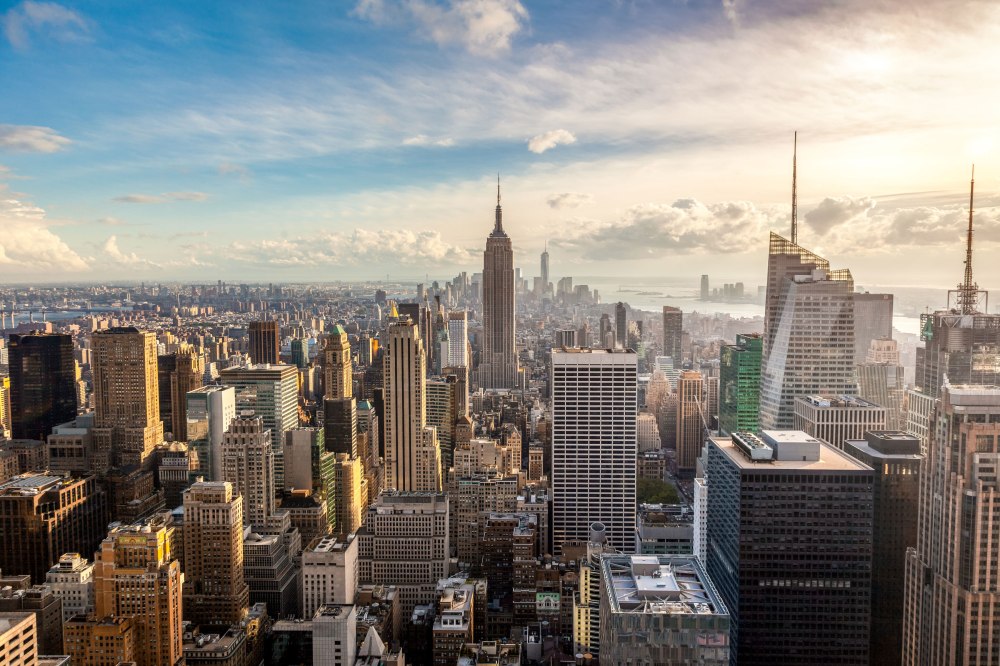 So many films…so many TV shows… So much of New York City — Manhattan, Broadway, Brooklyn — is ingrained in our popular culture, particularly for those who have never been there.
This is especially true when it comes to popular music. Since at least the 1920s, New York has been a ripe field for lyricists. If you look online at “songs about New York,” you’ll find more than 3,500 entries!
San Francisco has “I Left My Heart in San Francisco,” and Starship’s “We Built This City.” Chicago has “My Kind of Town” and Graham Nash’s “Chicago.” Detroit has J. Geils Band’s “Motor City Breakdown.”
But New York — holy smokes, the list is damn near endless. Of course, there’s Sinatra’s “New York, New York”… Billie Holiday’s “Autumn in New York“… And for crying out loud, there are 125 songs about Brooklyn! There are 80 that refer to Broadway … and 30 just about Coney Island!
So when I decided I wanted to write a blog entry about New York songs, I was immediately overwhelmed. How, pray tell, can I whittle down 3,500 songs to maybe 20?
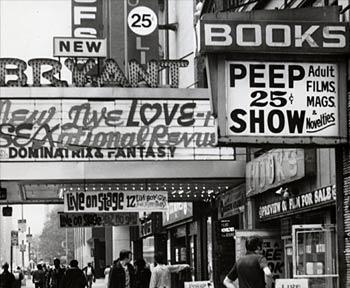 It’s interesting to note that New York City may be the only city that has had entire albums focusing on its life, people and culture. The Rolling Stones’ “Some Girls” LP (1978), for example, makes many references to New York:
“I’ve been walkin’ Central Park, singin’ after dark, people think I’m craaaaazy…”
“What a mess, this town’s in tatters, I’ve been shattered, my brain’s been battered, splattered all over Manhattan, uh huh, this town’s full of money grabbers, go ahead, bite the Big Apple, don’t mind the maggots…”
 Even British New Wave artist Joe Jackson recorded two LPs — the Top Ten success “Night and Day” (1982) and the uncharting sequel “Night and Day II” (2000) — that were entire song cycles focusing on New York City:
“Uptown, downtown, no one’s fussy, I’m a target, day, night, black, white, no one’s fussy, I’m a target…”
“It’s a hell of a town, steppin’ out in a bulletproof gown, so get  out of my goddamn way, I’m walking here, I’m talking here…”
Since I write about tunes of the ’60s, ’70s and ’80s, that immediately helped me narrow my focus. But even within that limited scope, there are still hundreds of songs to sift through.
But somehow, I’ve assembled a setlist of 20 selections of representative New York songs of that period. Two Spotify playlists are found at the bottom of this blog entry. The first covers the songs I featured in this blog entry. The other offers songs from the “honorable mention” list.
And here we go:
***************
 “New York State of Mind,” Billy Joel, 1975
Born in the Bronx and raised on Long Island, Joel has been a New York booster all his life, and “New York State of Mind,” a dramatic classic from his 1975 LP “Turnstiles,” permanently installs him in the unofficial New York Rock Hall of Fame. It has been covered by everyone from Barbra Streisand and Elton John to Tony Bennett and Alicia Keys. He sings about the Rockies, Miami Beach and Hollywood, but ultimately, “I’m just taking a Greyhound on the Hudson River line, I’m in a New York state of mind…”
 “All the Critics Love U in New York,” Prince, 1982
Prince wasn’t yet the superstar that “Purple Rain” would make him in 1984, but his “1999” album was popular enough, and this rock tune from that album is worth checking out. Its lyrics belittle New York rock music critics, saying they’ll love anything as long as it’s outrageously different: “You can wear what you want to, it doesn’t matter in New York, you could cut off all your hair, I don’t think they’d care in New York, all the critics love you in New York…”
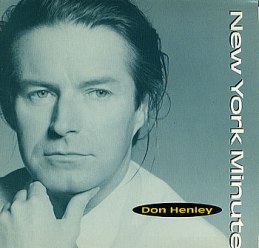 “New York Minute,” Don Henley, 1989
During The Eagles’ 15-year break (1981-1995), it was Henley who found the most success, mostly because his songs and recordings were far superior to his colleagues. On his excellent “The End of the Innocence” LP, which featured singles like “The Heart of the Matter” and the classic title song, “New York Minute” stood out as an unheralded gem, with a sophisticated arrangement and literate lyrics that played on the lasting metaphor about the fleeting nature of a “New York minute.”
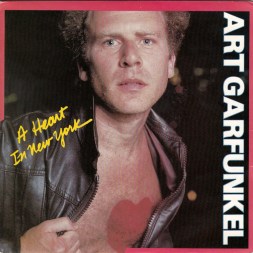 “A Heart in New York,” Art Garfunkel, 1981
This song is a hidden beauty. Garfunkel’s solo work did pretty well on the charts — the “Breakaway” LP in 1975 reached #9, thanks to the shimmering remake of the Thirties classic “I Only Have Eyes for You” and S&G’s reunion single “My Little Town.” But this song, written by Benny Gallagher and Graham Lyle, perfectly captured the feeling of New York, and was warmly received when performed during the iconic “Simon and Garfunkel in Central Park” HBO special and Columbia CD in 1981/1982.
 “The Boy From New York City” — The Ad Libs, 1964
A nobody duo of songwriters, George Davis and John Taylor, came up with this doo-wop classic, which ended up as a #8 song in late 1964 by The Ad Libs, produced by Jerry Lieber and Mike Stoller, one of the great songwriting teams from Brill Building fame. The success of this tune inspired the California-bred Beach Boys to write and record a response tune, “The Girl From New York City” in 1965, which noted, “The California guys can’t peel their eyes from that girl from New York City…” (Check out both songs on the Spotify playlist)
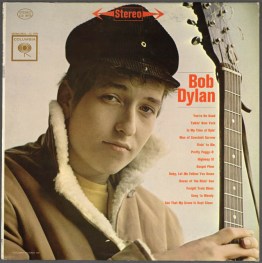 “Talkin’ New York,” Bob Dylan, 1962
His first LP was wildly uneven, and showed very little of the magnificence that would come bursting forth in his 1963-1966 period. But tucked onto that first record is “Talkin’ New York,” a ragged folk song that describes his arrival in New York from the hinterlands of Minnesota, with references to Greenwich Village (his early proving ground) and how he was originally received: “Come back some other day, you sound like a hillbilly, we want folk singers here…”
 “New York Groove,” Ace Frehley, 1978
Originally a #9 hit in the UK by the British teen glam-rock band Hello in 1975, “New York Groove” later became the only hit (#13 in the US) that emerged from the four mostly lame solo LPs released by the members of KISS in 1978. Ace Frehley, a native of The Bronx, was Kiss’s lead guitarist, and he has said he chose to record “New York Groove” because it seemed to accurately describe his time in the late ’70s when he was hitting on Times Square hookers.
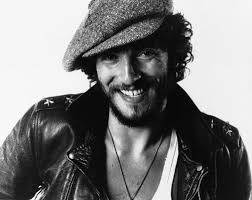 “New York City Serenade,” Bruce Springsteen, 1973
One of his finest dramas, from his incredible “The Wild, The Innocent and the E Street Shuffle” LP (1973). As a Jersey boy, Springsteen often looked across the river at the “Big City” and longed for the big stage. He wrote “vignettes of urban dreams and adolescent restlessness” and this 10-minute track is one of the best examples of his early work, before he boiled his thoughts down to four minutes or less…
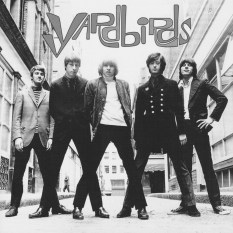 “New York City Blues,” The Yardbirds, 1967
“If you’ve ever been to New York City, you know what I’m talking about, they got such pretty girls in that big town, make a man want to jump around and shout…” The Yardbirds, then led by Jeff Beck and Jimmy Page, recorded many blues-based tracks, some of which went on to become substantial hits, but this deep track wasn’t one of them. Lead vocalist Keith Relf wrote this one, which appears on their “Greatest Hits” CD (although, curiously, it didn’t appear on any of their original studio albums).
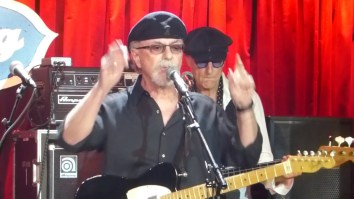 “King of the New York Streets,” Dion, 1989
Dion DeMucci, one of New York’s true native rock talents, called his band The Belmonts because they rehearsed in a Brooklyn house on Belmont Avenue. His early hits “Runaround Sue,” “The Wanderer” and “Ruby Baby” defined him as a doo-wop specialist, but his 1968 tribute “Abraham, Martin and John” showed he was capable of more. His impact on other greats who followed gave him the cachet to be reborn in the late ’80s with solid songs like “King of the New York Streets.”
 “New York City,” John Lennon, 1972
John & Yoko’s “Some Time in New York City” LP in 1972 was full of heavy-handed protest songs about the issues of the era, but musically, the tracks were widely disparaged as weak and disjointed, especially from someone with the credentials of Lennon. But the Chuck Berry-inspired “New York City” wasn’t all that bad, with references to the Staten Island ferry and the Max’s Kansas City nightclub.
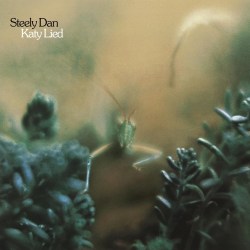 “Daddy Don’t Live in New York City No More,” Steely Dan, 1975
Walter Becker and Donald Fagen, the duo behind the wondrous Steely Dan, met in New York, and the city shows up in many of their songs (“The Royal Scam,” “Black Cow,” “Brooklyn”). This infectious track from 1975’s excellent “Katy Lied” LP tells the sordid tale of a father crippled by alcoholism who shuns New York, preferring instead to “driving like a fool out to Hackensack, drinkin’ his dinner from a paper sack…”
 “An Englishman in New York,” Sting, 1987
The Police got bigger and better during their 1977-1983 period, but Gordon “Sting” Sumner, who wrote almost all of the band’s songs, headed out on his own in 1985. By 1987, his multi-platinum LP “Nothing But the Sun” spawned numerous radio classics like “We’ll Be Together,” “Fragile,” “Be Still My Beating Heart” and Sting’s commentary on being a Brit living in the US, “An Englishman in New York.”
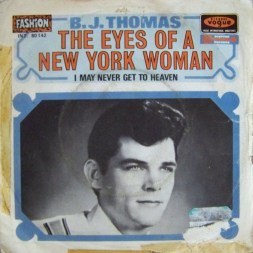 “The Eyes of a New York Woman,” B.J. Thomas, 1968
Houston-born Thomas went on to much greater fame with the 1968 hit “Hooked on a Feeling” (later made into a cringeworthy #1 hit by Blue Swede in 1974) and the “Butch Cassidy” ditty “Raindrops Keep Fallin’ on My Head.” But to my ears, his greatest moment was “The Eyes of a New York Woman,” which peaked at #28 in 1968. The lyrics say a lot: “East side cafes, west side plays, uptown, downtown, I’ll be there, I’ll never have to look for more, I found what I’ve been looking for… Deep in the eyes of a New York woman …“
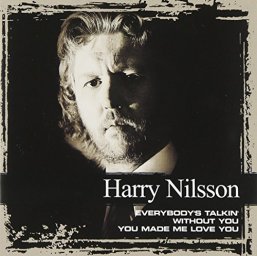 “I Guess the Lord Must Be in New York City,” Nilsson, 1969
Early on, critics and rival songwriters alike (including John Lennon and Paul McCartney) sang the praises of little-known Harry Nilsson, a Brooklyn-born wonder who moved to LA and found fame with songs like “Everybody’s Talkin’,” “Me and My Arrow,” “Without You,” “Jump Into the Fire” and “Coconut.” Before all that, he wrote and recorded this New York tribute song that mirrors “Everybody’s Talkin'” in arrangement and melody.
 “Nights on Broadway,” Bee Gees, 1975
The Bee Gees had been a hit pop group, Australia’s first, with hit singles in the late ’60s (“Holiday,” “To Love Somebody,” “I Gotta Get a Message to You”). After “Lonely Days” (#3 in 1970) and “How Can You Mend a Broken Heart” (#1 in 1971), producer Arif Martin suggested they retool their sound toward the coming disco craze, and the results brought astronomical fame and fortune. “Jive Talking'” started the ball rolling, followed quickly by “Nights on Broadway,” helped along by Barry Gibbs’s newfound falsetto voice.
 “The Only Living Boy in New York,” Simon and Garfunkel, 1970
As Art Garfunkel began his acting career with the Mike Nichols film “Catch-22” being filmed in Mexico in 1969, Paul Simon remained in New York, writing more songs and preparing for what turned out to be the duo’s final album, “Bridge Over Troubled Water.” This stunning piece refers to Art as “Tom,” which was Art’s nickname when the duo marketed themselves as “Tom & Jerry” in the 1950s. It was rather obtuse when released, but “The Only Living Boy in New York” all makes sense when you look at it years later.
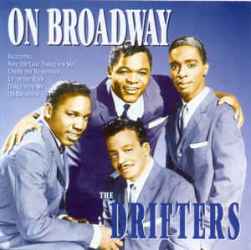 “On Broadway,” The Drifters, 1963
You can’t possibly assemble a mix of songs about New York that doesn’t include this awesome classic, a rare collaboration of rival songwriting teams Barry Mann and Cynthia Weil and Jerry Lieber and Mike Stoller. Together, they finished off a song that had been left uncompleted so The Drifters could record it within the imposed deadline. The result was not only a #9 song, it was covered by five or six dozen other artists over the next 25 years, including The Coasters, Bobby Darin, Tom Jones, Frank Sinatra and Eric Carmen, and of course George Benson, whose jazzier cover version reached #7 on the US charts in 1978.
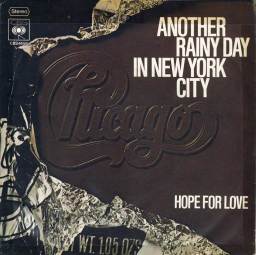 “Another Rainy Day in New York City,” Chicago, 1976
Chicago brought a revolutionary, big brass sound to Top 40 radio in 1970, but by 1976, they had settled into a comfortable, light-rock sound that many fans found disappointing. But the band still found themselves high on the charts with hits like this one from “Chicago X” (the chocolate cover), which also included the #1 hit “If You Leave Me Now,” rush-released after “Another Rainy Day” stiffed at #32. Still, its lyrics paint an appropriate picture of life in the big city when the rains come: “Softly sweet, so silently it falls, as crosstown traffic crawls…”
 Arthur’s Theme (The Best That You Can Do),” Christopher Cross, 1981
If you’ve ever seen the film “Arthur” (and you really must), there’s no getting around the Oscar-winning theme song, sung by Christopher Cross and written by a songwriting team comprised of Burt Bacharach, Carole Bayer Sager, Peter Allen and Cross himself. The film takes place in Manhattan, and the lyrics refer repeatedly to being “between the moon and New York City,” making it a no-brainer inclusion on this list.
***************
Honorable mention:
“First We Take Manhattan,” Leonard Cohen, 1988; “Paranoia Blues,” Paul Simon, 1972; “Brooklyn Kids,” Pete Townshend, 1983; “Wall Street Shuffle,” 10cc, 1974; “Empire State,” Fleetwood Mac, 1982; “Funky Broadway,” Wilson Pickett, 1967; “Mona Lisas and Mad Hatters,” Elton John, 1972; “Coney Island Baby,” Tom Waits, 1974; “New York’s Not My Home,” Jim Croce, 1973; “Looking for Love on Broadway,” James Taylor, 1977; “Harlem Shuffle,” The Rolling Stones, 1985; “Living for the City,” Stevie Wonder, 1973; “Do Like You Do in New York,” Boz Scaggs, 1980.
Since 1990, New York hasn’t lost any of its lustre as a fertile ground for hit songs:
Marc Cohn’s “Ellis Island” (1998); U2’s “New York” (2000); Richard Ashcroft’s “New York” (2000); Ryan Adams’ “New York New York” (2001); The Cranberries’ “New New York” (2002); R.E.M.’s “Leaving New York” (2004); Elton John’s “Wouldn’t Have You Any Other Way (NYC)” (2006); Stephen Bishop’s “New York in the Fifties” (2009); Taylor Swift’s “I Love New York” (2014).
 It’s a provocative topic, because people can disagree completely on whether a song is trash or treasure. For instance, I happen to like the music of the ’70s soft-rock band Bread. It’s what some call a “guilty pleasure.” Even the gooey ones like “If” and “Diary.” Others want to throw up at the mere mention of Bread. Personal preference is a peculiar thing…
 “Billy Don’t Be a Hero,” Bo Donaldson & The Heywoods, 1974; “My Ding-a-Ling,” Chuck Berry, 1972; “Something Stupid,” Frank & Nancy Sinatra, 1966; “Afternoon Delight,” Starland Vocal Band, 1976; “The Candy Man,” Sammy Davis Jr., 1972; “The Night Chicago Died,” Paper Lace, 1974; “Seasons in the Sun,” Terry Jacks, 1974; “Winchester Cathedral,” 1966; The New Vaudeville Band; “Convoy,” C.W. McCall, 1976; “Honey,” Bobby Goldsboro, 1968.
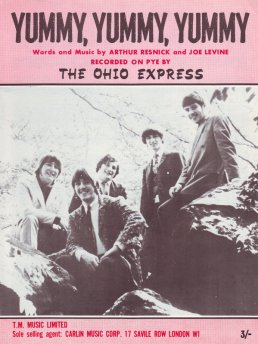 “Yummy Yummy Yummy,” Ohio Express, 1968
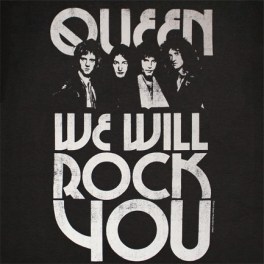 “We Will Rock You,” Queen, 1978
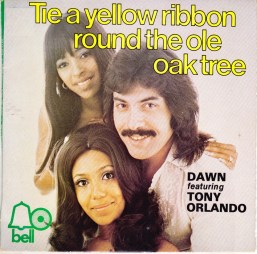 “Tie a Yellow Ribbon,” Tony Orlando and Dawn, 1973
 “Physical,” Olivia Newton-John, 1981
 “Babe,” Styx, 1979, and “Lady,” Styx, 1973
 Dennis DeYoung’s truly excruciating vocals. You needn’t look past two of Styx’s biggest hits, 1973’s “Lady” and 1979’s “Babe,” which demonstrate, without question, that this Chicago-based group is light years away from anything “progressive.” I couldn’t decide which of these grated on more nerves more, so you get them both.
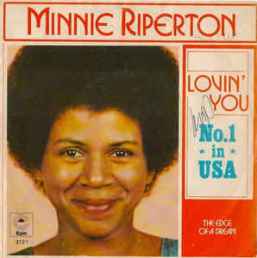 “Lovin’ You,” Minnie Riperton, 1975
 “Sing,” The Carpenters, 1973
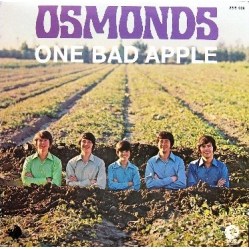 “One Bad Apple,” Osmonds, 1970
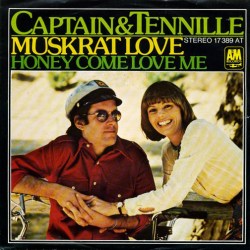 “Muskrat Love,” The Captain & Tennille, 1976
 “MacArthur Park,” Richard Harris, 1968
 “Torn Between Two Lovers,” Maureen MacGregor, 1977
 “Song Sung Blue,” Neil Diamond, 1972
 “In the Year 2525,” Zager & Evans, 1969
 “Don’t Give Up on Us,” David Soul, 1977
 “The Girl is Mine,” Michael Jackson & Paul McCartney, 1982
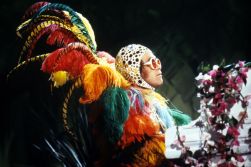 I found I needed to create a special category for Elton John, responsible for some of the most beloved and high-quality songs of his era (“Tiny Dancer,” “Your Song,” “Rocket Man,” “Burn Down the Mission,” “Levon,” “Friends,” “Candle in the Wind”). However, he evolved into a writer of some of the most obnoxious songs of the mid-’70s, too. “Crocodile Rock,” “Bennie and the Jets,” “Island Girl” and “Don’t Go Breaking My Heart” (with Kiki Dee) may have been popular on the charts, but they drove some listeners (like me) to the brink of madness.
