Young girls are coming to the canyon
“At first so strange to feel so friendly, to say ‘good morning’ and really mean it, to feel these changes happening in me, but not to notice ’til I feel it, young girls are coming to the canyon, and in the mornings, I can see them walking…” “Twelve Thirty (Young Girls Are Coming to the Canyon),” The Mamas and The Papas, 1967
*************
When I moved to Los Angeles in August 2011, I got in my car and started exploring the streets, the beaches, the tourist attractions and the famous landmarks that are mentioned in so many songs I listened to as a kid growing up in far-away Ohio.
The Pacific Coast Highway. Venice Beach. Sunset Strip. The Santa Monica Pier. Topanga Canyon. Hollywood Boulevard. The Troubadour.
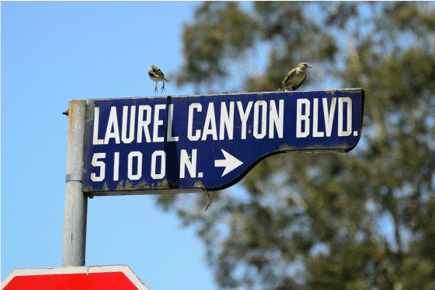 One afternoon, I found myself on Sunset Boulevard, heading toward one of the nation’s meccas for every music lover and album buyer, Amoeba Records. Sitting at a light, I looked at the street sign and realized I was at the base of Laurel Canyon Boulevard. Wow, I thought, Laurel Canyon. So much rock history there!
The main thing I recall reading about Laurel Canyon was how Joni Mitchell lived in a rustic cottage there in 1969, and shared the place for a while with Graham Nash. They wrote many of their wonderful early songs there, including Nash’s “Our House,” specifically about the idyllic home life they nurtured there as one of counterculture’s better-known couples.
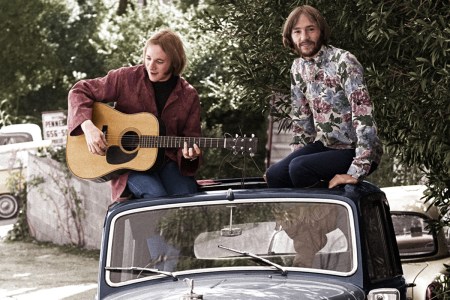
Stephen Stills and Peter Tork
I turned left and headed up the winding road in hopes of getting a taste for what the Laurel Canyon community was all about. I pictured some sort of woodsy Shangri-La where hippie types strummed guitars on front porches, waving and welcoming passersby in for tea and a hit off the hash pipe.
How silly of me to expect that more than 40 years later. That was then, this is now.
Laurel Canyon Boulevard today is a very busy, overtaxed roadway that brings way too much traffic up and down the canyon connecting the San Fernando Valley with West Hollywood. Like other canyon roads that snake through the Santa Monica Mountain range and the Hollywood Hills, Laurel Canyon can be a peaceful exception to the hustle-bustle of the rest of “El Lay,” especially if you turn onto the dead-end side streets that delve even deeper into the lush greenery. But on the main thoroughfare, the long slow line of cars driven by impatient residents and valley commuters have little patience for swivel-headed tourists who dawdle and gawk, wondering where the peace-and-love musicians have gone.
From the mid-’60s into the early ’70s, an inordinate number of game-changing musicians
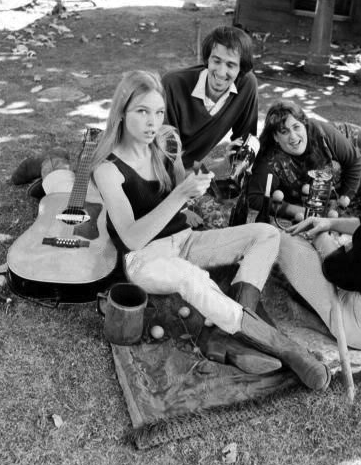
The Mamas and The Papas
whose songs represented “the California sound” called Laurel Canyon home, even if only briefly. The Byrds (Roger McGuinn, Chris Hillman and David Crosby) ruled the roost for a spell, as did John & Michelle Phillips of The Mamas and The Papas. John Densmore and Jim Morrison of The Doors lived there, as did Buffalo Springfield (Stephen Stills, Richie Furay and Neil Young). Bands like Canned Heat and Love were residents, as were Peter Tork and Mickey Dolenz of The Monkees. Even iconoclast Frank Zappa of The Mothers of Invention made his home in the Canyon for a while.
Carole King, who had first gained fame as a Brill Building songwriter in New York with husband/partner Gerry Goffin, moved to Laurel Canyon in 1970, where she wrote the songs that would end up on her exceptional “Tapestry” album, a defining record of the ’70s and, for a while, the best selling record in history.
John Mayall, pioneer of the British blues movement, moved to L.A. in 1968 in the wake of the breakup of his band The Bluesbreakers, and recorded and released “Blues From 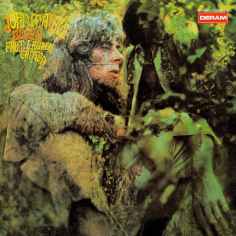 Laurel Canyon” that year. One track, a gentle blues number called “Laurel Canyon Home,” painted this simple picture: “Each and every morning, when the sun is high, I hunt around the canyon until I find a place to lie, it’s so beautiful to be alone, got the sun and trees and silence, I’m in my Laurel Canyon home, looking back a century, I look at where I stand, it must have looked the same as when Apaches roamed the land, it’s so beautiful to be alone, got the sun and trees and silence, I’m in my Laurel Canyon home…”
Perhaps most famous of the Laurel Canyon crowd was Mitchell, the Canadian singer-songwriter whose third LP, “Ladies of the Canyon,” was written there in 1969-1970. The title song describes the innocent waifs and sturdy Earth mothers who inhabited the community at the time: “Vine and leaf are filagree, and her coat’s a second-hand one, trimmed in antique luxury, she is a lady of the canyon… For her home, she gathers flowers, and Estrella, dear companion, colors up the sunshine hours, pouring music down the canyon…”
The Doors’ 1968 tune “Love Street” (from their #1 LP “Waiting For the Sun”) is Morrison’s nickname for Laurel Canyon Boulevard. He also references the Laurel Canyon Store, a 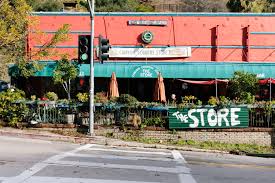 general-store hangout that still exists today: “She lives on Love Street, lingers long on Love Street, she has a house and garden, I would like to see what happens… I see you live on Love Street, there’s this store where the creatures meet, I wonder what they do in there…”
Long before this group of musicians descended on the area, Laurel Canyon had been an escapist place, a magical-forest part of Los Angeles where the noise and smog didn’t seem to penetrate. Hollywood actors in the ’30s, ’40s and ’50s found privacy there, a safe haven in which to conduct private trysts and experiment with drugs, away from the prying eyes of the paparazzi’s cameras.
In “Canyon of Dreams: The Magic and the Music of Laurel Canyon,” an exhaustive history and exploration published in 2009, author Harvey Kubernik offers this  description: “It was the place where you ran away from your parents, hid from authorities, wrote music, books, screenplays, hung out with bands, chart-toppers and pretenders. The music it gave birth to — before swollen egos and swollen nostrils brought a heavy rain down — somehow still informs the soundtrack of our lives.”
In the book’s foreword, Ray Manzarek, keyboardist of The Doors, said, “There was always some kind of magic afoot in that Canyon. The light and the sun infused that zone with a sense of joy. There was always something spiritual about that slice through the green earth, but never more so than in the ’60s. We had become the new tribe, and it felt as if we were spreading the message of (dare I say it today) love to a new world.”
Danny Hutton of Three Dog Night arrived in Laurel Canyon back in 1964 and never left, raising a family, tending a garden, and becoming a stalwart of the community. Today, he boasts the unofficial title of ambassador of the canyon. “Everyone has this thing about Laurel Canyon. It’s a mythical place for most people.”
The Wallflowers’ Jakob Dylan, son of legendary tunesmith Bob Dylan, has always been intrigued by the aura of Laurel Canyon’s rock ‘n roll heyday. In 2015, he staged a concert with Beck, Fiona Apple and other musicians to pay tribute to the music of that place and  time. He then collaborated with producer Andrew Slater to conduct interviews with some of the key players of that era — David Crosby, Michelle Phillips, Brian Wilson, Stephen Stills, Jackson Browne, Roger McGuinn, Eric Clapton, Graham Nash, even Ringo Starr and producer Lou Adler. He also spoke at length with Tom Petty (his final interview before his death) about how the songs and sounds born in Laurel Canyon had a profound influence on him and other contemporaries.
The result is a documentary of sorts called “Echo in the Canyon,” which is currently making a splash in cinema houses around the country. It’s kind of disjointed, woefully incomplete and flawed, in my opinion, but for people of my generation, “Echo in the Canyon” is a fun and invigorating 82 minutes well spent. For younger generations, or those who aren’t hip to the influences and inspirations of the Laurel Canyon story, it will no doubt be an eye-opening experience.
A side note: I thought my readers might like to know there’s a 2002 film called “Laurel 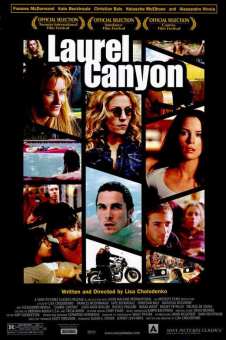 Canyon” starring Frances McDormand, Christian Bale and Kate Beckinsale that is well worth your time as well. Said director Lisa Cholodenko: “My film editor and I were listening to music one day, and had brought in that Joni Mitchell album, ‘Ladies of the Canyon.’ I used to love that record. We listened to it, and started talking about what the Laurel Canyon scene must have been like in the late ’60s-early ’70s. I thought it would be fun to set a movie in that scene but changed to a modern context. And I just took it from there.” It’s a quirky piece of fiction set in the Canyon that focuses on the evolving relationship between a hippie-type mother and her more conventional son and daughter-in-law as they explore sexual tensions and generational differences.
Photographer Henry Diltz, one of rock photography’s most respected figures, has captured hundreds of photos of Laurel Canyon and its most celebrated musical practitioners. One such photo appears on the iconic album cover for the debut LP “Crosby, Stills and Nash,” which was taken in West Hollywood, only a stone’s throw from Laurel Canyon. Another is the wonderful shot (below) of Joni Mitchell leaning out the 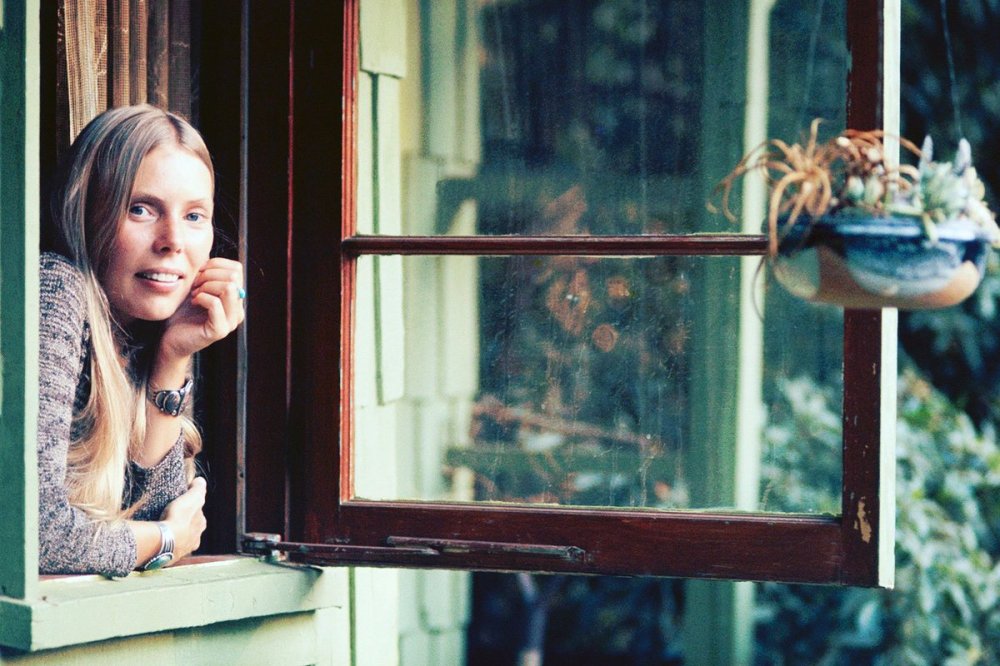 window of her Laurel Canyon cottage. “I really admired these people and their amazing music, and I felt honored to photograph them in their milieu. We are still close friends to this day.”
*****************
The Spotify play list below includes songs referred to in this essay as well as recordings from the “Echo in the Canyon” film soundtrack.
 Much as films were heavily censored in the ’30s, ’40s and ’50s to remove any scenes or dialog considered by industry watchdogs to be immoral, popular music in the first decades of the rock and roll era often came under the same sort of scrutiny by record company executives and radio programmers.
 Van Morrison’s beloved 1967 classic “Brown-Eyed Girl” raised eyebrows at the time because of the obvious sexual lyric “making love in the green grass behind the stadium with you” in the third verse. Most stations were reluctant to ban the whole song, so they simply removed that line and replaced it by repeating “laughing and a-running, hey hey” from the first verse, despite Morrison’s heated protestations.
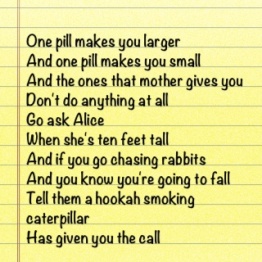 Many
Many 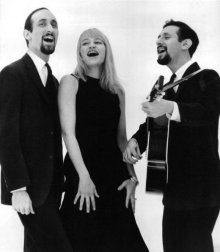 Sometimes the censors were totally off-base, interpreting an innocent children’s fairy tale like Peter, Paul & Mary’s “Puff the Magic Dragon” as a veiled reference to smoking weed. “Oh, for crying out loud,” said Peter Yarrow in 1963 when the song was released. “It’s just a children’s song, a story about a boy and a dragon.” But some stations in conservative areas blackballed it anyway, at least for a while.
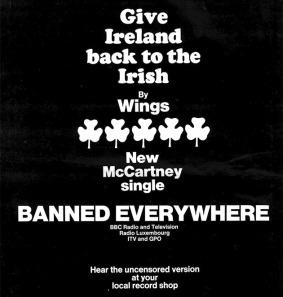 McCartney’s “Give Ireland Back to the Irish” (1972) were banned from the BBC for their perceived anti-government opinions.
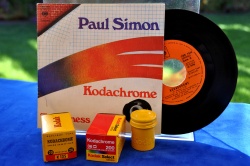 The BBC even had a firm rule against any
 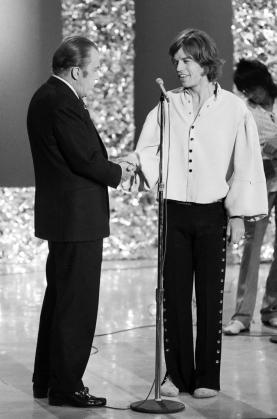 edgier acts to appear. First he booked those bad British brats, The Rolling Stones, and demanded that their brash young singer, Mick Jagger, change the words of “Let’s Spend the Night Together” to “Let’s Spend Some Time Together.” Jagger went along, but rolled his eyes at the camera each time he sang it.
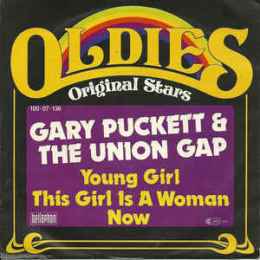 A couple of Gary Puckett songs in the late ’60s — “Young Girl,” “This Girl is a Woman Now” — focused on a creepy infatuation of a young girl by an older guy that, looking at it now, clearly bordered on pedophilia, but they somehow escaped the censors’ attention at the time. Even more curious was the case of The Buoys, a one-hit wonder group who had the sheer chutzpah to release a single in 1971 called “Timothy” that told the disturbing tale of three poor souls who were trapped in a caved-in mine, and two of the boys ate the third boy in order to survive!
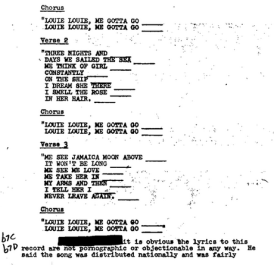 Perhaps the most extreme response to a supposedly objectionable lyric came in 1963 when a team of agents from J. Edgar Hoover’s FBI spent months investigating whether the words to The Kingsmen’s “Louie Louie” were obscene. Teens had furtively talked about how the lyrics were allegedly about a sexual liaison, but in fact, the song (written in 1957) was a rather bland ode from a sailor to his girl back home. Thanks to a marble-mouthed vocalist and less-than-optimum recording techniques, the words were pretty much impossible to decipher, even when studied at different speeds under headphones, and the FBI eventually threw up their hands.
 But that was then, this is now. In 2010, R&B artist CeeLo Green had an enormous hit with a song called, believe it or not, “F–k You.” They released a cleaned-up version called “Forget You” to satisfy radio programmers, but most listeners, to no one’s surprise, preferred the original.
 Hack's Back Pages