We should be grateful for The Dead
Periodically, I use this space to pay homage to artists whom I believe are worthy of focused attention — artists with an extraordinary, influential, consistently excellent body of work and/or a compelling story to tell. In this essay, I delve into the work of one of rock music’s most legendary bands that emerged from San Francisco in the ’60s and seemed to tour almost non-stop for nearly thirty years, playing for arguably the most fanatical base any rock band has ever known: The Grateful Dead.
********************
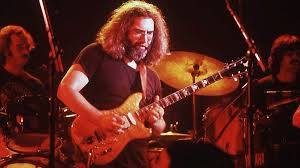
Twenty-five years ago this week, the great Jerry Garcia died of a heart attack at the age of 53. It brought to an end not only the life of a magnificent guitarist, songwriter and  spiritual figurehead but also his band. So crucial was Garcia to The Grateful Dead’s sound and vibe that the remaining members concurred they really couldn’t go on without him.
“Captain Trips,” they called him, an obvious reference to his experiences with LSD and other psychedelics, and also his position at the helm of his group, steering them along on their long, strange trip from ragged blues outfit to one of rock music’s most traveled, storied bands.
 Funny thing, though: While I admire their musical chops and what they were able to achieve in their three decades in the business, I would say I’ve been no more than a modest fan of The Dead over the years. I own the two marvelous LPs from 1970, “Workingman’s Dead”
 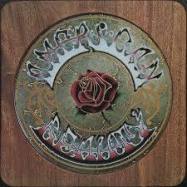 and “American Beauty”; the awesome triple album, “Europe ’72”; and their surprising commercial comeback in 1987, “In the Dark.” But if I were to list my favorite rock artists, I don’t think The Dead would make the Top 30.
Part of the reason, I think, is that I feel like I’m not really part of the one-of-a-kind bond the band shared with its core audience. I feel like an outsider, even though I’m sympathetic to the sweet devotion, sharing and general kindness that were the hallmarks of the relationship between the band and its fans, who are lovingly referred to as Deadheads. I feel as if I missed that era.
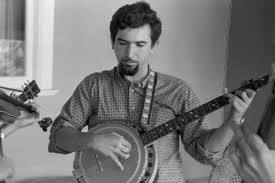 I’ve always found it fascinating that Garcia, considered one of the most expressive electric guitarists in rock history, began his musical journey as a banjo player in a jug band in the early ’60s. He loved bluegrass, “old-time” music and country, but he also enjoyed blues and rock ‘n’ roll, so in 1965, he liked the idea of forming an electric band with his friends Ron “Pigpen” McKernan, guitarist Bob Weir, drummer Bill Kreutzmann and bassist Phil Lesh.
In the “anything goes” San Francisco community of the mid-to-late 1960s, The Dead thrived on, and fed off of, the free-thinking mindset of the music lovers who attended their shows. The band had been involved in the notorious Acid Tests sponsored by counterculture author Ken Kesey and his “merry pranksters,” where everyone was eager
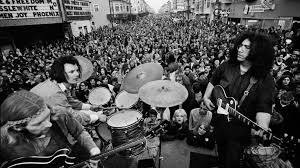
The Dead at a free concert in Haight-Ashbury
to experiment with mind-expanding psychedelic drugs, mostly LSD. The Dead’s music provided an ideal background, and became a sort of soundtrack to the trips (good and bad) everyone was taking.
The band existed as a fun-spirited collective, always in partnership with the audience. In the early days, they dedicated their time and talents, often for free, to their community, offering food, lodging, music, even health care to those who needed it. It has been said that the band performed more free concerts than any band in the history of music.
Garcia was always saying trippy things like, “I think every human being should be a
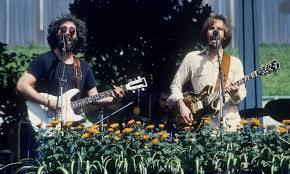
Garcia with Bob Weir
conscious tool of the universe. That’s why I think it’s important to get high. I’m not talking about getting zonked out, I mean being fully conscious. I think of The Dead as being a crossroads or a pointer sign, and what we’re pointing to is that there’s a lot of universe available, a whole lot of experience available over here. We’re a signpost to new space, and that’s the function we should be filling in society. In our own little society, that’s what we do, even though in the popular world, we’re just a rock and roll band.”
It’s fairly amazing, therefore, that a staid, mainstream recording company like Warner Brothers would sign a band like the Grateful Dead to its label. And sure enough, the 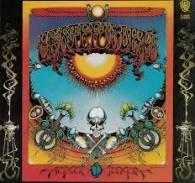 band’s first three albums — “Grateful Dead,” “Anthem of the Sun” and the puzzling palindrome “Aoxomoxoa” — were about as uncommercial as you could get. When Warners asked for a single they could promote on the radio, they responded with “Dark Star,” a valiant attempt at a sing-songy tune that degenerated into loose instrumental noodling that simply didn’t go over outside the Bay Area.
But here’s the thing: That “loose instrumental noodling” was exactly what the band did in their live performances, and the fans ate it up. Indeed, “Dark Star” in its original format lasted just 2:42, but on “Live/Dead,” the song and the jam that ensued from it went on for 23 minutes. (You can hear both versions on the Spotify playlist below.). As Lesh once said, “Recording albums in the studio felt artificial. The end result felt like making ads for the band. We always just wanted to play live, to  experience that collective improvisation together with the audience. That was the fundamental thing for us.”
And that’s why The Dead released more live albums than studio albums over the course of their career. And that’s why they began a tradition of recording just about every show they ever did. And that’s why fans who attended dozens, even hundreds of Dead performances took to making their own bootleg recordings, eventually spurred on by the band, who cheerfully permitted the practice.
It’s astounding to me that there have been nearly three hundred live albums officially released through the band’s own label or on Rhino Records. Any but the most ardent fans would find this excessive, even overwhelming, but Deadheads get off on picking out subtle differences in the way the band performed a given song, the way Garcia might shape his solos, the interchange between the drummers, the impact of the vocal 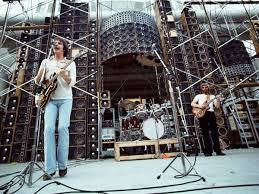 harmonies, the exceptional bass playing that seemed to connect it all.
A huge traveling entourage (musicians, road crew, managers and their families!) and a spirit of largesse took its toll on the band’s finances, but somehow they made it work. “We really weren’t interested in making money,” said Weir. “We just wanted to play every night.” A large portion of the money they earned was spent on building an insanely large “wall of sound” system to give their audience the best possible experience of hearing live music.
The band’s lineup changed over the years through death and attrition. Drummer Mickey Hart was added to give the band a two-drummer approach that served their improvisational format very well. Robert Hunter and John Barlow, both perceptive lyricists who worked with Garcia and Weir respectively, were considered “non-performing members” who brought a friendly sensibility to the band’s repertoire. McKernan died of alcoholism in 1973 and
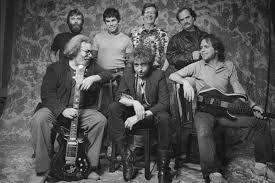
The Dead with Bob Dylan, 1987
was replaced by Keith Godchaux, whose singing wife Donna became the band’s first and only female member. They lasted until 1980 when Brent Mydland took over on keyboards, and by the late ’80s, they collaborated with the great Bob Dylan on a few tours. The talented Bruce Hornsby was an unofficial member of the group for a couple of tours in the early ’90s.
While everyone in The Dead dabbled in drugs, Garcia was of the “if it’s worth doing, it’s worth doing to excess” philosophy. This took him toward the darker drugs like heroin, to which he became severely addicted in the ’80s and ’90s. Eventually it affected his health

1987 LP
and his energy level, which affected his performances, and the Dead family started gently pushing him toward rehab, which he accepted but only half-heartedly. He suffered a diabetic coma that frightened him into clean living for a while, but in the end, the drugs had their way with him.
The band may have officially called it quits once he was gone, but the members have reunited periodically for one-off concerts, and various configurations — The Other Ones, Phil Lesh & Friends, Rhythm Devils, even Dead & Company — toured at various times through the 2000s and into the 2010s. As Lesh put it, “Some music was meant to be heard live, and we were dying to play it. So we did.” And of course, the recording of live shows has continued to the present day.
Currently showing on Netflix is “Long Strange Trip,” a remarkable six-part documentary on the Grateful Dead that I highly recommend to anyone even remotely interested in knowing more about this band, its members, its history, its culture, its name.
And what about its name? How did they come up with that? It’s an amusing story, well known among fans, but not among the music-loving public at large.
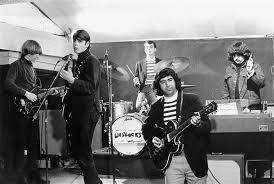
The Dead as The Warlocks
In 1966, Garcia and company were known as The Warlocks, but when they learned of another band also called The Warlocks (who, by the way, later changed to The Velvet Underground), they knew they needed a new name. “We were over at Phil’s house one day, and he had this big Funk & Wagnall’s Dictionary,” Garcia recalled. “I opened it at random, and my eyes first fell on ‘Grateful Dead’, those two words juxtaposed. It was one of those moments, you know, like everything else went blank, and there was GRATEFUL DEAD in big, black letters, such a stunning combination. So I said, ‘How about Grateful Dead?’ And that was it.”
Not everyone embraced it at first, but once they learned its meaning, they were on board. The phrase refers to folk tales in which “a dead person, or his angel, shows gratitude to someone who, as an act of charity, arranged for their proper burial.” They found this act of kindness in keeping with their overacting spirit of community.
 Stumbling on that phrase in a book was just the sort of cosmic randomness that fascinated Garcia, and it came to dominate how the band would exist throughout its lifetime. “Every night that we went out on stage, you never knew what might happen,” said Lesh. “We rarely had a prepared set list. We just played what felt right at that moment. God, I just loved that about us.”
An article in a music magazine once stated, “The real medium of rock and roll is records. Concerts are only repeats of records.” Lesh noted, “The Dead represent the opposite of that idea. Our records are definitely not it. The concerts are it, but we’re not in such  total control of our scene that we can say, ‘Tonight’s the night, it’s going to be magic tonight.’ We can only say we’re going to try it again tonight. Each night was like jumping off a cliff together.”
Dennis McNally, the band’s biographer and publicist, summed up The Dead’s magic this way: “They are the most American of all bands because each musician that started that band came from a completely different space musically. You had a bluegrass banjo player on lead guitar, a blues harmonica player on keyboards, a folky rhythm guitarist, an R&B drummer, an avant-garde classical composer picking up the bass, a marching band drummer, and a genius lyricist — you mix all these streams, dissolve the egos with acid, and stir vigorously. That’s Grateful Dead music.”
I, for one, am delighted to have their vast recorded repertoire available for my listening pleasure. You might call me grateful for The Dead.
********************
Because of the huge number of live recordings in The Dead’s vault, I found it too much to absorb to determine which tracks belong on a setlist. Since I am most familiar with the older “Live/Dead” (1969) and “Europe ’72,” the live cuts culled for this Spotify list are from those albums. Otherwise, you’ll hear my favorite selections from their studio LPs.
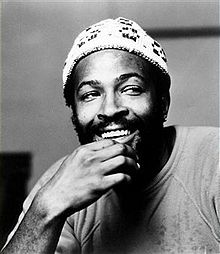 The lively world of popular music — rock, rhythm & blues, country, jazz, you name it — has been plagued by intermittent chapters of tragedy. Abuse of drugs and alcohol have caused the self-destruction of far too many talented musicians; plane crashes have prematurely taken a dozen or more giants from us; cancer and other diseases have claimed the lives of a few major artists as well.
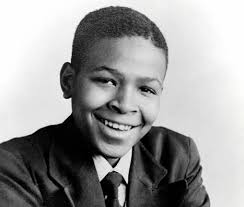 deep love of singing gospel music. He was encouraged to think about pursuing a career as a professional singer when, at age 11, he brought the house down at an elementary school play with a exhilarating performance of Mario Lanza’s “Be My Love.” He was a featured soloist of his junior high glee club and also sang in several doo-wop groups during his high school years.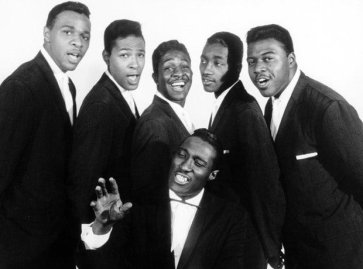
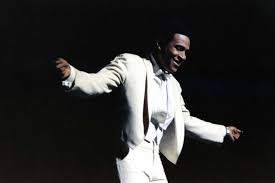 For the next seven years, Gaye enjoyed a nearly non-stop residence at or near the top of the R&B charts, scoring 25 singles in the Top Ten and earning the moniker “The Prince of Motown.” He was a major presence on the Motown performing circuit, sharing the stage with Smokey Robinson, The Supremes, The Temptations, Stevie Wonder and others. He did almost as well on the pop charts during this period, securing 13 Top Ten hits between 1964 and 1969.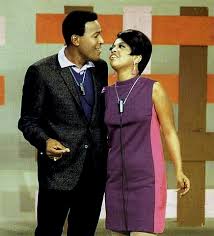
 Grapevine.” Holy smokes, what a performance. The record held a vise grip on the #1 slot for six weeks, and its followup, “Too Busy Thinking ‘Bout My Baby,” proved to be another classic.
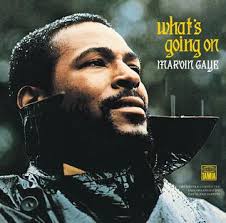 Gordy’s reaction to the finished track was blunt: “It’s the worst thing I ever heard in my life.” When he declined to release it, Gaye went on strike, refusing to record any other material until Gordy relented. Gaye enlisted the help of sympathetic sales guys, who forwarded copies of “What’s Going On” to key radio stations and record stores in defiance of Gordy, and the result was almost immediate. It vaulted to #1 and became Motown’s fastest selling single ever at that time. Convincingly persuaded, Gordy gave the green light to the album, and Gaye and company assembled eight more tracks written or co-written by Gaye, including the pointedly political hits “Mercy Mercy Me (The Ecology)” and “Inner City Blues (Makes Me Wanna Holler).”
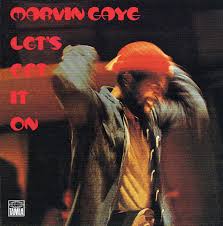 and one of the greatest albums ever attempted by a popular artist.”
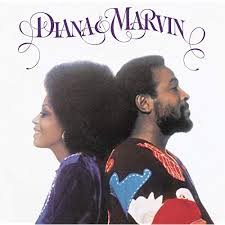 Marvin,” a more conventional collection of Ashford & Simpson songs on a duet LP with Diana Ross. By 1976, when disco began influencing just about every artist who put out a new record, Gaye countered with “I Want You,” which rivals anything Barry White ever released as a soundtrack for lovemaking. “Gaye seems determined to take over as soul’s master philosopher in the bedroom,” said Rolling Stone‘s Vince Aletti. “This is an adult album of private intimacy and sensuality.” Cliff White of New Musical Express called it “a voyeur’s delight… like peeking through the windows of the Gaye residence in the wee hours.”
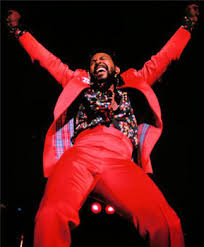 huge tax debt to the IRS also weighed heavily on him, eventually causing him to relocate to Europe for a spell. Although American listeners started to look elsewhere for new sounds, British audiences still clamored for Gaye, which resulted in a timeless performance and hugely popular concert LP, “Live at the London Palladium,” and yet another #1 hit, the influential “Got to Give It Up.”
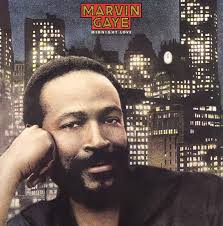 Now back in the States, he appeared in high-profile events like the “Motown 25: Yesterday, Today, Forever” TV special, and sang an iconic rendition of the National Anthem at the NBA All-Star Game in L.A. After one final U.S. tour, marred by illness and drug-fueled attacks of paranoia, Gaye moved into his parents’ L.A. home to care for his mother, who was recovering from kidney surgery.
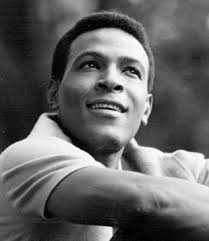 Despite his inner struggles, despite the hideous way his life ended, Gaye’s musical legacy remains intact. All those Motown classics, the brilliance of “What’s Going On,” the provocative music that followed and, most of all, That Voice are what we all want to remember about this man. His reputation as a maker of sensual bedroom songs earned new life when, in 2015, award-winning pop singer-songwriter Charlie Puth made his debut with the single “Marvin Gaye,” with these lyrics: “Let’s Marvin Gaye and get it on, you got the healing that I want, just like they say it in the song, until the dawn, let’s Marvin Gaye and get it on…”
 Hack's Back Pages