Shall I tell you about my life?
I’ve found that many, possibly a majority, of American fans of Fleetwood Mac are unfamiliar with the name Peter Green. And that’s a shame, even an outrage, and I hope this post this week helps open a few eyes to his importance to the band’s history, and to rock and blues music in general.
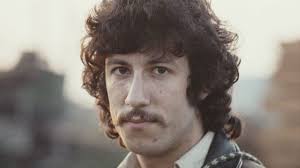
Green, who passed away July 25 at the age of 73, was the brilliant, influential guitarist and founder of the British blues band that he chose to call Fleetwood Mac, named after the rhythm section of drummer Mick Fleetwood and bassist John (Mac) McVie.
He was an enormously crucial figure in England during his tenure with the band, which ran for only three years from 1967-1970. In 1969, Fleetwood Mac was the biggest group in England, selling more records there than The Beatles and The Rolling Stones. In the U.S., though, Green and his band were known only to blues aficionados and rock music

L-R: Fleetwood, Green, Spencer, McVie
geeks. The first three albums — “Fleetwood Mac” (1968), “Mr. Wonderful” (1968) and “Then Play On” (1969) — were all Top Ten hits in Britain, but they barely made the Top 200 here.
Same was true for their singles, “Albatross” (#1), “Man of the World” (#2), “The Green Manalishi” (#10) and “Oh Well” (#2) — huge hits in England that failed to chart in the U.S. (except “Oh Well,” which stalled at #55). It wasn’t until nearly a decade later, after another incarnation of Fleetwood Mac became international superstars, that Green started earning more recognition here, even though relatively few of the band’s new fans took the time to go back and listen to Green’s pivotal contributions on those early LPs and singles.
His time in the limelight was relatively brief because of inner demons that haunted him almost daily and got worse as time moved on. He had low self-esteem and suffered from mental illnesses that were made far worse from experimentation with drugs, especially LSD. Green didn’t like the idea of being paid for his talent, choosing instead to withdraw from the public eye and society in general. Just as Pink Floyd had Syd Barrett, Fleetwood Mac had Peter Green, two creative leaders who went mad under the pressure and left before their bands ended up going mega-platinum.
Still, Green’s legacy is in his recorded works, which has become far more widely 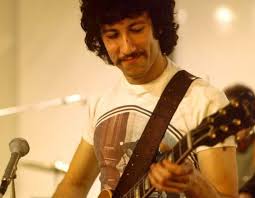 appreciated in recent years. I certainly knew the highlights of his work in the Sixties, but I confess to missing out on many of the deep tracks and live recordings in his catalog, which I’ve immersed myself in all week. The guy had such a marvelous economy of style with his Gibson Les Paul, and I urge you to treat yourself to a focused listen to the playlist I’ve assembled below.
A measure of his reputation today is the number of top flight media outlets that have prominently featured obituaries this week about Green’s life. It was not just Rolling Stone, NME and Guitar Player that ran articles in recent days; Green was also lauded in lengthy tributes by NPR, CNN, the BBC, Bloomberg, The Atlantic and The New York Times. Even The Economist ran a piece that dares to call him “Britain’s greatest blues guitarist.”
Green was in that generation of young post-war Brits who were energized by the American rock and roll records they heard on “pirate radio” because the BBC wouldn’t play them. “I was passionate about my love for American music, for rock and roll, and somehow it went from that to the blues,” Green said years later. “The music drove me to learn guitar. I really wanted to spread the word about this music.”
He met Fleetwood in 1964 when he joined a local London band called Peter B and The Loons. “When Greenie (as his friends and admirers called him) settled in and trusted us to back him, his playing became a voice no one could ignore,” Fleetwood wrote in his “Play On” autobiography. “He could be running through a blues progression we’d heard a thousand times, but when Greenie played it the old notes sounded new. His tone was wailing, high and lingering. It gave me shivers every night. Still does when I hear the records.”
In the summer of 1966, John Mayall’s Bluesbreakers (the premier blues band at the time) suffered a mighty blow when virtuoso guitarist Eric Clapton left to form the power blues  trio Cream. Mayall, having heard Green at blues festivals, invited him to fill the void many naysayers thought couldn’t be filled. Imagine their surprise when they heard Green’s beautifully crafted guitar parts on the group’s 1967 LP, “A Hard Road,” or the stunning solos he served up in concert. Green actually added value to the band because he also played a mean harmonica, and more important, he contributed original blues songs and sang them, something Clapton wasn’t doing yet.
When Green was given free studio time one day to record demos of five originals, he invited Fleetwood and McVie to play behind him. Recalls Fleetwood, “One instrumental number was a dirty bit of Chicago-style electric blues, and it came out fucking hot. ‘I’ve got a name for that one,” Greenie said with a knowing grin. ‘I’m calling it Fleetwood Mac.’ I said, ‘You mean, as in John and me? Why would you call it that?’ He answered, ‘Easy. Fleetwood Mac is the name of my favorite rhythm section.'”
 Green had said he always wanted to play his own music in his own band, and so it was only about eight months later that he broke away from Mayall, coercing Fleetwood to follow him. Bassist McVie had been with Mayall longer and chose to remain, but he was soon convinced to join Green, who was so thrilled to have both men in the lineup that he named the band after them, just as he did with the demo. Jeremy Spencer, a slide guitarist and singer who also did spot-on imitations of several of the early rock and roll pioneers, rounded out the original lineup, and Fleetwood Mac was born.
The foursome became known for their exhilarating concerts, full of Green’s both fast- and slow-tempo blues, uncanny Elvis takes by Spencer, and a dose of naughty  vaudevillian humor from Fleetwood to spice things up. They toured relentlessly around England and Europe, and Green’s reputation as a real boy wonder (he was 21) on guitar only grew. In early 1968, they released their debut LP, “Fleetwood Mac,” which came along at just the right time on blues music’s arc of popularity in Britain, reaching #4 and remaining high on the charts through the end of the year.
The band’s first single, “Black Magic Woman,” didn’t fare as well, stalling at #37 (although a little more than two years later, Santana took Green’s  song to #4 in the US where it remains a staple of classic rock). Fleetwood Mac’s second LP, “Mr. Wonderful,” came out only seven months after the first, and although it did well, peaking at #10, it suffered from muffled production and a sameness to the tracks. Still, with two albums in the Top 30, Fleetwood Mac was one of the hottest bands going.
It was right around this time that Green started telling Fleetwood that he had grown uncomfortable with the fame the band was now getting. “Peter didn’t want to be a star, but he did need to express himself,” wrote Fleetwood. “He had a real presence, off-stage and on, that made people take notice of him. He didn’t want to be king of the castle, although by shining so brightly, he couldn’t avoid it.”

Kirwan and Green
Green’s strategy was to bring in a third guitarist, someone with a style that would mesh well with his, someone who could also write great songs and sing, therefore taking some of the pressure and spotlight off Green. They found that person in 18-year-old Danny Kirwan, who joined the band just in time to participate in their first #1 single, a beautiful instrumental called “Albatross,” which was a radical left turn from the strict blues/rock repertoire.
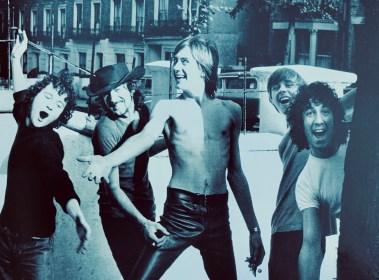
Spencer, McVie, Fleetwood, Kirwan and Green in 1969
“Peter was the type of creative person who needed to evolve,” said Fleetwood. “Once he became comfortable doing a chosen form, his nature was to mutate. The truly talented players did that, and did it well. Look at The Beatles.
“So we added Danny, and he and Peter found a natural fit, with Danny’s sense of melody on rhythm guitar really drawing Peter out, allowing him to write songs in a different style than he’d been able to previously. Rock songs just poured out of him.”
 The third LP, “Then Play On,” the last to include Green, was dominated by Kirwan and his songs, vocals and subtle guitar playing, with Green happy to play a secondary role. The songs he started writing seemed incrementally darker; the next hit single, Green’s “Man of the World,” had lyrics that offered plenty of red flags about his deteriorating mental condition: “Shall I tell you about my life?/ They say I’m a man of the world/ I guess I’ve got everything I need/ I wouldn’t ask for more/ And there’s no one I’d rather be/ But I just wish that I’d never been born…”
It was a classic psychological battle he was fighting in his head: He was eager to get his blues music out there, to play guitar and sing his own songs, but he was uncomfortable with all the attention and, eventually, even the money their success brought in. Like with many bands of that era, dabbling in recreational drugs was all the rage, and Green turned out to be fond of LSD, despite the deleterious effect it was having on his fragile psyche.
Fleetwood: “The complicated mental illness that seized him in 1970 had transformed him from the friend and co-pilot I’d loved so dearly to a mystery I still can’t fathom.  Since the onset of his condition, he had struggled morally with the fact that his gift — his beautiful, singular guitar playing — was something that could be commodified. He refused to acknowledge that his playing should be celebrated, let alone rewarded. Rather than let that happen, he started refusing to play.”
Green, who was born Jewish as Peter Greenbaum, began wearing robes and wanting to have long discussions about Christianity. He fell in with a manipulative cult in Germany, and soon wanted to sell his guitars and give away all his money, living simply off the land. He finally left the band for good in May 1970 after the release of Green’s last song, the harrowing acid-rock excursion “The Green Manalishi,” full of extreme guitar and anguished howling. “Losing Peter was like taking the rudder out of a 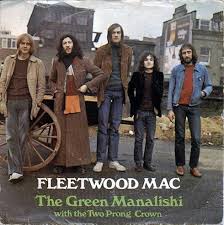 sailboat,” said Fleetwood. “As a band, we were still afloat, but we were drifting, with no map and no land in sight.”
Green went through institutionalization and rehabilitation in the 1970s, living reclusively and avoiding his old mates, who had soldiered on with a revolving door of different guitarists, each with their own set of emotional issues. Even the lineup that recorded the hugely successful “Fleetwood Mac,” “Rumours,” “Tusk,” “Mirage” and “Tango in the Night” albums between 1975-1987 had major relationship problems that were great fodder for songs but detrimental to the band’s emotional well being.
Ironically, Green returned to the business in 1980 and ended up making a half-dozen pretty decent solo albums, the first two (“In the Sky” and “Little Dreamer”) reaching the

“In the Sky” LP
mid-30s on the UK album charts. After another decade of obscurity brought on by depression, he resurfaced in 1997 in the form of Peter Green’s Splinter Group, which included musicians like Nigel Watson and Cozy Powell who helped Green rekindle his career once again. The Spotify playlist below includes healthy servings of the best of both phases of his post-Fleetwood Mac music.
This past February, Fleetwood organized “A Tribute to Greenie” at the London Palladium, with Pete Townshend, Billy Gibbons, David Gilmour, Noel Gallagher, and Kirk Hammett all taking the stage (although Green did not).
As Premier Guitar put it this week: “If a true sign of a guitarist’s impact on his art are the players who carry the torch of his influence, Green’s acolytes are an impressive lot. They include former Rolling Stones member Mick Taylor, who replaced him in Mayall’s Bluesbreakers; Clapton himself, who has praised Green as “one of the best”; Aerosmith’s

Green in 2005
Joe Perry; Genesis’ Steve Hackett; the Black Crowes’ Rich Robinson, and Wishbone Ash’s Andy Powell. Gary Moore, who bought Green’s Les Paul from him shortly after Green left Fleetwood Mac, owned it for 36 years before selling the instrument at auction. Since then, it was purchased by Hammett, who paid $2 million and has used it in recent live performances.
The late B.B. King once said of Green, “He had the sweetest tone I ever heard. He was the only one who gave me the cold sweats.”
Stevie Nicks, who joined the band in 1975 as it rocketed to superstardom, had this to say: “It was, in the beginning, called Peter Green’s Fleetwood Mac. I thank you for that, Peter. You changed my life. When Lindsey and I were invited to join the group, I went out and bought all the albums and listened to them, and I was very taken with Peter’s guitar

Fleetwood and Green, 2005
playing. It was one of the reasons I was excited to join the band. My biggest regret is that I never got to share the stage with him. I always hoped in my heart of hearts that that would happen.”
Fleetwood added, “No one has ever stepped into the ranks of Fleetwood Mac without a reverence for Peter Green and his talent, and his belief that music should shine bright and always be delivered with uncompromising passion.”
Rest in peace, Peter. Your legacy is intact.
*********************

.

 Auger is a British jazz/rock keyboardist who has played as a session musician and in several configurations with jazz and rock musicians alike. He played on The Yardbirds’ “For Your Love” hit single in 1965, and in a group called The Steampacket with Rod Stewart, Long John Baldry and Julie Driscoll. He made more albums with Driscoll and the band Trinity before forming The Oblivion Express in 1970. On that group’s fourth effort, the 1973 LP “Closer to It,” there’s a pretty solid cover version of Marvin Gaye’s “Inner City Blues,” but the standout tune I want to share is “Happiness is Just ‘Round the Bend,” a marvelous jazz/rock track featuring Auger on vocals and keyboards. Auger has continued working with a broad range of artists in Europe and the U.S., playing festivals and doing live TV performances well into the 2000s.
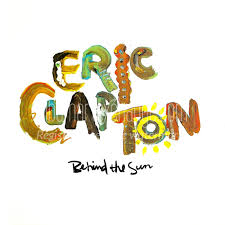 By the mid-’80s, Clapton had seemingly done it all. He played iconic guitar parts and solos with The Yardbirds, John Mayall’s Bluesbreakers, Cream, Blind Faith and Derek and the Dominos, and evolved into a damn good singer and songwriter as he began a solo career in 1974. He also had kicked heroin and alcohol addictions, and struggled through a marriage to Pattie Boyd, George Harrison’s ex-wife, which influenced the songs he was writing. He was chagrined when he turned in the tapes for his 1984 album “Behind the Sun,” and the label found it too depressing. They insisted he record three more radio-friendly songs with a team of seasoned producers and musicians, and the result was a likable but disjointed LP that still stalled at #34 on the US album charts. The single was one of those three, the irresistible “Forever Man,” a hard-driving tune by Texas songwriter Jerry Williams that fared modestly at #26 on the pop charts.
 To my ears, the recorded output of this “band” is one spectacular track after another, with maybe two or three duds in their whole seven-album catalog of their initial run (1972-1980). Donald Fagen (keyboards and vocals) and Walter Becker (guitar, bass) co-wrote disarming, clever, infectious songs, and brought in hired guns like guitarist Larry Carlton, sax man Phil Woods and singer Michael McDonald to record the parts as Fagen and Becker envisioned them. They had their share of hit singles (“Reelin’ in the Years,” “Josie,” “FM,” “Peg,” “Hey Nineteen”), but just as juicy were the deep tracks, and there were dozens: “Doctor Wu,” “Bad Sneakers,” “The Fez,” “Your Gold Teeth,” “Glamour Profession,” “Brooklyn.” You’ve got to check out “Night By Night,” a funky piece from their third LP, “Pretzel Logic,” with riveting horn charts and drop-dead vocals. You simply can’t go wrong with any of Steely Dan’s albums.
 I’ve been a big Rafferty fan since 1973 when, as part of Stealers Wheel, he scored with “Stuck in the Middle With You,” which went on to appear in a key scene in Quentin Tarantino’s “Reservoir Dogs.” Rafferty hit his commercial peak in 1978 with the fabulous “Baker Street” and its indelible sax riff, followed by the engaging “Right Down the Line,” both from his consistently excellent “City to City” LP. From the next album, “Night Owl,” Rafferty had some success with two singles, “Days Gone Down” (#12) and “Get It Right Next Time” (#21), but just as strong a candidate would have been “The Tourist,” also featuring Rafferty’s smooth Scottish tenor, solid melodic song structure and that soaring sax from Raphael Ravenscroft. Rafferty’s aversion to touring and a crippling alcohol addiction affected his sales from that point forward, but you’d do well to discover the seven subsequent albums he made before his death in 2011 at age 63.
 Drummer Buddy Miles was a musical legacy: His father played upright bass for Duke Ellington, Count Basie and others, which helped give him cachet when he sought drumming gigs with R&B and soul acts like The Delfonics and Wilson Pickett. At age 21, he moved to Chicago and teamed up with blues guitarist Mike Bloomfield and singer Nick Gravenites to form the blues/rock/soul band The Electric Flag. The next year, he contributed to sessions for Jimi Hendrix’s “Electric Ladyland” LP, and then joined Band of Gypsys, Jimi’s new blues rock trio. By early 1970, Miles released his first solo album, anchored by the heavy bass line and marvelous groove of the title track, “Them Changes.” The tune appeared on two successful live albums as well — “Band of Gypsys” (1970) and “Carlos Santana and Buddy Miles Live!” (1972). Miles died in 2008 at age 60.
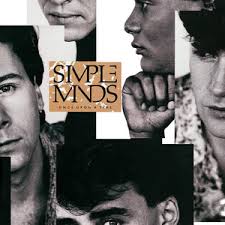 Although this Glasgow, Scotland-based art rock/new wave band built a strong fan base in the UK during its initial five album run (1979-1984), they made almost no impact in the US. When Simple Minds were asked to record a song by a German songwriting duo for use in John Hughes’ coming-of-age film “The Breakfast Club,” they balked at first, preferring to record their own songs, but eventually relented. “Don’t You (Forget About Me),” of course, became a huge international #1 hit and the group’s signature song. Recorded concurrently in 1985 was their seventh LP, “Once Upon a Time,” which featured producer Jimmy Iovine, who pushed singer Jim Kerr to achieve a more energetic vocal style. It worked — the album reached #10 in the US, thanks to stellar tracks like “Alive and Kicking,” “All the Things She Said” and especially “Sanctify Yourself,” which reached #14 in 1986. You rarely hear it anymore….until now.
 In their native Cleveland and other Midwest pockets, The Michael Stanley Band was a wildly popular, multi-talented rock band during their 10-year run, but elsewhere, MSB were virtual unknowns, which is a crying shame. Stanley recorded two solo acoustic albums in the early ’70s, then formed MSB and recorded an album a year for a decade, each packed with strong rock tracks like “Misery Loves Company,” “Last Night” and “In the Heartland” and the occasional ballad (“Waste a Little Time on Me,” “Why Should Love Be This Way” and “Spanish Nights”). One of my favorite rockers in their catalog is “In Between the Lines,” the leadoff track from their “MSB” album. Bob Pelander’s impactful piano hook, Rick Bell’s savage sax lines and Stanley’s guttural vocals pack a real wallop.
 Still one of the most astonishing debut albums of all time, “The Doors” was almost a Doors greatest hits package, with not only the longer album version of the huge #1 hit “Light My Fire” but also “Break On Through,” “Soul Kitchen,” “20th Century Fox,” “Back Door Man,” “The Crystal Ship” and the dark opus “The End.” Notorious vocalist Jim Morrison was singing at his best in those days, and the organ-driven sound of the band helped the group stand out from all the guitar bands so prevalent at the time. Of the three or four deep tracks you rarely hear from this LP, “Take It As It Comes” is a keeper, with Ray Manzarek in charge on keyboards. The band’s later work included some real gems (“Riders on the Storm,” “When the Music’s Over,” “Love Me Two Times,” “Roadhouse Blues”), but was far more erratic. Morrison’s mysterious death in 1971 at age 27 effectively closed the door on their career, but their legendary music lives on.
 Stills’ impressive track record as a songwriter, guitarist and singer with Buffalo Springfield and Crosby, Stills and Nash created high expectations when he began his solo career. The “Stephen Stills” album in 1970 met those expectations, but most everything that followed was highly inconsistent. One or two enjoyable songs does not a great album make, as we learned on “Stephen Stills 2” (1971) and “Illegal Stills” (1976). It wasn’t until 1977’s “CSN” reunion with Crosby and Nash that we were treated to five superb Stills tunes on the same LP. But those isolated tracks on ho-hum records are well worth your time. “Change Partners,” for instance (from “SS 2”), is one of Stills’ best tunes, and “Buyin’ Time” from “Illegal Stills” would’ve fit in nicely on the CSN album if there had been room. It’s carried by fine Hammond organ by Stills and harmonies by Donnie Dacus and Mark Kaylan, who continued working with Stills on his next few solo projects.
 When Jeff Lynne and others from the British rock band The Move went off on their own in 1971, they adopted a lofty goal: Pick up where The Beatles left off. Lynne said they wanted to focus on orchestral instruments to give the music a classical sound, with rock guitars used as accompaniment, hence the new group’s name: Electric Light Orchestra. Did it work? An early hit from “ELO II” merged Chuck Berry’s “Roll Over Beethoven” with a portions of Beethoven’s Fifth Symphony and made the Top Ten in the UK. On the band’s next LP, “On the Third Day,” they included the catchy original “Showdown,” which featured a funkier backbeat to go with their trademark sweeping strings. ELO went on to become one of the biggest concert draws and record sellers of the late 1970s/early 1980s, and Lynne ended up working extensively with George Harrison and, later, all three remaining Beatles on their “Free as a Bird” and “Real Love” singles in 1995.
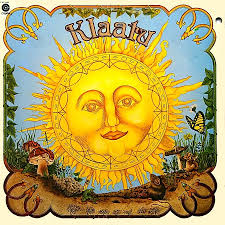 This obscure Canadian band consisted mainly of two multi-instrumentalists named John Woloschuk (keyboards) and Dee Long (guitars), who wrote very Beatlesque pop and progressive rock. When they signed with Capitol in 1976, their debut album (known as “3:47 EST” in Canada) was released in the US as “Klaatu.” The band chose to include no photos nor individual musician credits; all songs were simply listed as being written and published by “Klaatu.” When an American journalist speculated that the LP might actually be a secretly reunited Beatles recording under a pseudonym, it led to widespread rumours. Klaatu’s vocal style and musical creativity could definitely be considered similar to the Beatles, especially on tracks like “Sub-Rosa Subway.” Compare this to the next track, from McCartney’s solo work from the same period.
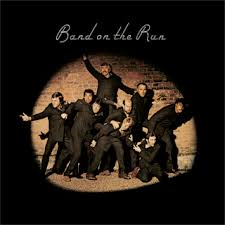 After The Beatles’ breakup, McCartney couldn’t resist including at least one track per album that sounded like it would’ve fit nicely on “The White Album” or “Abbey Road.” “Maybe I’m Amazed,” “The Back Seat of My Car,” “My Love,” “Band on the Run” — all have richly produced melodies laden with strings and backing vocals. Also from the “Band on the Run” LP is the suite-like “Nineteen Hundred and Eighty-Five,” which gallops along furiously to the album’s conclusion, when it wraps up the song cycle with a quick reprise of the title track’s chorus. It reiterates the album’s loosely imagined theme of escape, with lyrics that capture the idea of artistic freedom through love. I think it’s one of the best dozen songs in McCartney’s solo career.
 Hack's Back Pages