Rosin up your bow and play your fiddle hard
November 2007. My wife Judy and daughter Emily were on a college trip visiting Nashville with a friend and her daughter to check out Belmont University. While they were in town, they decided to buy tickets to the Christmas 4 Kids annual benefit concert that Charlie Daniels hosts every year at the fabled Ryman Auditorium.
They were told if they stopped in at a souvenir shop on Second Avenue where a Charlie Daniels Museum was set up in the back half of the retail space there, they’d probably  find the man himself, signing autographs and taking photos.
Sure enough, there he was, larger than life with his trademark ten-gallon hat. Emily and her friend Sarah were thrilled to get their picture taken with the Nashville icon.
At the Ryman that evening, the ladies enjoyed performances by several country artists (including an up-and-coming gal named Taylor Swift) before Daniels and his band took the stage. Two songs into their set, country star Martina McBride interrupted the proceedings to offer Daniels a Christmas present of his own. “Thank you, Charlie,” she read from a letter, “for all you’ve done to make Christmas wishes come true for thousands of children through the years. Now it’s time to make a wish come true for you. You are officially invited to become a member of the Grand Ole Opry!”
Daniels was visibly stunned. It took him several minutes to compose himself and offer his heartfelt gratitude for the honor he had dreamed about since he was a boy. The girls witnessed a very special moment in the life of a very talented man who came from simple beginnings to become a major presence in country, bluegrass, Southern rock and blues music.
**************
Now Charlie Daniels, at age 83, has died, a victim of a hemorrhagic stroke July 6th.
“My heart is crushed today,” said country star Travis Tritt. “Charlie was the guy who took me under his wing and encouraged me when I was first getting started. He was always there for me when I needed him. I have so many great memories of touring, performing,  writing and recording with Charlie, but my favorite memories are of simply talking with the man when it was just the two of us alone. Farewell, dear friend, until we meet again.”
Daniels has been universally admired for his superb abilities on the fiddle, guitar, banjo and mandolin, and as a vocalist and songwriter. He was also revered by many for his kindness and generosity. “He was one of the nicest, kindest people I have ever met,” said Jason Aldean. “Thanks for the musical legacy you left for all of us.”
Singer/fiddler Natalie Stovall added, “Charlie Daniels was the epitome of a Southern gentleman. He was kind, welcoming and so sweet. Playing ‘Devil’ with him will forever be a highlight of my life. No doubt The Devil is pissed as hell with how loud the angels are rejoicing in Heaven today.”
 The “Devil” she’s referring to is, of course, “The Devil Went Down to Georgia,” Daniels’ signature song and by far his biggest commercial peak, reaching #3 on the pop charts and #1 on the country chart in the summer of
  1979. It’s essentially a spirited bluegrass workout, telling the story of a competition between Satan and local boy Johnny as to who was the better fiddler. It was featured in the popular film “Urban Cowboy,” won the Country Music Awards’ Single of the Year, and earned the band a Grammy. The album it came from, “Million Mile Reflections,” reached #5 on the pop chart and #1 on the country chart, and reached triple-platinum sales figures.
Born in North Carolina in 1936, Daniels grew up listening to Pentecostal gospel in church, bluegrass bands at local events, and R&B and country on Nashville 50,000-watt AM stations, including the Grand Ole Opry radio program. At age 28, he had his first taste of success when he co-wrote “It Hurts Me,” a song Elvis Presley recorded. Once he moved to Nashville in 1967, he worked as a session musician, often for his producer friend Bob Johnston, most notably playing guitar and electric bass on Bob Dylan’s 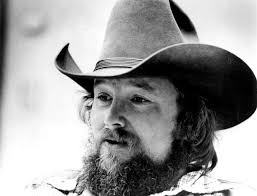 “Nashville Skyline,” “Self Portrait” and “New Morning” LPs.
Daniels fattened his resumé by adding guitar and bass on Leonard Cohen’s “Songs From a Room” and “Songs of Love and Hate,” and also contributed to Ringo Starr’s country LP, “Beaucoup of Blues.” Tammy Wynette and Barbara Mandrell recorded a few of his songs, and he even produced a few albums for artists like The Youngbloods.
His first couple of solo albums barely made the charts, but his third included the whimsical country story-song “Uneasy Rider,” the humorous tale of a traveling hippie who talked his way out of a fight in a redneck bar, which became a surprise Top Ten pop hit in 1973.
 The 1974 album “Fire on the Mountain” was the first to be credited to The Charlie Daniels Band, which included Taz DiGregorio on keyboards, Tom Crain on guitars, Fred Edwards and Don Murray on drums and Charlie Hayward on bass. CDB, as their fans called them, toured relentlessly and began hosting and headlining the annual Volunteer Jam in Nashville that year, a tradition that ran for 20 years and featured big names like The Allman Brothers Band, Willie Nelson, Stevie Ray Vaughan, James Brown, Emmylou Harris, Ted Nugent, Chris Stapleton and Billy Joel.
Albums like “Nightrider” (1975) and “Saddle Tramp” (1976) offered a healthy cross-section of Southern rock (“Birmingham Blues”), country rock (“The South’s Gonna Do It Again”), bluegrass (“Orange Blossom Special”), blues (“It’s My Life”), acoustic country (“Everything is Kinda Alright”) and even 10-minute mostly instrumental workouts  (“Saddle Tramp”) that were huge in concert.
They maintained a steady core audience throughout the ’80s, appearing on “Saturday Night Live” in 1982 and having a Top Ten country hit, “Drinkin’ My Baby Goodbye,” in 1986. By the late 1990s, Daniels and his longtime manager David Corlew founded Blue Hat Records and released a diverse slew of albums, including his first all-bluegrass album, several Christmas collections, and “Deuces,” an LP of collaborations with the likes of Dolly Parton, Vince Gill, Brad Paisley and Brenda Lee.
Daniels had shown a slightly-left-of-center political leaning during the ’70s when he advocated for legalizing marijuana and appeared at fundraisers for Democrat Jimmy Carter’s presidential campaign. As the 1980s rolled in, Daniels’ first attempts at political lyrics in two mainstream hits showed him drifting toward the conservative side of the spectrum. “In America” (#11) focused on the heartland’s patriotic response to the Iranian 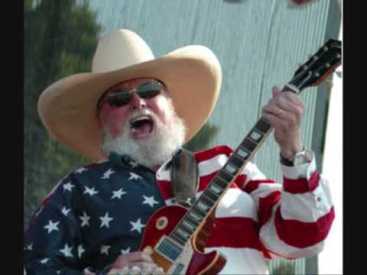 hostage crisis, and “Still in Saigon” (#22) commiserated with veterans who returned from Vietnam with post-traumatic stress disorder and other mental illnesses.
In the new millennium, Daniels chose to take on an increasingly outspoken role in the issues of the day. After the 9/11 attacks, he issued a single, “This Ain’t No Rag, It’s a Flag,” and when peace activists protested the impending war in Iraq, he wrote “an open letter to the Hollywood bunch,” calling them “pampered, overpaid, unrealistic children.” He also issued anti-abortion arguments, defended the Second Amendment, and later castigated Barack Obama’s policies. He seemed to relish in stirring the pot, and since most of his conservative Southern fan base concurred with his views, he didn’t see any downside.
His health began failing around 2010. He had prostate cancer surgery, suffered a mild stroke and had a pacemaker installed, and yet he continued performing and maintaining involvement in his charity events and philanthropic activities up until the end. His final album was 2018’s “Beau Weevils: Songs in the Key of E,” and he toured with Travis Tritt and the Cadillac Three late last year.
I was a modest fan of country rock during its mid ’70s heyday, and liked CDB’s music  fine, although I didn’t buy much of it. I saw them in concert once, in the summer of 1982, when I was reviewing concerts for a Cleveland newspaper. Here’s what I had to say at that time: “CDB is a very tight band, and they clearly enjoy what they’re doing. They offered two dozen songs that mixed the newer hits with a liberal dose of tunes from their earlier albums to keep new fans on their toes and older fans happy. Without a doubt, it was Daniels, a mountain of a man with a gentle twang in his fine singing voice, who dominated the proceedings. He played his trusty fiddle on only four songs, not quite enough to suit me, but his guitar and the piano, lead guitar and pedal steel of his colleagues more than compensated.”
My friend Mark, who was with me at that concert in ’82, reminisced about the time he saw the band in college. “It was at the little old fieldhouse at Bethany College. We sat on 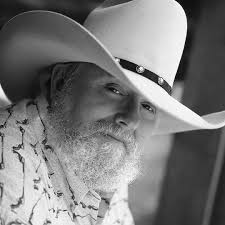 the floor right in front of the stage, with our cowboy hats and bottles of Rebel Yell, and we held up signs requesting ‘MORE FIDDLE!’ The band liked the signs enough that they invited us back stage to party afterwards. What a memorable time hanging out with them. They were all really great, fun guys, and such terrific musicians!”
Clearly, Charlie Daniels left quite a legacy as a musician, entertainer, storyteller, philanthropist, opinion sharer and friend. As he often said, “God gave me a gift to play music for a living, and I feel it’s my responsibility to give something back.” You’ve surely done that, good sir, many times over. Rest in peace.
***************
In appreciation of his music, here’s a Spotify playlist of The Charlie Daniels Band’s better known songs along with a few that may be new to you.

 Disco is actually an abbreviation for discotheque, a French term meaning “phonograph library.” In 1950s Paris, nightclubs began eliminating live bands and instead laid down dance floors, suspended colored lights, and replaced the jukebox with two turntables on which a deejay would continuously play pre-selected dance music with no breaks, keeping the clientele dancing all night long. During the ’60s in major US cities, this concept morphed into New York clubs like The Peppermint Lounge, where go-go dancing was the hot new thing, and Arthur’s, generally regarded as the first and foremost discotheque in town.
 Most observers agree disco music entered the mainstream in 1973 or 1974, with songs like George MacRae’s “Rock Your Baby,” Barry White’s “Can’t Get Enough of Your Love Babe,” The Hues Corporation’s “Rock the Boat,” Gloria Gaynor’s version of the Jackson 5 hit “Never Can Say Goodbye” and especially Donna Summer’s “Love to Love You Baby,” a 16-minute, multi-part extravaganza that took dancers on an emotional groove ride. Also key were two instrumental tracks that reached #1 in 1974: “Love’s Theme” by Love Unlimited Orchestra and “TSOP (The Sound of Philadelphia)” by MFSB, which served as the theme song for the hugely popular TV dance show “Soul Train.”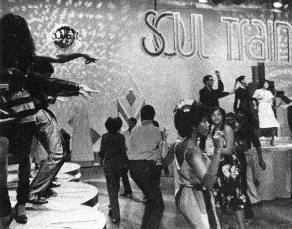
 The promise of sex went hand in hand with disco. It always was either implied or blatantly stated, from KC and the Sunshine Band’s relentless chorus “Do a little dance, make a little love, get down tonight” to the sensual grooves reinforcing the message in Johnnie Taylor’s “Disco Lady”: “Move it in, move it out, shove it in, round about, disco lady…”
 Momentum continued to build in 1975 and 1976: Van McCoy’s “The Hustle,” Silver Convention’s “Fly Robin Fly,” Labelle’s “Lady Marmalade,” and Kool and the Gang’s “Hollywood Swinging,” and KC’s string of #1 hits (“Get Down Tonight,” “That’s the Way I Like It,” “Shake Your Booty”). It wasn’t long before half of the Top Ten songs in
  the nation each week were disco, written expressly for DJs to spin in the discos, which began sprouting up in more and more cities, giving city dwellers and suburbanites alike a compelling reason to dress up and go out on the town for an evening of nightlife.
 Me This Way,” A Taste of Honey’s “Boogie Oogie Oogie,” Glory Gaynor’s “I Will Survive” and Chic’s cringeworthy “Dance, Dance, Dance (Yowsa, Yowsa, Yowsa).” Even soul music divas like Diana Ross were successfully crossing over with tracks like “Love Hangover” and “Upside Down.”
 the world could I keep my seat…Everybody’s doing the disco duck…”
 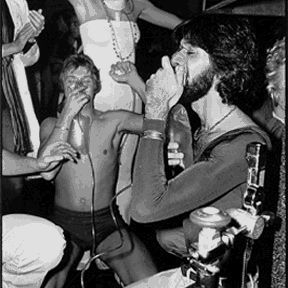 themselves in sexy flowing Halston dresses and high heels, and men donned wide-lapel leisure suits with open shirts revealing hairy chests and gold medallions…and coke spoons. In addition to the casual sex that went on in and around the clubs, recreational drug use was rampant there as well, particularly cocaine, amyl nitrite and other designer drugs intending to provide the blasts of energy needed to keep on dancing.
 producers had read an article in New York Magazine about the disco scene occurring not only in Manhattan but Brooklyn and outlying areas as well. The ultimately tragic tale of a kid who hated his job but fancied himself the king of the dance floor each Saturday night was little more than a vehicle for the hugely successful soundtrack album, which sold 25 million copies and included the Bee Gees hits that have defined the disco era ever since (“Stayin’ Alive,” “Night Fever,” “More Than a Woman,” “You Should Be Dancing”). It’s interesting to note that the producers rush-released the movie because they had already spied “Disco Sucks” bumper stickers in LA and feared that disco’s peak had come and gone.
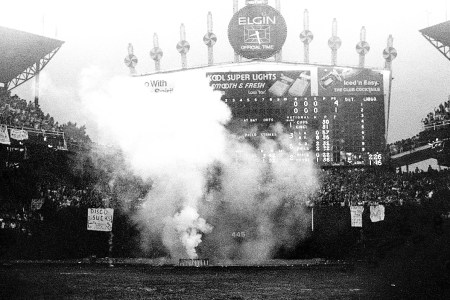 rockers grew desperate. Finally, in July 1979, when a Chicago rock radio DJ lost his job when his station switched to an all-disco format, he organized a “Disco Demolition” promotion at Comiskey Park, ostensibly to boost tickets sales to a White Sox doubleheader. Anyone with 98 cents and a disco record could gain admittance, and between games, the DJ detonated a huge pile of discarded disco LPs, sparking a near riot as 10,000 rock fans poured onto the field in celebration, resulting in a forfeit.
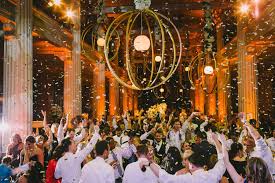 dressed like Rambo, using machine guns to mow down the guy in the white suit on the colored dance floor.”
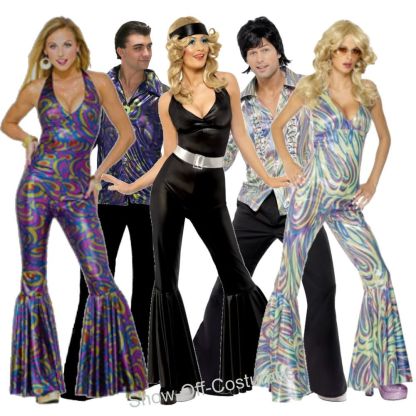 Many folks who were pre-teens, teens, or in college during the disco years have said they look back very fondly on that time. “It was fun, it was exciting, we dressed up,” said my friend Kathy. “It was kind of like a fantasy life for a few hours. For most people I knew, we weren’t doing much drugs or having sex in the clubs. We were drinking and dancing to the music all night long.”
 Hack's Back Pages