Take a sad song and make it better
Is there anything left to be said about The Beatles that hasn’t been said?
Well, maybe.
 There have been hundreds, maybe a thousand or more books written about the Fab Four. Some of them date back to the Sixties when the group was still together, while others were published as recently as 2017. There are authorized (and unauthorized) biographies, detailed rundowns of their recorded works, lurid exposés of their sex-and-drugs stories, “meanings behind the lyrics” discussions, tell-alls by ex-spouses, even coffee-table books with nothing but photos. Being a huge Beatles fan, I happen to own a couple dozen of these myself.
So is there anything left? Is there any new light that can possibly be shed on these guys and their music?
Amazingly, yes, but not in a new book.
The fascinating new information comes this time in video (DVD) form — a revealing series called “Deconstructing the Beatles,” which successfully breaks down specific Beatles recordings to their individual components in order to show how they were assembled, how they were accomplished, how they became the songs we have known and loved for all these years.
 Truth be told, these are essentially just glorified “TED Talks” — videos of lecture presentations before auditoriums full of like-minded folks who share the same love for The Beatles’ classic recordings. I can’t deny that these talks occasionally made me roll my eyes just like some of those lame-o multimedia lectures we were all subjected to back in high school.
But damn, the “Deconstructing the Beatles” tapes are full of such fascinating information that I’m willing to overlook the less-than-excellent production quality. Even for a Beatles aficionado like me, I was thrilled to find out many new tidbits I hadn’t known before.
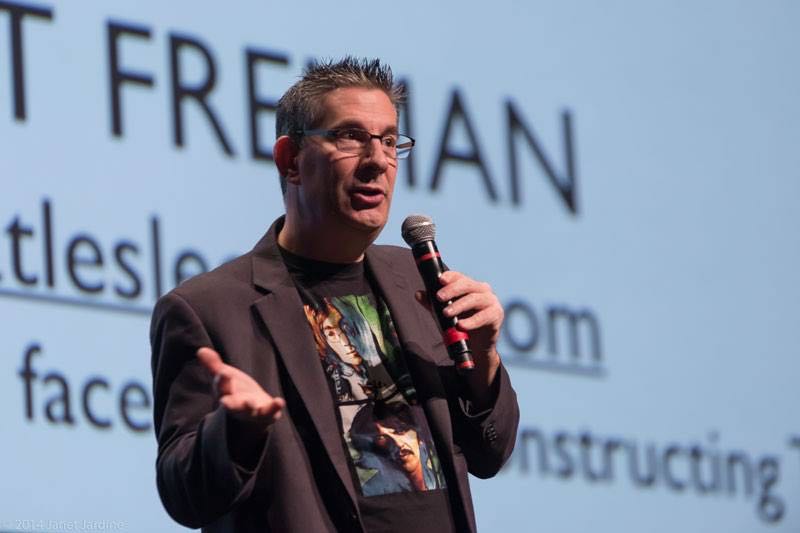
The guy behind all this is an undeniably nerdy fellow named Scott Freiman, a curious combination of entrepreneur, scholar, composer, producer and Beatles enthusiast. Here’s how he explains his motivation for this project: “I like to take apart the creative process. Isolating the tracks of the original recordings allows people to understand what The Beatles accomplished in the studio, and appreciate the music even more than they could just listening to it.”
So far, Freiman has “deconstructed” four of The Beatles’ 13 original studio albums. He wisely began his efforts with what many would call the group’s best, most intriguing LPs — “Rubber Soul,” “Revolver,” “Sgt. Pepper’s Lonely Hearts Club Band” and “The Beatles (The White Album).”
 In each album’s deconstruction, he begins his talks with a 10-question quiz, just for fun, to gauge the audience’s knowledge of that album’s songs. He then provides historical perspective about the climate and conditions in which the album was created.
For example, we learn that “Rubber Soul” — a superlative collection of songs that exponentially advanced the band’s musical development — was recorded during an impossibly demanding 30-day window in late 1965, between the end of several months of live appearances and a firm date by which the lacquered mixes had to be delivered in time for the Christmas shopping season.
How utterly amazing that The Beatles walked into Abbey Road studios on October 12th of that year with only a couple of rough song fragments, and then exited on November 13th with 16 extraordinary recordings (14 album tracks and a two-sided single) that not only rocketed to #1 on the charts but earned widespread praise for their sophisticated growth in musical ideas and lyrical content.
On the other hand, “The White Album” was laid down in the tumultuous year of 1968, when the world was rocked by assassinations and upheaval, and the band’s vibe was one of increasing tension and estrangement. No wonder at least one third of the songs on that album were essentially solo tracks rather than band recordings.
What “Deconstructing the Beatles” gives us, most of all, is an audio-visual breakdown of individual song tracks so that we can hear vocals (lead and harmonies) without instruments. Or we can hear just the inventive bass part, or just the drum flourishes, or just the harmonium or organ, to learn how or why those individual parts made such an important contribution to the track’s final result.
On the “Rubber Soul” DVD, we are reminded how large a role the tambourine played in Beatles recordings in 1965. And we learn how a bouzouki (a Greek stringed instrument) was the source of the unique sound heard on “Girl,” and how George Harrison’s attempts at sitar parts on “Norwegian Wood” were noticeably lame on the first few takes. Perhaps most remarkably, we are shown how the harpsichord solo in the middle of “In My Life” was, in fact, not a harpsichord at all but a piano played at a slower tempo and then sped up on the recording to sound like a harpsichord.
We learn that, as the band convened in the spring of 1966 to begin work on “Revolver,” the studio very quickly became a workshop where new ideas, new sounds, new methods were explored and employed in the making of the game-changing tracks found on that album. These days, technology allows bands to get any sound they want through the use of synthesizers and similar devices, but in 1966, they had to come up with imaginative ways to achieve the sounds they heard in their heads.
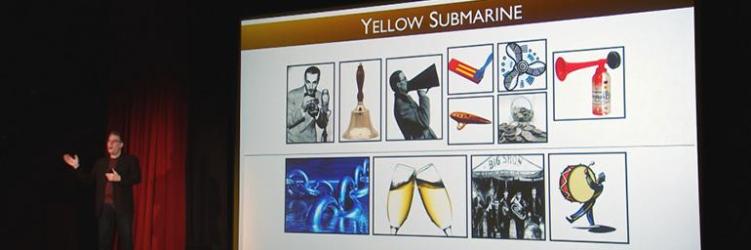 Through the isolation of tracks on the recording of “Yellow Submarine,” Freiman explains how chains pulled through shallow water made the sound of waves, and how various noisemakers from the Abbey Road sound effects cupboard were used to produce the sounds approximating the noisy underwater chamber of a submarine.
By isolating the background vocal tracks of “Paperback Writer,” Freiman reveals that at one point, George Harrison and John Lennon are actually singing “Frere Jacques” behind Paul McCartney’s lead vocals. Freiman also shows us how the basic structure of McCartney’s Motown tribute “Got to Get You Into My Life” borrows heavily from Stevie Wonder’s “Uptight,” which was a big hit at that time.
By the time we scrutinize the songs of “Sgt. Pepper,” we are treated to a fascinating look-see into how the sounds behind those tracks were devised. Freiman shows us how a tamboura and a Lowery organ gave us the effects behind “Lucy in the Sky With Diamonds, and how harmoniums and snippets of calliope recordings were mixed together to create the circus-like sounds of “Being For the Benefit of Mr. Kite.”
Just as important to Freiman’s storytelling is the inclusion of little-known tidbits about the back stories behind the Beatles songs. For instance, the inspiration for “She’s Leaving Home,” which tells the tale of a girl from an upper-class background who flees her parents to test the waters of a hippie lifestyle, is an actual British runaway to whom Paul once awarded a prize on British TV’s “Ready Steady Go” program back in 1963. Similarly, we learn that the Prudence in “Dear Prudence” is actually Mia Farrow’s sister, who squirreled herself away in her cabin at the Mahareshi’s India retreat and needed to be cajoled to “come out to play.”
Freiman isolates the song tracks to show us how toilet paper and combs were used to create sounds on “Lovely Rita,” or why Lennon was so eager to have his vocals altered on “Tomorrow Never Knows.” Freiman also features a previously unheard demo tape to show how Lennon used the inspiration of a breakfast cereal commercial to come up with “Good Morning Good Morning.” He gives us insight into how Lennon directed the use of various animal sounds to create the fade-out to the “Sgt. Pepper” reprise track.
Perhaps most insightfully, Freiman explains how the wondrous “A Day in the Life” track was constructed, allowing us the chance to hear isolated orchestral instruments as they built toward the mind-blowing crescendo.
So many interesting stories here. I’ll bet you didn’t know that the edgy sound you hear on “Yer Blues” was achieved by the band cramming into a ridiculously small studio room to record it. And I’ll wager it’s news to you that the Beatles made a 30-minute, slow-paced heavy-metal take on “Helter Skelter” that preceded the frenetic faster-paced recording we hear on “The White Album.”
And did you know that The Beatles recorded more than 100 takes of a Harrison song called “Not Guilty,” and then ended up cutting it from “The White Album”? (It eventually appeared a decade later on a Harrison solo LP.)
And who knew that McCartney played lead guitar parts on several Beatles tracks — “Taxman,” “Back in the USSR” and “Sgt. Pepper,” to name just a few — because Harrison was either not available or couldn’t adequately perform what was required?
 Here’s my favorite new factoid of the entire project: When Lennon and McCartney were working on “A Day in the Life,” and were searching for some way to connect McCartney’s “Woke up, fell out of bed” fragment back into Lennon’s main “I read the news today, oh boy” part, they used the chord sequence they’d just heard in Jimi Hendrix’s recording of “Hey Joe” (F-C-G-D-A). Fantastic.
Freiman has indicated that his next “deconstructing” project will address The Beatles’ final studio LP, “Abbey Road,” and I eagerly anticipate his exploration of how that incredible “Side Two” medley was assembled.
He hasn’t yet mentioned any plans to deconstruct the group’s first five albums (“Please Please Me,” “With the Beatles,” “A Hard Day’s Night,” “Beatles For Sale” and “Help!”), probably because those recordings were far more simple in arrangement and production, and lacking in studio trickery. Consequently, there’s very little “deconstructing” there to be done.
But it sure has been fun to get this behind-the-scenes look at how our favorite Beatles tracks were made.
The Spotify list below draws from “The Beatles Anthology” series of CD sets released in 1995-1996, which offer “first drafts,” alternate takes and previously unreleased fragments culled from the recording process of those classic Beatles songs. Enjoy!
 But I want to focus on an occasion when music brings back fond memories of positive times. For me, the year was 1971, and the artist was Elton John.
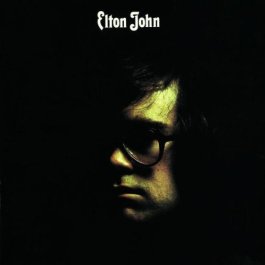 John,” and what I discovered simply knocked me out. Instead of “more of the same,” the other nine songs exhibited an extraordinary synthesis of orchestrally arranged literary story-songs and funky Americana tunes that sounded like a hybrid of British chamber music and piano-driven Leon Russell tracks.
 the Elton John Experience. The enigmatic words, the dynamic violin/cello backing, and the grand production values all played roles every bit as important as Elton’s stunning melodies, riveting piano work and one-of-a-kind vocal acrobatics, and a gripping bass-and-drums accompaniment.
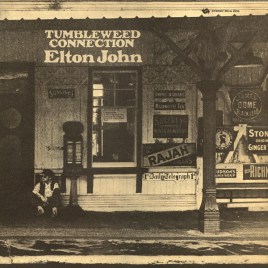 Turns out the first album had been recorded a full year earlier, in January 1970, and released in April, but we Yanks hadn’t learned of it for nine months. Meanwhile, Elton and his crew had returned to the studio with a new batch of songs in the summer of 1970 and released them in October.
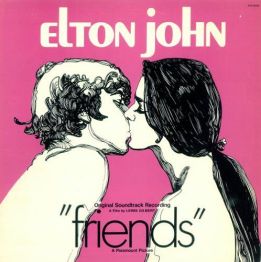 on another label, for an obscure French film called “Friends.” At this point, I’m so crazy about anything Elton that I buy it and take it home.
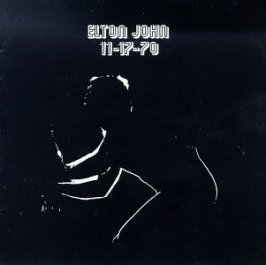 out renditions of six songs from his repertoire, giving us a solid hint of what he might sound like if we were lucky enough to ever see him in concert.
 One other important part of this collection of early Elton memories is his strong December 1971 LP, “Madman Across the Water,” which includes more epic productions like “Tiny Dancer” (which enjoyed new life after being prominently featured in the 2000 film “Almost Famous”), “Levon” and the amazing title track. All of these utilize the same signature Buckmaster string arrangements and Dudgeon production qualities. Dudgeon is quoted as saying, “That orchestral riff on the outro of ‘Levon’ is the greatest arrangement I’ve ever heard.”
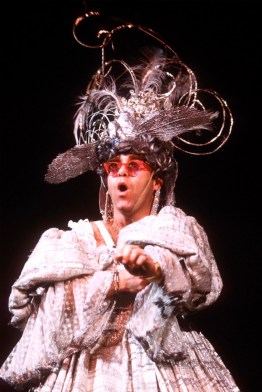 moved out of state and we went our separate ways. I don’t know if it’s a coincidence that Elton started writing what I felt was more disposable commercial stuff at that same time (“Honky Cat,” “Crocodile Rock,” “Bennie and the Jets,” “The Bitch is Back”). These songs and others like it may have thrilled the masses and sold millions of copies, but they didn’t do much for me. I just couldn’t connect to them emotionally, and I can’t deny that a huge reason for that is the overly flamboyant Liberace-like persona he chose to adopt at that point. It was just too much, too far removed from the Elton John I fell for in early 1971.
 Hack's Back Pages