But if I really say it, the radio won’t play it
Boldly creative art has been facing censorship for centuries, and attempts to stifle provocative popular music lyrics have been going on since the Top 40 Hit Parade debuted way back in the 1930s. Over the years and still true today (although to a far lesser extent), song words have been occasionally bleeped, masked and even outright banned to keep lyrics deemed inappropriate or objectionable from being heard on the public airwaves.
 Much as films were heavily censored in the ’30s, ’40s and ’50s to remove any scenes or dialog considered by industry watchdogs to be immoral, popular music in the first decades of the rock and roll era often came under the same sort of scrutiny by record company executives and radio programmers.
Instances of censorship involved different types of objections — profanity, politics, sacrilege, sexual content, drug abuse, even commercial product mentions. Radio programmers typically said they were worried of running afoul of decency laws or offending powerful interests, but more often than not, they were just as concerned about losing revenues from advertisers or local retailers who refused to be associated with a song’s edgy lyrical content.
But what, exactly, is edgy? How do we define it? Standards regarding what is objectionable have changed significantly over 80+ years. This is particularly true when it comes to lyrics about sex. In 1943, for example, a British singer named George Formby found out that his recording of a song called “Who I’m Cleaning Windows” was going to be banned from airplay because the British Broadcasting Corporation (BBC) decided the lyric was “too racy.” Here’s how it went: “The blushing bride she looks divine, the bridegroom he is doing fine, I’d rather have his job than mine, when I’m cleaning windows…” Wow. This innocuous song was banned, evidently, because someone determined we shouldn’t hear lyrics that they thought described a voyeur spying on newlyweds from his perch on the window washing scaffold.
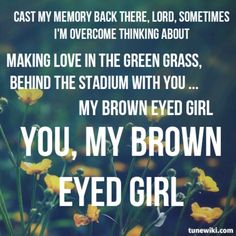 Van Morrison’s beloved 1967 classic “Brown-Eyed Girl” raised eyebrows at the time because of the obvious sexual lyric “making love in the green grass behind the stadium with you” in the third verse. Most stations were reluctant to ban the whole song, so they simply removed that line and replaced it by repeating “laughing and a-running, hey hey” from the first verse, despite Morrison’s heated protestations.
(It’s interesting to note that Morrison had originally written the song about a Caribbean woman and had entitled it “Brown-Skinned Girl,” but the record company refused to release a song that seemed to endorse a mixed-race relationship, so he grudgingly agreed to change it to “Brown-Eyed Girl.”)
By 1987, the George Michael hit “I Want Your Sex” managed to reach #1 that year, but it met enough resistance in a few conservative areas to create the alternate version “I Want Your Love.” And through the years, there has been no shortage of rather graphic sex-oriented lyrics hidden deep on rock albums (check out Frank Zappa’s “Dinah-Moe Humm” from 1973), but they usually slid under the radar because they didn’t get radio play except on the most maverick FM stations.
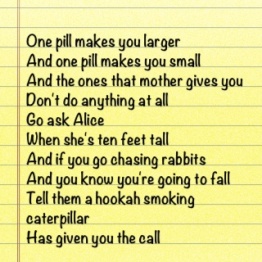 Many songs with references to drug use started in the freewheeling ’60s with tracks like Jefferson Airplane’s “White Rabbit,” which tied the story of “Alice in Wonderland” to hallucinogens. And while John Lennon always maintained the “LSD” initials of The Beatles’ “Lucy in the Sky With Diamonds” was purely coincidental, the song was clearly awash in psychedelic imagery.
And there are much earlier examples: Some versions of the 1940s-era Cole Porter standard “I Get a Kick Out of You” were rewritten to remove the second verse — “Some, they may go for cocaine, I’m sure that if I took even one sniff, it would bore me terrifically too, yet I get a kick out of you” — because censors feared it would glamourize drug use (even though it’s clear the singer didn’t even try the stuff!).
While drug-oriented lyrics abound on many album tracks of rock LPs, if they show up in the hit singles, they’re usually subject to some sort of censorship. Tom Petty’s 1994 song “You Don’t Know How It Feels” includes the line, “Let’s get to the point, let’s roll another joint,” a blatant marijuana reference that was intentionally garbled by many radio stations.
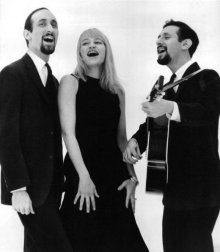 Sometimes the censors were totally off-base, interpreting an innocent children’s fairy tale like Peter, Paul & Mary’s “Puff the Magic Dragon” as a veiled reference to smoking weed. “Oh, for crying out loud,” said Peter Yarrow in 1963 when the song was released. “It’s just a children’s song, a story about a boy and a dragon.” But some stations in conservative areas blackballed it anyway, at least for a while.
Overt political views were sometimes deemed too controversial for radio play. Barry McGuire’s antiwar song “Eve of Destruction” (1965) made waves because of the line ‘they’re old enough to kill but not for votin’.” The Sex Pistols’ “God Save the Queen” (1976) and Paul 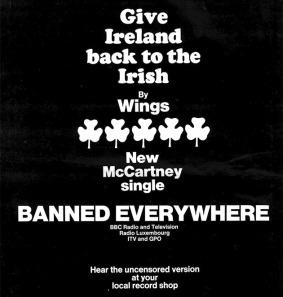 McCartney’s “Give Ireland Back to the Irish” (1972) were banned from the BBC for their perceived anti-government opinions.
Stations squeamish about offending religious groups took issue with The Beatles’ “The Ballad of John and Yoko” (1969), which was bleeped in most Bible Belt markets each time Lennon sang, “Christ! You know it ain’t easy…” Producers of the rock opera “Jesus Christ Superstar” had to battle mightily for a while to get the title track played in some communities that assumed it was blasphemous. The Charlie Daniels Band’s “The Devil Went Down to Georgia” (1979) met resistance too — not because of Satan (who loses the fiddle duel, after all), but with the line “I told you once, you son of a bitch,” which was changed to “son of a gun” in some markets.
The Who’s “My Generation” (1965), with its stuttering vocals, was thought by some to be offensive to those with speech impediments. Dire Straits’ “Money for Nothing” (1985) faced a fight regarding what many considered a defamatory remark against gays in the second verse — “that little faggot is a millionaire” — even though composer Mark Knopfler pointed out he was belittling the small-minded thinking of the character who spoke the line. In these cases, the bans didn’t last more than a week or so, but it’s interesting to note that objections were raised at all.
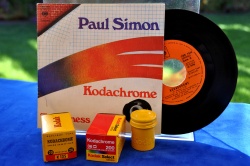 The BBC even had a firm rule against any commercial product placement in song lyrics, which caused problems for Paul Simon’s hit “Kodachrome” (1973). The Kinks’ singer Ray Davies had to return to a London studio to re-record a vocal part for the 1970 hit “Lola,” revising the lyric from Coca-Cola to cherry cola.
For years, “The Ed Sullivan Show” ruled supreme as the arbiter of which rock ‘n roll groups were worthy of nationwide TV exposure, beginning with Elvis in 1956 and up through the game-changing Beatles performances in early 1964. But Sullivan reserved the right to approve all material, and in 1967, he rolled the dice twice by inviting two 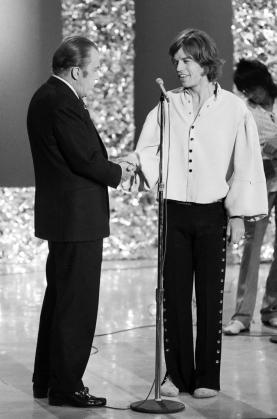 edgier acts to appear. First he booked those bad British brats, The Rolling Stones, and demanded that their brash young singer, Mick Jagger, change the words of “Let’s Spend the Night Together” to “Let’s Spend Some Time Together.” Jagger went along, but rolled his eyes at the camera each time he sang it.
Then a month later came Jim Morrison and The Doors, who were forced to alter their #1 hit “Light My Fire” by changing “girl, we couldn’t get much higher” to “girl, we couldn’t get much better” (even though it didn’t rhyme with “liar” and “fire”). Morrison played along during rehearsals, but when the show was taped, he looked defiantly into the camera and sang the real lyric, and Sullivan went through the roof, canceling all future appearances by the group.
The main problem with censorship, though, has alway been that it’s arbitrary and uneven in enforcement. Who gets to say what is objectionable? How do we determine the standards? When and where are they enforced? Why do some songs face an embargo or tampering while others skate by without any challenges?
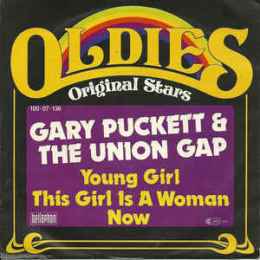 A couple of Gary Puckett songs in the late ’60s — “Young Girl,” “This Girl is a Woman Now” — focused on a creepy infatuation of a young girl by an older guy that, looking at it now, clearly bordered on pedophilia, but they somehow escaped the censors’ attention at the time. Even more curious was the case of The Buoys, a one-hit wonder group who had the sheer chutzpah to release a single in 1971 called “Timothy” that told the disturbing tale of three poor souls who were trapped in a caved-in mine, and two of the boys ate the third boy in order to survive!
The hypocrisy and randomness of the censors’ actions was puzzling, to say the least. Having sex in the grass? No way, Jose. Cannibalism? Hey, no problem. Share a little weed? Not on your life. Interest in underage girls? Oh, that’s okay.
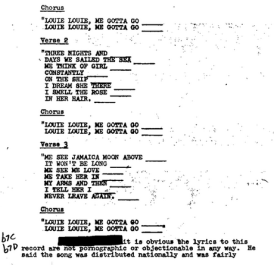 Perhaps the most extreme response to a supposedly objectionable lyric came in 1963 when a team of agents from J. Edgar Hoover’s FBI spent months investigating whether the words to The Kingsmen’s “Louie Louie” were obscene. Teens had furtively talked about how the lyrics were allegedly about a sexual liaison, but in fact, the song (written in 1957) was a rather bland ode from a sailor to his girl back home. Thanks to a marble-mouthed vocalist and less-than-optimum recording techniques, the words were pretty much impossible to decipher, even when studied at different speeds under headphones, and the FBI eventually threw up their hands.
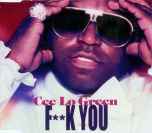 But that was then, this is now. In 2010, R&B artist CeeLo Green had an enormous hit with a song called, believe it or not, “F–k You.” They released a cleaned-up version called “Forget You” to satisfy radio programmers, but most listeners, to no one’s surprise, preferred the original.
The times they are a-changin’, indeed…

