August 31, 1974. A handful of friends and I were filing into cavernous Cleveland Muncipal Stadium for an eagerly anticipated “World Series of Rock” concert by Crosby, Stills, Nash and Young, with The Band and Santana also on the bill…but the weather looked grim. Even though we knew the music was going to be superb, none of us wanted to spend eight hours outdoors in crummy weather.
Grey skies turned darker. Rain started falling when the opening act, a talented singer-songwriter named Jesse Colin Young, took the stage with a modest backing band and sang nine or ten of his jazz-inflected folk rock songs. They gamely played through the raindrops as the stadium crowd of 82,000 began hunkering down for what looked to be a wet afternoon and evening.

But 45 minutes later, as Young began playing the title track of his new album “Light Shine,” something amazing happened. The rain stopped, the clouds began parting, and within a few minutes, the sun shone through. People rose to their feet in gratitude and applauded en masse, and from then on, the weather cooperated.
The fact that the storm ended as Young played “Light Shine” was just a glorious coincidence…or was it? I chose to give this musician credit for saving the day, and I headed out the next morning to buy the album, becoming enough of a fan to see him in concert three more times over the next several years.
This fond concert memory came back to me as I heard the sad news that Young died this week of heart failure at age 83. Although he achieved only modest success on the US pop charts during his career, he touched many lives. As rocker Steve Miller put it, “The world has lost a great troubadour with a huge heart and a beautiful, generous soul. Thank you for all the inspiration, peace, love and happiness you shared with us.”
Young’s biggest commercial success came early when he was the leader of the ’60s band The Youngbloods, who recorded the Chet Powers peace-and-love anthem “Get Together.” Powers had written it in 1963, and it was recorded by The Kingston Trio, We Five and Jefferson Airplane before The Youngbloods put their spin on it in 1967. Their single stalled at #62, but in early 1969, it was used in a “call to brotherhood” radio public service announcement by the National Conference of Christians and Jews. When re-released as a single, it reached #5 on US pop charts and has endured as a classic ever since.
Young said he had an epiphany when he heard singer Buzzy Linhart perform it in a Greenwich Village club in the mid-’60s. “The heavens opened and my life changed,” he recalled in 2021. “I knew that song was my path forward. The lyrics are just to die for. To this day, it gives me a thrill to play it.”
In case you’ve forgotten: “If you hear the song I sing, you will understand, /You hold the key to love and fear all in your trembling hand, /Just one key unlocks them both, it’s there at your command, /Come on, people now, smile on your brother, /Everybody get together, try to love one another right now…”
In his heartfelt obituary in The New York Times this week, writer Jim Farber wrote: “Young’s voice was as sensuous as his words. Blessed with a boyishly high pitch, and with the ability to bend a lyric with the ease that a great dancer uses to navigate a delicate move, he balanced his innocent character with a sophisticated musicality. His phrasing, like his composing, drew from a wealth of genres, including folk, jug band music, psychedelia, R&B and jazz, both traditional and modern.”

Young was born Perry Miller in 1941 in Queens, NY, and showed an aptitude for music he inherited from his mother, a perfect-pitch singer and violinist. He studied piano and classical guitar and was particularly enamored of blues, jazz and folk music during stints at Ohio State University and New York University. He admired the then-thriving folk music scene in Greenwich Village, quitting school to perform full time.
He chose his Western-sounding stage name by combining the names of outlaws Jesse James and Cole Younger, as well as the Formula One designer and engineer Colin Chapman.
In 1964, he won a contract with Capitol, releasing his debut LP, “The Soul of a City Boy,” a collection of acoustic blues and folk. While touring, he met guitarist Jerry Corbitt and formed The Youngbloods, who became the house band at Cafe Au Go Go in the Village for a spell.

Though the Youngbloods’ albums — “The Youngbloods” (1967), “Earth Music” (1968), “Elephant Mountain” (1969), “Good and Dusty” (1971) and “High on a Ridge Top” (1972) — never enjoyed much chart success, several of their songs proved popular on FM stations of the era, particularly in California, which helped precipitate Young’s move to the Marin County area, where he lived much of his life. One of those songs was the harrowing “Darkness, Darkness,” Young’s reflection on what he imagined US soldiers felt in the Vietnam War, which has been covered by a dozen other artists including Richie Havens, Eric Burdon, Mott the Hoople, Golden Earring, and Robert Plant, whose 2002 rendition won a Best Male Rock Performance Grammy.

Young chose to disband The Youngbloods and resume his solo career in 1973, releasing the impressive “Song For Juli” album, which out-charted anything The Youngbloods had done, peaking at #51. It contained mostly country rock originals as well as a jazz-inspired tribute to his Marin home, “Ridgetop.” That LP kicked off a respectable five-album run between 1973-1977: “Light Shine” (1974), “Songbird” (1975), the live “On the Road” (1976) and “Love on the Wing” (1977).
I found Young’s music so appealing because it tended toward feel-good melodies and positive topics. “Love of the natural world is as much a theme in my music as romantic love,” he said in 2016. “I got a bigger high out of walking over the ridgetop in Marin and looking out at the national seashore than any drugs I ever did.”
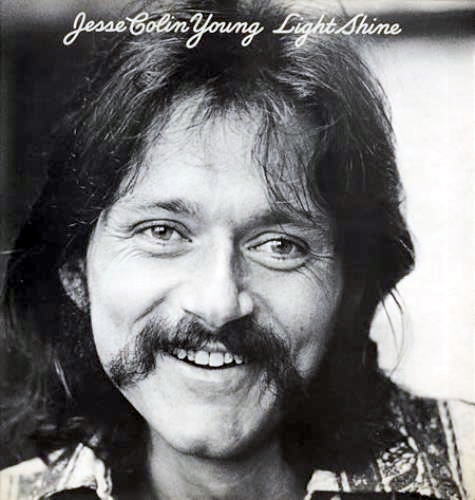
And yet, perhaps my favorite Young track is a pensive 11-minute piece called “Grey Day,” in which he observes how gloomy weather can affect his mood: “It’s a grey day, and the pine trees are dripping in a grey mist, /And I feel like I’m tripping in a grey world, /My reality’s a-slipping, /lost in a fog on a such a grey day…” He snaps out of it with the next tune, the aforementioned “Light Shine,” where he urges us to be beacons of hope: “Come on, be a sunrise, /Let your love light fill your eyes, /Yeah, and let it shine on all night and day, /Moving like a river flow, we can make the feeling grow /If you only shine on, shine on all day…”
He was among the socially conscious artists who participated in the “No Nukes” concert and movement in 1979, adding “Get Together” to the proceedings and subsequent album next to Crosby, Stills and Nash, Bruce Springsteen, James Taylor, Jackson Browne, Bonnie Raitt and The Doobie Brothers.
As times changed in the late ’70s and early ’80s, Young’s music fell out of favor with much of the record-buying public, but when I saw Young perform at a small club in Cleveland Heights in 1986, he held the small but adoring crowd in the palm of his hand. He continued to periodically release new LPs on various labels, including his own Ridgetop Music. Each of the ten albums he put out between 1978 and 2019 has some fine tunes worthy of your attention (some of which I just discovered in the past few days as I reviewed Young’s catalog), and I’ve included some of them among the better-known songs on the Spotify playlist you’ll find at the end of this piece.

I’d like to shine a spotlight on “For My Sisters,” one track from his final LP, 2019’s “Dreamers.” It has lyrics that I suspect many of us feel like singing loudly in these troubling times: “This is a song for resisters and everything we hold dear, /A world where everyone’s welcome, and all our voices are heard, /And though the darkness surrounds us, we feel the love that has bound us, /And we won’t fake it anymore, you can’t fake it anymore, /It’s time to even up the score, don’t mistake it, /We won’t take it anymore…”
Rest in peace, gentle troubadour. Let us hope we soon learn not just to “try and love one another” but to actually do it.
**********************


Wonderful tribute Bruce. I was at the Cleveland Stadium World Series of Rock Concert also. What a great day! Saw JCY at the Winchester Tavern with his daughter. He was a great human being. Very sad.
Thanks for what you do.
David Chilcote
LikeLike