I’m in pieces, bits and pieces

Some of classic rock’s tales aren’t quite long enough to warrant full treatment, but they’re still worthy of attention. So I’ve gathered up a little bit of this and a little bit of that, and I’ve thrown them into the pot for a mixed bag of short stories I hope you enjoy:

************************

A classic rock self-fulfilling prophecy

They were just a ragtag band of misfits, essentially a bar band from Jersey that, against all odds, made a dream come true.

They were called Dr. Hook and the Medicine Show, named partly because of Ray Sawyer, one of their singers, who had lost an eye in a car accident and always wore an eye patch. They played a lively brand of country, rock and folk that was alternately funny and serious, and their improvisational performances were full of suggestive lyrics and partial nudity. They were making it up as they went along.

They ambushed Clive Davis in his Columbia Records office one day in 1971 and danced on his desk as they auditioned their songs for him, and they must’ve caught Davis in a vulnerable mood because they were just playful enough in their anarchic presentation to win a contract.

Their manager/producer helped cement a relationship between the band and poet/author/songwriter/playwright Shel Silverstein, who wrote the children’s book “Where the Sidewalk Ends” and also wrote “A Boy Named Sue” for Johnny Cash. Silverstein’s first effort for Dr. Hook was a bittersweet ditty called “Sylvia’s Mother,” which proved to be an unlikely hit in early 1972. He proceeded to write them a whole batch of whimsical, bawdy songs like “Freakin’ at the Freakers’ Ball,” “Get My Rocks Off” and “If I’d Only Come and Gone” for their second album, “Sloppy Seconds.”

That album also included a clever parody of the rock and roll lifestyle called “The Cover of Rolling Stone,” which claimed that, even if a band had all the groupies and pills and friends that money could buy, their biggest goal would be “the thrill that’ll getcha when you get your picture on the cover of the Rollin’ Stone.” It was released as a single in late 1972 and did decent business on the charts, but it wasn’t until Dr. Hook’s manager barnstormed the offices of Rolling Stone and sold editor Jann Wenner on the plan to make the song a reality that it reached #6 in the spring of 1973.

Truth be told, the magazine was only five years old at the time, and Wenner’s notoriously huge ego wanted the fame and cachet of being regarded as a savvy businessman. He saw how the song lyrics and title helped give his counterculture publication a jumpstart toward a more mainstream audience. He sent a veteran writer on tour with Dr. Hook for a couple weeks and came up with a cover story on the band (though, by all rights, they hadn’t achieved enough to really deserve it).

In the end, Dr. Hook never got their photo on the cover, but the March 28th, 1973, issue featured a caricature of the band and the words, “What’s-Their-Names Made the Cover.” As far as the band was concerned, they had indeed made it.

The coveted cover spawned by Dr. Hook’s song

**************************

Let me stand next to your fire

In March of 1967, a still-unknown trio called The Jimi Hendrix Experience was set to perform at a London club on a bill that included Cat Stevens, The Walker Brothers and Englebert Humperdinck. While the band waited to perform, Hendrix and his manager Chas Chandler were discussing ways to increase the band’s media exposure. A local journalist named Keith Altham was also there, and he suggested they needed to do something more dramatic than The Who’s penchant for smashing their instruments. Altham thought for a moment, then said, “Well, it’s a pity you can’t set fire to your guitar.”

Chandler’s eyes lit up, and he asked the road manager to find some lighter fluid. The group gave a torrid 45-minute performance, which concluded with Hendrix lighting his Fender Stratocaster on fire. The stunt worked, giving Hendrix more attention than he bargained for, and he repeated it three months later at the Monterey Pop Festival in California with film cameras capturing it for posterity.

After the London show, press agent Tony Garland gathered the charred remains of the guitar and took them to his parents’ home and stored them in their garage, where they remained for nearly 40 years.

One day in 2006, Garland’s nephew was combing through boxes in that garage when he found the seared Strat and, knowing that his uncle had once worked for Hendrix, did a little research. Sure enough, he had a rock and roll heirloom on his hands, and it was auctioned off later that year for $575,000.

Jimi Hendrix’s first char-grilled guitar

*************************
“Really Cheap Pine”

Much has been written about the songwriting partnership of John Lennon and Paul McCartney and how they wrote “nose to nose” in the early days but were composing songs virtually solo in The Beatles’ last two or three years. In 1965, for their groundbreaking masterpiece LP “Rubber Soul,” they were still merging ideas for melodies, lyrics and arrangements, and one of their finest efforts, “Norwegian Wood,” came from that period.

McCartney has published his recollections about the origins of songs from The Beatles’ catalog, and here’s what he had to say about this one: “John came in one morning, and he had this first stanza, which was brilliant: ‘I once had a girl, or should I say, she once had me.’ That was all he had, no title, no nothing, but we both could tell where this one was going to go based on that opening line. And it pretty much wrote itself. Once you’ve got the great idea, they do tend to write themselves, assuming you know how to write songs.

‘It’s him trying to get laid, it’s about an affair, but he wanted to be more cryptic about it because of Cynthia, you know. So I picked up the story at the second verse. John said in that Playboy interview he did just before he died that he hadn’t the faintest idea where the title came from. But I do. A friend of ours had just had his room done out in wood. A lot of people were decorating their places in wood. Norwegian wood. It was pine. Really cheap pine. But that’s not as good a title. “Isn’t it fine, Really Cheap Pine”…

Anyway, the girl decides she doesn’t want to do it, and she makes him sleep in the bath. In the last verse, I had this idea to set the Norwegian wood on fire as revenge, so we did it very tongue in cheek. She had led him on, then said, ‘You’d better sleep in the bath’. We thought the guy would want to have revenge of some kind. ‘I lit a fire’ could have meant to keep myself warm, and wasn’t the decor of her house wonderful? But it didn’t. It meant I burned the fucking place down as an act of revenge, and then we left it at that, and ended it there.”

**************************

It’s not always about romance

Writing lyrics about one thing when you mean something else is a favorite ploy of rock songwriters. Two of the biggest hits Daryl Hall and John Oates ever charted offer two examples of this technique.

In 1981, they released “I Can’t Go For That (No Can Do),” which appears to be about one half of a romantic couple telling the other half that there are some things they refuse to do: “You’ve got the body, now you want my soul, /Don’t even think about it, say ‘no go,’ /I’ll do anything that you want me to do, /Yeah, I’ll do almost anything that you want me to, /But I can’t go for that, no, no can do…”

Oates explained, “In reality, that song is about the music business. It’s about not wanting to be pushed around by record labels, managers and agents, and being told what to do, and wanting to stay true to yourself creatively. But we thought it would be a good move to universalize the topic of the song, making it into something everyone could relate to and ascribe personal meaning to in their own way. So we kept the words less specific, and it worked out well.”

The same sort of thing happened the following year as Hall was working on a song about New York City in the ’80s and how it could be a tough place that put people through the wringer. Said Oates, “But we started thinking that there are a ton of listeners who’ve never lived in New York or even been there, and maybe couldn’t relate to that. So we made it about not a city but a manipulative woman. People can identify with that kind of experience, I think. So it became ‘Maneater'”: “I wouldn’t if I were you, I know what she can do, /She’s deadly, man, and she could really rip your world apart, /Mind over matter, ooh, the beauty is there, but a beast is in the heart, /Oh-oh, here she comes, watch out boy, she’ll chew you up, /Oh-oh, here she comes, she’s a maneater…”

“The most heart-melting love song ever penned”

It seems a safe bet that there have been more songs written about love than any other topic, so it’s an almost impossible task to select the best ones, or to designate one as the finest of them all.

In 1966, Brian Wilson was collaborating with lyricist Tony Asher on a new batch of songs slated to comprise The Beach Boys next LP, “Pet Sounds.” Wilson had been riding high for the past five years writing most of the group’s hits, from “In My Room” and “Don’t Worry Baby” through “California Girls” and “I Get Around.” He developed a healthy if grudging respect for the songs of The Beatles when they first appeared on U.S. charts in early 1964. By late 1965, though, his confidence faltered when he heard their album “Rubber Soul,” which knocked him off his feet. “Those songs were so wonderful,” Wilson recalled, “and I felt that I really had to up my game if we were still going to be able to stay up with them.”

Wilson sat at the piano, working his way through melodies and chord progressions, landing on some that didn’t seem like the pop music he’d been writing but still intrigued him. Asher said, “I was there with Brian, and I came up with what I felt was a grabber of a first line: ‘I may not always love you.’ Brian argued against it, but I really liked that twist, and I defended it by writing the next couple of lines as, ‘But long as there are stars above you, you’ll never need to doubt it.

Asher continued, “Then there was a disagreement about using ‘God’ in not only the words but the title. We had lengthy conversations about that, because unless you were Kate Smith singing ‘God Bless America,’ no one thought you could say ‘God’ in a pop song.  Brian said, ‘We’ll just never get any air play.’ But some people told him it was “an opportunity to be really far out because it would cause some controversy, which he didn’t mind at all. So we kept it in.”

The song, of course, is “God Only Knows,” which has been described by Paul McCartney as “the greatest song ever written” and by multiple Grammy-winning songwriter Jimmy Webb as “my favorite song of all time.” Barry Gibb of The Bee Gees has said, “When I first heard it, it blew the top of my head off. My first thought was, ‘Oh dear, I’m wasting my time, how can I ever compete with that?'”

It’s been recorded by literally hundreds of artists from Andy Williams to David Bowie, from Manhattan Transfer to Michael Bublé, and in 2014, a special recording of it was made involving Wilson and such luminaries as Elton John, Stevie Wonder, Chrissie Hynde, Pharrell Williams, Chris Martin and Lorde. There’s an astonishing version by a guy named Nicholas Wells that features his multi-tracked voice doing all the harmonies that’ll send chills up your spine. The Beach Boys original recording of it has also been used in many film soundtracks like “Love Actually” and “Boogie Nights.”

Even so, Wilson, who had the most amazing ear and musical sense, was right about one thing: It didn’t get much air play, at least not at first. It stalled at #39 on the U.S. charts upon first release, although it went to #2 in England, where perhaps the use of “God” in a pop song wasn’t such a problem.

Tony Asher (left) and Brian Wilson

*************************

Life’s tragic twists

Irony can be humorous — like when a truck carrying old discarded tires has a blowout — but it can also be mighty cruel. That’s the sad case with singer-songwriter Jim Croce.

Croce was in bands and coffeehouse trios and in a men’s chorus in college at Villanova University in Philadelphia, and cut an album, “Facets,” in a Delaware studio at age 23 for $500. He married his wife Ingrid, also a singer, in 1966 and performed with her as a duo, doing covers of popular songs, mostly in small clubs on the East Coast college circuit. They recorded an album for Capitol Records, “Jim and Ingrid Croce,” in 1969, comprised of a dozen songs they had written. Neither of these recordings made them much money, and even the pay they received for gigs wasn’t covering the rent. They became disillusioned with the music business, and moved to a farm in Pennsylvania.

Croce took to working various odd jobs — truck driver, welder, construction work, teaching guitar lessons — but he couldn’t shake his desire to keep writing songs, often with lyrics about his experiences at those jobs (case in point: “Working at the Car Wash Blues,” eventually recorded in 1973). This continued for another two years or so, as he and Ingrid struggled to make ends meet, but once she found out she was expecting, Croce became more focused on making music his profession.

Ingrid, A.J. and Jim Croce

In 1972, a demo tape he shopped around was turned down by three dozen labels, but his perseverance paid off when RCA Records signed him to a three-record deal. His first single, the upbeat, whimsical “You Don’t Mess Around With Jim” from the debut album of the same name, made its way up the charts, and reached #8 in September 1972. The more downbeat, poignant “Operator” followed, peaking at #17 in December, and things looked promising. He made appearances on “American Bandstand,” “The Tonight Show,” “Dick Cavett” and “Midnight Special,” as another original song about a rough-and-tumble sort, “Bad, Bad Leroy Brown,” spent two weeks as the nation’s #1 song in July of 1973.

His next album and its title song, “I Got a Name,” poised for release on September 21, seemed to say it all. Croce was on a roll and had finally established himself as a successful singer-songwriter. But all the touring required to support his records wore him down, and he missed his wife and young son A.J. In a letter to Ingrid dated September 17, Croce told her he had decided once the current tour ended to quit music and stick to writing short stories and movie scripts as a career and withdraw from public life.

But fate intervened, and on September 20, Croce and four others, heading from one gig to another, were killed when their twin-engine plane crashed during takeoff in Louisiana.

“I Got a Name” was released the next day as planned and reached #10, and “Time in a Bottle,” released a few months later, was a posthumous #1 hit, but Croce never got to enjoy their success.

This photo of A.J. Croce holding his dad’s hat
appeared on the inside sleeve of Croce’s “Greatest
Hits” collection in 1974

**************************
 

The stories we could tell

The archives of rock music are full of unusual anecdotes, bizarre historical notes, strange coincidences and amusing back stories. Here at Hack’s Back Pages, I have shared some of them in longer essays about major artists, or in brief write-ups about specific songs on a themed playlist. For this post, I’ve compiled 10 fascinating tidbits from the classic rock era that I thought would pique your interest. At the end you’ll find two playlists of songs I’ve referred to in the text.

Rock on!

**********************
Steam’s B-side #1 hit

In 1969, a struggling young band known as Steam recorded a song called “It’s the Magic in You, Girl,” selected by their label as a potential hit.  They were then told, “Okay, now go ahead record something else, anything at all, to put on the B-side of the single.  It can be instrumental, it doesn’t matter.  Whatever you want.”  They started playing a light, accessible groove, jamming for 20 minutes while the singer added a bunch of “na na na”s and other off-the-cuff lyrics, and they were done.  The producer edited it down to the best three minutes, slapped it on the back of “It’s the Magic in You, Girl,” and shipped it out. As it turned out, DJs thought the A-side was lame and ignored it, but they were taken by the catchy ditty on the B-side.  Within a few weeks, “Na Na Hey Hey Kiss Him Goodbye” was the #1 song in the country.

*********
Richie Havens and band at Woodstock

Because the organizers of the Woodstock Music and Arts Fair had seriously underestimated the crowd turnout for the three-day event in August 1969, access to the site was hopelessly jammed, causing substantial delays for several of the musical acts who were scheduled to perform. Because of this, Richie Havens, a Greenwich Village folk act, valiantly stepped in to the opening slot and proved to be a welcome surprise.  Havens had intended to play a 45-minute set list of folk songs and covers, including his minor anti-war hit “Handsome Johnny,” but he was told to continue playing for nearly two hours because the bands scheduled after him still hadn’t arrived. Having run out of tunes, he ended up improvising on the old spiritual “Motherless Child” that ended up becoming one of the festival’s anthems, “Freedom.”  Said Havens later, “I’d already played every song I knew and I was stalling, asking for more guitar and mic, trying to think of something else to play – and then it just came to me.  My band and I riffed on a few chords and I just sang ‘Freedom!’ over and over. Hey, the establishment was foolish enough to give us all this freedom, and we used it in every way we could.”

*********

The Funk Brothers backing Stevie Wonder

From 1964 to 1969, Motown artists made an enormous presence on the US Top 40 airwaves. Artists like The Supremes, The Temptations, Smokey and The Miracles, The Four Tops, Marvin Gaye and Stevie Wonder had major chart success with multiple hit singles, and Mary Wells, Martha and The Vandellas, The Contours, Gladys Knight and The Pips, Kim Weston, Junior Walker and The All-Stars, and Brenda Holloway also took turns on the pop charts with records that are still enormously popular more than 50 years later.  The unsung heroes of all this dazzling music were the dozen top-flight session musicians who accompanied the singers on every one of their records. They were the Motown Records house band, and they referred to themselves as The Funk Brothers: Drummers Benny Benjamin and Uriel Jones, guitarists Robert White and Eddie Willis, keyboardists Joe Hunter and Earl Van Dyke, percussionist Eddie Brown and the incomparable James Jamerson on bass. Name any iconic Motown hit, and these guys played on it. Martha Reeves once refused to cut a track when key players were unavailable, declaring, “Ain’t no one recording nothing without The Funk Brothers!” You can now learn the whole story behind The Funk Brothers on the documentary “Standing in the Shadows of Motown.”

*********

Status Quo 1968 hit single

Just as there have been many dozens of artists who made it big in the US but are unknown in England, the reverse also holds true. Bands like Slade, The Jam, Blur and Manic Street Preachers have had broad chart success in the UK but made barely a dent in America. One of the more remarkable examples of this is Status Quo, who debuted in both countries in early 1968 with the psychedelic rock hit, “Pictures of Matchstick Men,” which peaked at #12 in the US and #2 in England.  American listeners never heard from them again, but in Britain, they set chart records that still stand today.  Once Status Quo switched from psychedelia to a boogie band, they have charted more than 20 Top Ten LPs in England and Europe, including four #1s between 1972 and 2019, and they have more than 60 singles, with 40 of them reaching the Top 20.  In the US, you’d be hard pressed to find more than a handful of people who’ve ever heard of Status Quo, although “Pictures of Matchstick Men” might still turn up on ’60s “one-hit wonder” playlists from time to time.

*********
“The Graduate” soundtrack

In 1967, Mike Nichols was directing the rather controversial comedy film “The Graduate,” starring Anne Bancroft and Dustin Hoffman. When the time came to select music for the soundtrack, Nichols, a big fan of Simon and Garfunkel, approached Paul Simon to write some songs for it. Simon was hesitant, but agreed, coming up with plot-appropriate new material about divorce (“Overs”) and angst about the future (“Punky’s Dilemma”). Nichols wasn’t thrilled with either one, and opted to use S&G tracks like “The Sound of Silence” and “Scarborough Fair.” Simon mentioned he had another song he was working on called “Mrs. Roosevelt,” adding, “I guess I could change it to ‘Mrs. Robinson‘…” Nichols went nuts. “You have a song called ‘Mrs. Robinson’ and you weren’t even going to play it for me?!” Simon replied, “Well, I haven’t finished it. I only have the chorus.” Since Nichols was fast approaching a deadline so the film could be released before year’s end, he had S&G record just the chorus of “Mrs. Robinson,” which was used in a couple of different scenes when Hoffman’s character is driving. And that’s why you don’t hear the whole song in the movie. Simon completed it a month or two later, the duo recorded the full tune for their “Bookends” LP, and by June 1968, it was the nation’s #1 single.

*********

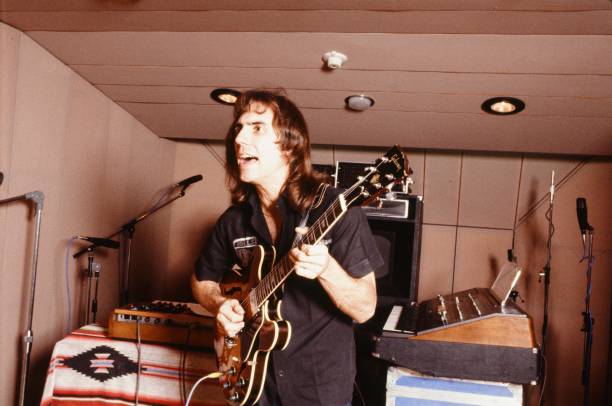
Mick Hucknall

Dynamic lead singer and front man Mick Hucknall sported a head of long, unkempt red hair, which made him the undisputed visual focal point of his group, a Manchester punk band known as The Frantic Elevators. Although they disbanded in 1984, Hucknall started anew with a fresh lineup, performing British soul music.  They chose to adopt the name Red (Hucknall’s nickname, of course), but one night, the promoter of a club where they were performing asked them their name, Hucknall responded, “Red.  Simply Red.”  Sure enough, when they went on stage an hour later, they were introduced as “Simply Red.”  They were amused by the misunderstanding and decided to keep the name, becoming enormously popular in the UK and, to a lesser extent, the US as well.

*********

Gregg Allman

In early 1969, electric guitar virtuoso Duane Allman had finally assembled the powerhouse group he had been looking for: a rock-solid bass player, not one but two drummers, and a second lead guitarist, with whom he could trade solos and build inventive harmonies on blues classics and originals alike. But he was missing a singer, and he knew exactly who he wanted.  “There’s only one guy who can sing in this band, and that’s my baby brother,” Duane said defiantly. Gregg Allman, keyboard player/singer/songwriter, was still under the thumb of a record company in L.A., where the brothers had been pushed into recording two unsatisfying albums as The Hour Glass.  Duane had bailed on the contract in favor of session work back in Georgia, leaving Gregg to appease the label. Duane implored his brother to return, so Gregg hitchhiked home and walked into a rehearsal, where the group dove in to a Muddy Waters song they’d been working on called “Trouble No More,” and Gregg was floored.  Duane told Gregg to sing, and he confided, “I don’t know if I can cut this. I don’t know if I’m good enough.”  The older brother retorted, “You little punk, I told these people all about you, and you’re not gonna come in here and let me down.”  They counted it off and Gregg gave it all he had.  “Afterward, there was a long silence,” Duane said, “and we all knew.”

*********
“Maybellene”

It was May of 1955, and the record business was about to undergo a sea change. In addition to the six major labels that dominated the industry, smaller independent companies were making their mark with lesser known niche artists who enjoyed some success on a regional basis with narrower audiences.  One of these was Chess Records in Chicago, which specialized in blues and R&B music with artists like Muddy Waters, Howlin’ Wolf and Etta James. Label honcho Leonard Chess was eager to find a “crossover” act — a black musician who could take the energy of R&B and make it acceptable to white radio stations and audiences. “What I need,” he mused, “is someone who can successfully merge country music with blues music.” Enter Chuck Berry, who shared the desire to merge the fire of blues with the story-telling of country. He took an old Nashville song called “Ida Red,” gave it a bluesier beat and wrote lyrics about two cars challenging each other. Chess was overjoyed, but changed the title and chorus to “Maybellene,” and within a couple months, it reached #6 on the Top 40 charts as the first mainstream rock ‘n roll song.

*********
“Sittin’ In”

Jim Messina had been the producer (and a musician) on Buffalo Springfield’s last album in 1968, and had then joined forces with Richie Furay to form Poco, producing that group’s first three albums as well. By 1971, he decided to sign a six-album deal with Columbia as an independent producer. The label assigned him to crooner Andy Williams (“it just wasn’t a good fit”), and then tried pairing him with Dan Fogelberg, who wanted to make an album “just like Poco,” but Messina wanted something different. He accepted an offer to groom newcomer Kenny Loggins, who had great songs and a voice but not much else. Messina set him up with a talented band of players, helped him hone his existing songs and co-wrote a few more with him, and ended up singing and playing on many of the tracks as well. By the time the LP was ready for release, Columbia thought Messina was so integral to the project that they chose to call it “Kenny Loggins With Jim Messina Sittin’ In.” He brought name recognition and was included in the cover photo as another card player around a poker table. The solo artist became Loggins & Messina, a duo that lasted for seven successful albums over six years.

*********

“McCartney”
“John Lennon/Plastic Ono Band”
“All Things Must Pass”
Ringo’s “Beaucoups of Blues”

The Beatles last recorded together in the summer of ’69 for the “Abbey Road” album, but their final album release came in the spring of ’70 with “Let It Be,” even though those tracks were recorded 18 months earlier. Soon enough, solo albums from each Beatle were released. So the public at large, especially those who didn’t come of age until decades later, can be forgiven for sometimes mistaking songs from solo albums as Beatles tracks. Many people think “Maybe I’m Amazed” is a group effort, but it comes from “McCartney,” Paul’s solo debut. Tunes like “What Is Life” and “Isn’t It a Pity” certainly have a Beatlesque flavor to them, but they both appear on George Harrison’s first solo LP, “All Things Must Pass.” John Lennon’s “Working Class Hero” sounds like a lost track from “The White Album” sessions. Even Ringo’s hit “It Don’t Come Easy” (co-written with Harrison) sounds like a Beatles tune. Just for fun, a couple of years ago I assembled two dozen songs from the four musicians’ 1970-1971 solo albums and labeled it “The Lost Beatles Album,” which envisions what might have resulted if they’d stayed together another year or so. I’ve included it as a separate Spotify playlist below.

****************************