Seasons change and so did I
Periodically, I use this space to pay homage to artists who I believe are worthy of focused attention — artists with an extraordinary, influential, consistently excellent body of work and/or a compelling story to tell. In this essay, I delve into the work of a group that is considered royalty in its native Canada, and revered among many U.S. fans as one of the best Top 40 hit bands of the late ’60s and early ’70s: The Guess Who.
***************
I have always loved the songs of The Guess Who, and the amazing rock vocals of Burton Cummings. When tunes like “Undun” or “Hand Me Down World”

Clockwise from top: Burton Cummings, Randy Bachman, Garry Peterson, Jim Kale
or “Albert Flasher” come on the radio, I am instantly transported to 1970-71, hanging with friends and driving with my girl around the east side suburbs of Cleveland, Ohio.
To me, their records were perfect little pop songs, carried either by Cummings’ rollicking piano and distinctive voice or the stinging guitar riffs of Randy Bachman (at first) or Kurt Winter. Between 1969 and 1974, The Guess Who was Canada’s biggest success story, scoring 10 Top 20 hits in the US and twice that number in their native country. Their albums performed less well (only three reached Top 20 status in the US), which isn’t really all that surprising, as the group was, from the outset, a singles band.
“We had our eye on the Top 40 charts,” Cummings reflected. “That was our goal, to have a hit single in the US. Once we did that with ‘These Eyes’ in early 1969, Randy and I gained the confidence to write more in the same vein, and then they became hits too.”
Soon, recalls Bachman, “It was like we were finishing each other’s sentences. I’d play Burton a whole song of mine, he’d play me a song of his, and we’d say, ‘Let’s make mine the verse and make yours the chorus,’ and vice versa. Sometimes we had heard songs we wanted to imitate, something by Lennon and McCartney, or Brian Wilson, or even Burt Bacharach and Hal David. We liked to rock, but we enjoyed writing ballads too.”
Few people would claim that The Guess Who catalog had a lot of emotional depth. The lyrics were often quirky, sometimes even a bit lame, but when put to irresistible melodies as sung by Cummings, it didn’t seem to matter. Consider, for instance, “Rain Dance.” What are we to make of these words? “Fifi said to Don the baker, ‘Can you show 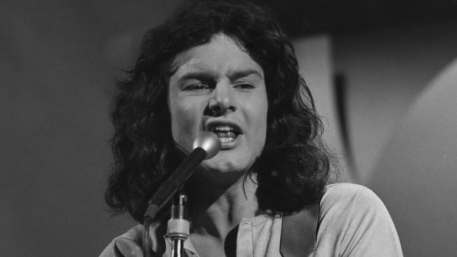 me how to make another bun, Don?’, And I’m still standing with my next door neighbor saying, ‘Where’d you get the gun, John?’…” Cummings fashioned such a memorable melody line that the song ended up at #19 (in Canada, it reached #3).
There were instances, though, when Cummings came up with lyrics that had substance, like on the melancholy piano ballad “Sour Suite,” a minor hit which touched on the sad feelings of an off night and depressing memories the next morning (“I don’t want to think about a runaway dad that took away the only thing that I’ve ever had, don’t even miss him this morning, I don’t want to think about a cold goodbye, or a high school buddy got a little too high, I can’t help him out this morning…”)
So let’s answer the question many people have always been curious about: Why “The Guess Who”?
Originally, Bachman (then only 16) had formed a group in 1962 with drummer Garry Peterson and bassist Jim Kale, with singer/guitarist Chad Allan as the front man. Using the common naming format of many rock bands of that period, they called themselves Allan and The Silvertones. They soon morphed into Chad Allan and The Reflections, and gained some notoriety in Canada, mostly in and around their home base of Winnipeg in the central Canadian province of Manitoba. By 1965, they changed their name to Chad Allan and The Expressions because a US band called The Reflections had scored a Top 10 hit with “Just Like Romeo and Juliet.”
As Chad Allan and The Expressions, things started happening when they recorded a cover version of “Shakin’ All Over,” a 1960 hit in England by Johnny Kidd and The Pirates.  The Expressions’ label, Quality Records, frustrated by the inability of Canadian groups to break into the American market, came up with an idea: They chose to credit the record to (Guess Who?), hoping it would be better received if it was thought to be by a British Invasion act. Sure enough, the song reached #22 in the US in early 1965 and went all the way to #1 in Canada. The band’s real name was revealed a few months later, but disc jockeys continued to announce the group as The Guess Who, which effectively forced the official name change.
In 1966, Cummings was added on keyboards and backing vocals, but then Chad Allan chose to leave the band, which put Cummings at the forefront as lead singer. This new lineup kept the momentum going in Canada with several Top 20 singles, including Neil Young’s “Flying on the Ground is Wrong,” the eventual Carpenters’ hit “Hurting Each Other” and two Bachman compositions, “Believe Me” and “Clock on the Wall,” but they all stiffed in the US and elsewhere.
Once Bachman and Cummings put their songwriting talents together in 1968, something clicked. “These Eyes” zoomed to #6 in the US, followed by “Laughing” at #10 (a chart topper in Canada). “Undun” did less well, stalling at #22, but “No Time” reached #5 in the US and was another #1 in Canada. This was all in the space of 10 months.
(“No Time” had actually been first recorded in ’68 with a weird intro, a longer guitar break and an extended vocal section at the end. This version rarely gets heard, but you’re in for a real treat — you can hear it on the Spotify playlist at the end of this essay. Cummings’ vocals and Bachman’s guitar are both amazing here).
Then came the strange case of “American Woman.” The band had returned to Canada after a long string of American shows, and at a small hall in Ontario, they were taking the stage after a brief break. Bachman was tuning his guitar after replacing a broken
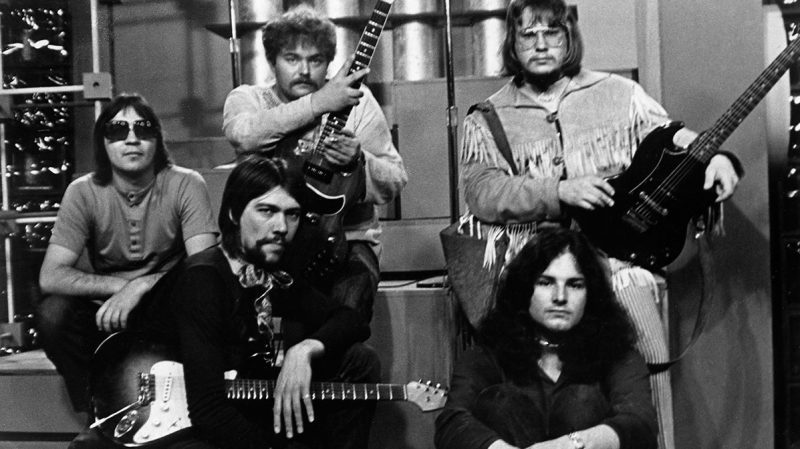
(Clockwise from left): Jim Kale, Greg Leskiw, Garry Peterson, Burton Cummings, Kurt Winter
string and realized he was playing a new riff. The other members returned to the stage and joined in, creating a jam session in which Cummings improvised lyrics about how homegrown Canadian women were preferable to American girls. A couple of lines (“I don’t need your war machine, I don’t need no ghetto scenes”) were interpreted as anti-American, but as Cummings said, “It was just a sentiment I ad libbed that night. The Vietnam war was raging at the time, and we had a lot of draft dodgers in the audience.”
The band recorded the song a week later and, despite the apparent putdown (“American woman, stay away from me”), the song zoomed to #1 in the US and Canada, as did its flip side, “No Sugar Tonight/New Mother Nature.”
Festering underneath this success, though, was increased tension between Bachman and Cummings. Bachman had chosen to avoid drink and drugs and had even converted to Mormonism, while Cummings was more of a wild child (as were Kale and Peterson).  According to “Bachman,” the recently released documentary, “I had become the group’s de facto manager. I was handling our business affairs, counting the money, constantly up in the morning, going to the bank when it opened, coming back, and then getting [the other band members] out of bed, nursing their hangovers and driving them to the next gig. When you do that 300 days a year, it takes its toll.”
Bachman had been suffering painful gallbladder problems and needed surgery, but the touring prevented him from getting the care he needed. Things came to a head in May 1970, when Bachman played his last show with The Guess Who at New York City’s Fillmore East. “We hit No. 1 with the American Woman album and single, and now we’re suddenly headlining. I said, ‘Okay, guys, I need to go home for two weeks. I have an operation scheduled.’ They said, ‘Great, well, we’re gonna keep going.’ I said, ‘Am I coming back?’ They said, ‘No, we’re kind of glad you’re gone.’ They were into the drug culture, I wasn’t. So I was glad to leave, but I was sad to leave. This had been my life. I had run this band.”
Bachman’s place was quickly filled by guitarist Kurt Winter, an old Winnipeg friend who offered not only great guitar work but wrote some memorable tunes like “Bus Rider” and “Hand Me Down World.” Because The Guess Who’s radio hits kept on coming almost
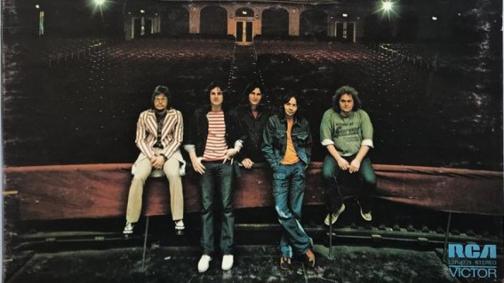
From their “Live at the Paramount” album cover, 1972
seamlessly, the casual listener took no notice of Bachman’s departure. Winter became Cummings’ new songwriting collaborator, and they teamed up on “Hang On To Your Life,” “Rain Dance,” “Heartbroken Bopper” and “Runnin’ Back to Saskatoon.” Alone, Cummings came up with “Share the Land,” “Albert Flasher,” “Glamour Boy” and my personal favorite, 1974’s “Star Baby.”
I couldn’t help but feel sad that The Guess Who’s final chart success was the insipid “Clap for the Wolfman,” a tribute of sorts to the radio legend Wolfman Jack. To my ears, it’s boring, and pales in comparison to almost any other track in The Guess Who’s repertoire.
By 1975, Cummings decided to give a solo career a try, effectively ending the band’s run. Kale bought the rights to the name and continued assembling various Guess Who lineups to hit the road and even record albums over the ensuing years, but none could manage much success.
Cummings’ first attempts at going it alone did all right, with “Stand Tall” (#10 in the US), “I’m Scared,” “Break It to Them Gently” and “You Saved My Soul” all reaching the charts, but it didn’t last long. Still, he stayed active in the business, writing and producing and occasionally performing. He even participated in a few Guess Who reunion concerts,

Bachman and Cummings in the late ’80s
with and without Bachman in the lineup, which is fairly remarkable, considering the way they parted ways in 1970. Naturally, those shows generated the most enthusiasm from the public.
Said Cummings in 1986, “Sometimes when you leave a well-known band, it’s almost immediate death. Lots of people have tried it and fallen by the wayside. I’m pleased that there are still people who like me or my songs or the way I sing them. Some of them like me well enough to come see me perform. And I do sing quite a few Guess Who tunes. Hey, those were some great songs. I was the band’s singer, and I wrote or co-wrote most of the songs, so why would I avoid performing them? Certainly the audience wants to hear them.”
As for Bachman, he struggled upon leaving The Guess Who in 1970 because industry folks couldn’t understand why he would leave a group just as it had attained a #1 album and single. But he soldiered on, first putting together a country rock band called Brave Belt with old colleague Chad Allan, and when that didn’t pan out, he recruited his brothers Tim and Robbie and bassist/vocalist Fred Turner to form Bachman-Turner
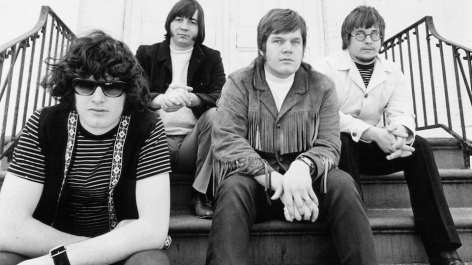
The Guess Who, 1968
Overdrive in 1973.
BTO enjoyed a very successful run for a few years, churning out solid pop rock hits like “Takin’ Care of Business,” “Let It Ride,” “Ain’t Seen Nothing Yet” and “Hey You.” (Me, I always favored the sultry, jazz-inflected “Blue Collar” featuring Turner’s vocals.)
So… Is the story of The Guess Who compelling? Perhaps not. Is their body of work “extraordinary, influential or consistently excellent”? Hmmm, not so much. But nevertheless, I just go crazy when I hear “These eyes have seen a lot of loves but they’re never gonna see another one like I had with you” and “I was a workshop owner in the gulch for the people and I offered myself to the world,” dammit! And I have a hunch that many of my readers share my affection for the songs of The Guess Who. I hope the Spotify playlist I’ve assembled below (which includes a few solo Cummings and BTO selections) hits the spot for you this week.
*************
 To some extent, we are all creatures of our own times. The people we knew, the experiences we had, and definitely the music we listened to when we were in our teens and ’20s made permanent impressions on us.
 Pete Townshend struggled mightily to come up with a suitable followup to The Who’s monumental rock opera “Tommy.” His concept, entitled “Lifehouse,” was to be a multi-media project focusing on the relationship between an artist and his audience, centered around the idea of one perfect, universal note symbolizing human unity. Townshend damn near had a nervous breakdown over the frustrations encountered in bringing the thing to fruition, which caused him to abandon “Lifehouse” and instead release most of its music as a single album. That album, “Who’s Next,” is often regarded as The Who’s finest, but curiously, it’s missing “Pure and Easy,” the excellent tune that best defined the project for which it was written. That outstanding track didn’t appear until the 1974 compilation album “Odds & Sods.”
 Coming during a transitional phase in The Kinks’ career arc, “Lola Versus Powerman and the Money-go-round, Part One” was described by one critic as “a wildly unfocused but nevertheless dazzling tour de force, featuring some of Ray Davies’ strongest songs.” Certainly, “Lola” was an unqualified chart success for the band, even if Davies (and many others) grew to hate it over the years. The better tune from the LP, in my view as well as Davies’, is “Apeman,” just as whimsical and sing-songy as “Lola” but far more musically engaging. It reached #5 in the UK but stiffed at #45 in the US, qualifying it as a candidate for this “lost classics” playlist.
 The smoldering, powerful voice of Paul Rodgers was the key element in making Bad Company such a hard rock sensation in the 1970s, but before that, Rodgers was the vocal foundation of the great, underappreciated British band Free, known foremost for the Top Five rock classic “All Right Now.” Free assembled in 1968 and released their first LP when all four members were barely 18, cranking out a few blues rock standards and several originals by Rodgers and guitarist Andy Fraser. The 1969 second album “Free” failed to make the US charts but was popular among cult fans, especially the mesmerizing opener “I’ll Be Creepin’,” which has all the elements that sold millions the next year on “All Right Now.”
 Years before they filled arenas and topped the charts, Yes was another struggling British progressive rock band, rehearsing daily and learning their chops while playing cover songs in small club gigs. Atlantic Records took notice and signed them in 1969, and although their first LP (“Yes”) failed to chart anywhere, their follow-up, “Time and a Word,” did modestly well in England, reaching #45, even though they were still unknowns in the US. The album consisted mostly of Jon Anderson originals, one of which, “Then,” has always appealed to me. The track features organ and guitar work by Tony Kaye and Peter Banks, respectively, both of whom were replaced by the time of their 1971 breakthrough LP, “Fragile.” Anderson’s tenor voice is, as on nearly every Yes song, front and center on the recording.
 As the precursor to the legendary “Aqualung” album, “Benefit” is often neglected in discussions of Jethro Tull’s music, and when it is mentioned, talk centers on the hard rock tunes that dominate the proceedings (“To Cry You a Song,” “With You There to Help Me”). One of Ian Anderson’s most delightful acoustic numbers is “Inside,” which features the ever-present flute, an irresistible uptempo beat, and some on-point lyrics about life and the need for a positive outlook (“I’m sitting on the corner feeling glad, got no money coming in, but I can’t be sad, that was the best cup of coffee I ever had, and I won’t worry ’bout a thing because we’ve got it made here on the inside, outside’s so far away…”)
 Reed’s preferred version of this classic tune came on The Velvet Underground’s fourth LP, “Loaded,” marked by a pretty 15-second melodic intro, and the uptempo arrangement later copied and made more famous in Mott the Hoople’s 1972 recording of it. Reed continued performing “Sweet Jane” throughout his solo years, and there’s a fabulous eight-minute live version on the 1974 live LP “Rock ‘n Roll Animal.” In the late 1980s, the Canadian band Cowboy Junkies revived Reed’s slow-tempo version in their rendition that was a popular single in Canada and on modern rock stations here. But The Velvet Underground’s original is still a gas to hear.
 People were taken aback when Harrison’s solo debut was a double album (actual a triple, but the third was just a bunch of random jams), but it shouldn’t have been that surprising. With two brilliant egomaniacs running the show in The Beatles, Harrison’s songs were often pushed aside, which meant he had a lot of material sitting on the shelf when “All Things Must Pass” was being assembled. One was “Art of Dying,” whose lyrics date to 1966 when Harrison was first getting into Eastern teachings and spiritual enlightenment. Phil Spector gave this track his trademark “wall of sound” production, with lots of reverb and layers of instruments, and Eric Clapton adding some dazzling guitar fills. It should’ve been a big radio tune but is instead a lost classic.
 McCartney’s solo debut album was on the receiving end of a lot of bad vibes, arriving as it did at the time Paul made the official announcement of The Beatles’ breakup (although they’d technically split at least six months earlier). McCartney played all the instruments, and wrote and recorded the whole album at home on a 4-track recorder, and to many people, that made it sound amateurish. “Maybe I’m Amazed” got all the airplay because it was arranged to sound like it could’ve come from “Abbey Road.” But there are some really great nuggets to be found here as well, including “That Would Be Something,” “Man We Was Lonely,” and two songs rejected by The Beatles, “Junk” and “Teddy Boy.” My favorite track is “Every Night,” with its great melody and potent lyrics about the depression McCartney was going through following the disintegration of The Beatles.
 One of my favorite records of 1970 has to be “Moondance,” Morrison’s third album in a career that includes forty studio releases over 50 years. It’s one of his most likable LPs, chock full of easygoing melodies and romantic lyrics. I never understood why the title cut wasn’t released as a single — it has certainly become one of his best known tunes in the years since. Instead, the choice for the single was “Come Running,” which barely made the US Top 40. It’s a catchy little shuffle featuring piano and sax and Morrison’s immediately identifiable vocals, all the ingredients that turned up the following year on his Top Ten hit “Domino.”
 Following Randy Bachman’s departure from The Guess Who in 1970, singer/keyboardist Burton Cummings assumed control of the band’s direction, and by the time of the 1971 LP “So Long Bannatyne,” we started hearing more piano-based tracks like “Sour Suite” that veered from the band’s straightforward hit-single formula. This mellow, melancholy piece didn’t make it higher than #50 on the US singles chart, although it reached #12 in their native Canada, and many diehard fans pick it as one of their favorites in the group’s catalog. The lyric “It’s just like 46201” refers to an Indianapolis zip code, where Cummings wrote the song while in a glum mood one morning after an off night performing there.
 Out of nearly 50 studio albums released in Sir Elton’s lengthy career, critics have often picked “Tumbleweed Connection” as the cream of the crop, and I’m inclined to agree with them. Lyricist Bernie Taupin had become fascinated with tales of the American Wild West, and most of the tunes that appeared on “Tumbleweed” reflected that interest. “Come Down in Time,” however, was more of a timeless ballad that might’ve appeared on other albums from that period. With delicate use of harp, oboe and strings, producer Gus Dudgeon made it one of the LP’s most memorable songs, carried, of course, by John’s tender voice.
 In my view, Mason never achieved the success he should have. He’s a gifted songwriter, guitarist and singer, but he seemed to run into roadblocks along his path, some of them due to his own quirky stubbornness. He could’ve been a key component of Traffic, but he kept leaving and coming back, feuding often with leader Steve Winwood. Strangely, Mason’s solo albums were only half-heartedly promoted by the various labels who released them. His 1970 debut “Alone Together” is one of the best LPs of that era, and it reached #22 on the album charts, but it coulda-shoulda been a chart topper. You’ll find great songs throughout (“Only You Know and I Know,” “World in Changes,” “Sad and Deep as You”), but the real highlight is the 7-minute closer, “Look at You, Look at Me,” with Mason’s stellar guitar work, especially on the extended fadeout.
 Hack's Back Pages