Are you with me, Doctor Wu?
This is the tenth and final (for now!) in a series of posts that feature analysis and commentary about some of my all-time favorite albums and artists.
To recap: The following albums and artists have been singled out: Crosby, Stills and Nash (and Young)’s “Crosby Stills and Nash” and “Deja Vu”; The Who’s “Tommy” and “Who’s Next”; Jethro Tull’s “Aqualung” and “Thick as a Brick”; Bruce Springsteen’s “The Wild, the Innocent and the E Street Shuffle” and “Born to Run”; The James Gang’s “Yer’ Album” and Joe Walsh’s “The Smoker You Drink, the Player You Get”; The Beatles’ “Rubber Soul,” “Revolver,” “The White Album” and “Abbey Road”; Dire Straits’ “Making Movies” and “On Every Street”; Joe Jackson’s “Night and Day” and “Blaze of Glory”; and Led Zeppelin’s “Led Zeppelin” and “Led Zeppelin II.” This final installment lauds Steely Dan’s “Countdown to Ecstasy” and “Katy Lied.”
At some point, several months from now, I will again offer analysis and commentary on more of what I consider some of my all-time favorite albums, but I felt it was time to get back to addressing other topics and milestones in the world of rock music of the ’60s, ’70s and ’80s. Rock on!
**************
My introduction to the wondrous talents that comprise the curious musical entity known as Steely Dan came as it did, I suspect, for most rock music listeners: the hypnotic salsa beat of the hit single “Do It Again,” which reached #6 on the US pop charts in late 1972/early 1973. (I was a senior in high school then, and our basketball team featured a hot shooter named Jack, and whenever he made a basket, those of us in the stands would cheer, “Go back, Jack, do it again…”)
Six months later at graduation time, Steely Dan returned to the charts with “Reelin’ in the Years,” which provided a marvelous soundtrack for us to reminisce about our transition from high school to college. At that point, I decided the band was worthy of 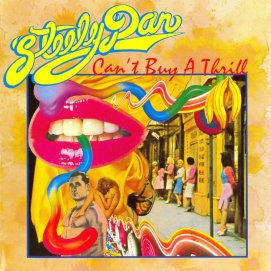 further exploration and bought the debut LP, “Can’t Buy a Thrill.” I was pleased to find a very appealing array of styles, textures, arrangements and lyrics contained in the ten tracks, especially “Dirty Work,” “Only a Fool Would Say That,” “Brooklyn” and “Kings.”
Soon enough, though, I turned my attentions elsewhere for the next year or so, concentrating on other stuff, mostly progressive rock, as I recall. It was freshman year, after all, and I lived in a dorm full of like-minded stoners.
Then in May of 1974, I became aware of a new single by Steely Dan called “Rikki Don’t Lose That Number,” and, remembering how much I had enjoyed the first album, I raced to the record store to pick up their new LP. To my surprise, I found not one but two “new” Steely Dan albums in the bins. There was the just-released “Pretzel Logic,” featuring “Rikki,” but there was also “Countdown to Ecstasy,” their second album which had apparently been released with little fanfare, and no hit single, nine months earlier in July 1973.
What a treat to suddenly have two Steely Dan LPs to delve into! I found the accessible three-minute pop songs on “Pretzel Logic” to be instantly likable, catchy and captivating, especially “Night By Night,” “Parker’s Band,” “Barrytown” and “Charlie Freak.” Donald Fagen’s enunciated vocals, embellished with rich harmonies behind them, brought the quirky lyrics to life, and the songs seemed to gallop along on the strength of sizzling guitar parts, sax solos and horn sections packed into each arrangement.
But I was much more intrigued by the longer tunes heard on “Countdown.” Here, I thought, were some really substantive tracks on which the musicians could really stretch out. Fagen and songwriting partner Walter Becker had come up with some more 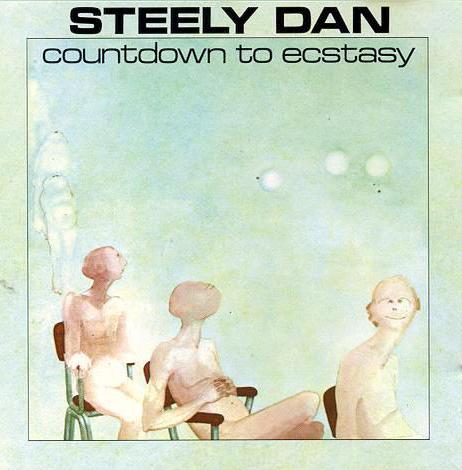 diversely challenging material that was at once accessible and more sophisticated, and the band members responded with obvious enthusiasm.
Take, for example, “My Old School,” an exuberant number about the duo’s days at Bard College in Annandale-on-Hudson, New York, where they met in the late ’60s. They weren’t exactly fond of the place (hence the line, “California tumbles into the sea, that’ll be the day I go back to Annandale”), but nonetheless, many college reunions I’ve attended in the years since have featured old friends joyously singing this track at the top of their lungs. The horn charts are, to my ears, among the most spectacular you’ll ever hear on a pop tune, expertly captured by producer Gary Katz, who manned the boards for all of Steely Dan’s albums.
Another impressive track is “Bodhisattva,” basically a blues-rock structure with jazz

Baxter (left) and Dias from a 1973 TV appearance
underpinnings and a swing beat, and lots of room for some amazingly fluid guitar solos from Steely Dan’s original axemen, Denny Dias and Jeff “Skunk” Baxter.” Baxter also shines on the delightful “Pearl of the Quarter,” an irresistibly heartfelt tribute to Louise, a New Orleans hooker, where he offers some sweet pedal steel guitar.
The song I can never get enough of is the album closer, “King of the World,” which utilizes Dias’s dexterous guitar and Fagen’s middle-break synthesizer on which to build a riveting work about what it might feel like to survive a nuclear apocalypse. Few bands have ever come up with lines like these: “No marigolds in the promised land, there’s a hole in the ground where they used to grow, any man left on the Rio Grande is the king of the world as far as I know…”
Although “Countdown to Ecstasy” really grew on me, to the point where it stands as one of my all-time favorites, none of its eight songs grabbed the denizens of 1973 pop radio. “My Old School” and the celebrity-centric “Show Biz Kids” stiffed at #63 and #61, and the album managed to reach only #35, although earning gold-record status eventually.
Said Baxter at the time, “I think the diversity you hear on ‘Countdown’ makes it much more interesting for us and, we hope, for the people who buy the albums. There are a lot of things you can grab on to, but that doesn’t mean we’re so predictable that you can instantly associated one cut with the next. We’d rather have people looking forward to a song that might be completely different than looking forward to a song they know is going to sound the same as the last song. It’s not the accepted commercial formula, which we think is usually a big mistake.”
As most observers now know, Steely Dan began in 1972 as a six-piece rock group that
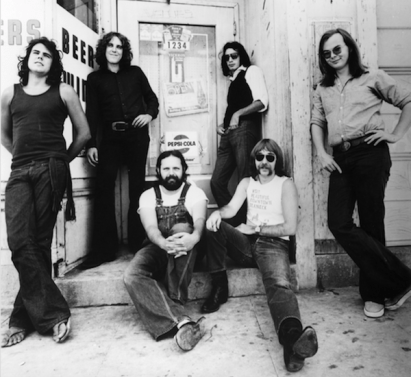
The original lineup (L-to-R): drummer Jim Hodder, vocalist David Palmer, guitarist Denny Dias, keyboardist/vocalist Donald Fagen, guitarist Jeff “Skunk” Baxter” and bassist Walter Becker
could take the embraceable music and profoundly weird lyrics that Fagen and Becker were writing and turn them into solid recordings and play them convincingly in concert. And for two years, they did just that. Fagen on keyboards and vocals, Becker on bass, Dias and Baxter on guitars, Jim Hodder on drums, and second singer David Palmer worked reasonably well as a unit, and racked up the early hit singles.
But Palmer proved to be an unnatural element and was dismissed, and Fagen and Becker quickly found that they loathed touring, largely because, as fussy perfectionists, they couldn’t rely on the notoriously unpredictable sound quality of concert venues and their often sketchy equipment and technicians. Steely Dan soon became the first major pop group to openly defy their record label by refusing to tour at all, and rarely doing interviews, concentrating all their efforts instead on songwriting and recording.
That decision may have irked the guys in the suits, but it fascinated critics and fans, who liked what they heard and were satisfied to let the music on the albums do the talking. The other casualty was Baxter, who made his money from touring and couldn’t afford to hang around for the periodic studio gig, and instead joined The Doobie Brothers, a hard-working touring band for the remainder of the ’70s.
Fagen and Becker, who both tended to prefer jazz music over rock, thought they could  bring that sort of loose-formed sensibility to what they were doing in the studio. In a 1975 article, Fagen described it this way: “We find that we want to pick musicians we think will fit a particular song. Sometimes we’ll hear somebody on a record and hire them for the date, and if it works out, great. Jazz musicians are always playing with different people, and I don’t see why that can’t happen here. Of course, some rock musicians don’t like that. We might have chords that constantly modulate, and they don’t know what’s going on, and they freak out and leave. That’s okay. We find somebody else.”
Beginning in 1975 with the stunning “Katy Lied,” that’s exactly what transpired. Seven different guitarists are used on the album’s ten tracks, from Becker and Dias to jazz greats Larry Carlton and Elliott Randall and rock stalwart Rick Derringer. Future vocal superstar  Michael McDonald beefs up the background voices, and eventual Toto founders Jeff Porcaro on drums and David Paich on keyboards bring muscle to the arrangements as well.
Even though there were technical problems in bringing the album to realization, and Fagen still has regrets with the final mix, I was among those who was completely floored by how amazing it sounded through a good sound system in 1975. And Side One (remember when the songs were divided into Side One and Side Two?) remains, for me, one of the all-time best album sides ever recorded. “Black Friday,” “Bad Sneakers,” “Rose Darling,” “Daddy Don’t Live in New York City No More” and “Doctor Wu” are five back-to-back killer Fagen-Becker masterpieces, each expertly performed by some of the best musicians in the business.
Which is not to detract from Side Two’s fine moments, including Derringer’s solo on the bluesy “Chain Lightning,” McDonald’s prominent voice on “Any World That I’m Welcome To,” and the cheesy funk of Fagen’s keyboards on the perverse “Everyone’s Gone to the Movies,” wherein a local weirdo delights in showing stag films to the neighborhood kids in his den. Such a motley stew of sounds and themes coming at you in Steely Dan’s albums…
The trend toward multiple guest musicians and lyrics about fringe outcasts continued with 1976’s “The Royal Scam,” hailed by some critics as Steely Dan’s finest achievement, and there are certainly tracks found there that rank among the true gems of Steely Dan’s catalog, like “Kid Charlemagne,” “Don’t Take Me Alive” and the harrowing title track.
Their commercial peak was “Aja,” which reached #3 on the album charts and sold many millions of copies on the strength of its three hit singles (“Deacon Blues,” “Peg” and “Josie”), and it often served as the go-to album played at concert venues as the roadies changed equipment from the warm-up act to the headliner. Its impossibly slick production values were held up as the gold standard by many, while others criticized that perfection as the antithesis of what rock’s dirty rebel soul was supposed to sound like.

“The Dan,” circa 1974
And sure enough, the tipping point came within the next couple of years, as the sound that eventually became pejoratively known as “yacht rock” gave way to a quirkier New Wave vibe, injecting fresh ideas into what had become a relatively ho-hum scene. “Gaucho,” Steely Dan’s last album for three decades, explored the decadence of LA like never before on ear-candy tracks like “Babylon Sisters” and “Glamour Profession,” more slick sounding than even anything on “Aja.” It’s unquestionably a worthy entry in the Dan catalog.
But I will always prefer, and invariably return to, what I heard from the Fagen-Becker team in their 1973-1975 period than what followed. There was something so radical and yet comforting, so inventive and yet familiar, in the songs they made at that point in the evolution of their song crafting. I invite you all to wrap your heads around these albums and breathe deep. This is amazing stuff.
*************
The Spotify list below offers “Countdown to Ecstasy” and “Katy Lied” in their entirety, but I couldn’t resist sneaking in another couple of tracks from “Pretzel Logic” in between, just to remind you of the stellar quality of Steely Dan’s work found elsewhere during that period.

 pedigree and musical capabilities were not necessarily evident to most pop music fans even at his brief commercial peak. But I firmly believe his substantial repertoire is in a class of its own among artists of his age and proclivities.
 By 1978, he had formed the Joe Jackson Band (including Graham Maby on bass, Dave Houghton on drums and Gary Sanford on guitar) and was in search of a record deal, hawking an album-length demo of smart songs melding rock, melodic jazz and New Wave that became the surprisingly notable debut “Look Sharp!” Released on A&M in the US in 1979, it reached #20 on the album charts here, thanks in part to airplay given to the quirky “Is She Really Going Out With Him?” and “Sunday Papers.”
 Jackson showed his willingness to take a risk and stretch his own musical horizons (as well as those of his listeners) by making his next project a loving tribute to the genre of Big Band and the swing music artists of the ’40s like Louis Jordan and Cab Calloway. The result, the irresistible “Jumpin’ Jive,” reached a respectable #42 in the US in 1981 and made it to #14 in the UK. It also inadvertently served to jumpstart a popular revival of other traditional dance genres like rockabilly (The Stray Cats, The Blasters).
 jazz workout in the middle break; “Target,” “Another World” and “T.V. Age” adopt pogo-like New Wave rhythms; “Chinatown” utilizes Asian chord changes and melody lines in its soundscape; and the slower dramatic ballads “Real Men” and “A Slow Song” feature exquisite, Broadway-like song structures.
 Caswell on effervescent pop tracks like “Happy Ending.” On “Big World,” he took the boldly creative tack of recording live in an acoustically pristine music hall before an audience instructed to remain silent. As the album title implies, he dabbled in a smorgasbord of styles from salsa to punk, from tango to jazz, from torch song to pop, from soul to cabaret.
 were ending,” commenting on the optimism of their 1950s childhood (“Tomorrow’s World”), the politics of terrorism and the Cold War (“Rant and Rave” and “Evil Empire”), yuppies and materialism (“Discipline”) and rockers who wear out their welcome (“Nineteen Forever”). He thought it was his best work and was sorely disappointed at what he felt was the indifference of his record label, the critics, and even his audience.
 great songs, well played and magnificently produced.
 Many of my readers, I’m guessing, barely know Jackson’s work. I offer this strong encouragement to listen closely to “Night and Day” and “Blaze of Glory,” and, indeed, much of his catalog. He’s the real deal.
