Isn’t life strange, a turn of the page
Popular music is full of stories of rock groups that were lucky enough to have a #1 single almost right away but then unable to duplicate their success. The record label might stick with them for a year or two, but without sales, the groups lose their contracts and are never heard from again. You’ve no doubt heard such artists referred to as “One-Hit Wonders.”
The Moody Blues, who went on to become one of the most successful British progressive rock groups in history, came pretty close to being saddled with that dubious distinction. They signed a deal with Decca in early 1964 and, before the year was out, they topped the charts in England with “Go Now,” which also broke into the Top Ten in the US. Like much of their repertoire at the time, “Go Now” was a cover version of a rhythm and blues song recorded by an American soul singer, Bessie Banks, with lead singer/guitarist Denny Laine as the front man.

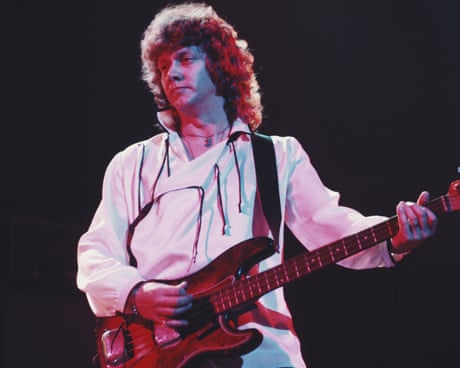
But then they struggled unsuccessfully for nearly two years to come up with another hit, and Decca was ready to drop them from their roster of artists. Laine grew frustrated and left, as did bassist Clint Warwick. The core group of keyboardist Mike Pinder, flutist Ray Thomas and drummer Graeme Edge soldiered on by welcoming new members Justin Hayward on guitar and John Lodge on bass.
(Lodge died last week at age 82, and with Pinder, Thomas and Edge all passing away over the past eight years, this leaves Hayward as the sole surviving member.)
The group had built up a debt that Decca wanted to recoup, so they came up with a plan: Use the Moody Blues to create a rock music version of Dvorak’s classical music piece, “New World Symphony,” to help promote the label’s new subsidiary, Deram Records, and its new high-end sonic development they called Deramic Stereo. The band had little choice but to go along.
The Moodies’ revised lineup quickly reached the conclusion that the project wasn’t going to work, but with support from their producer and engineer, they boldly proposed to write a cycle of original songs about “everyman’s archetypical day” (dawn, morning, mid-day, late afternoon, evening, night) which would then be expanded and connected by classical music passages, written and conducted by Peter Knight and recorded with a session “orchestra” that called themselves the London Festival Orchestra. To their everlasting credit, the label agreed.
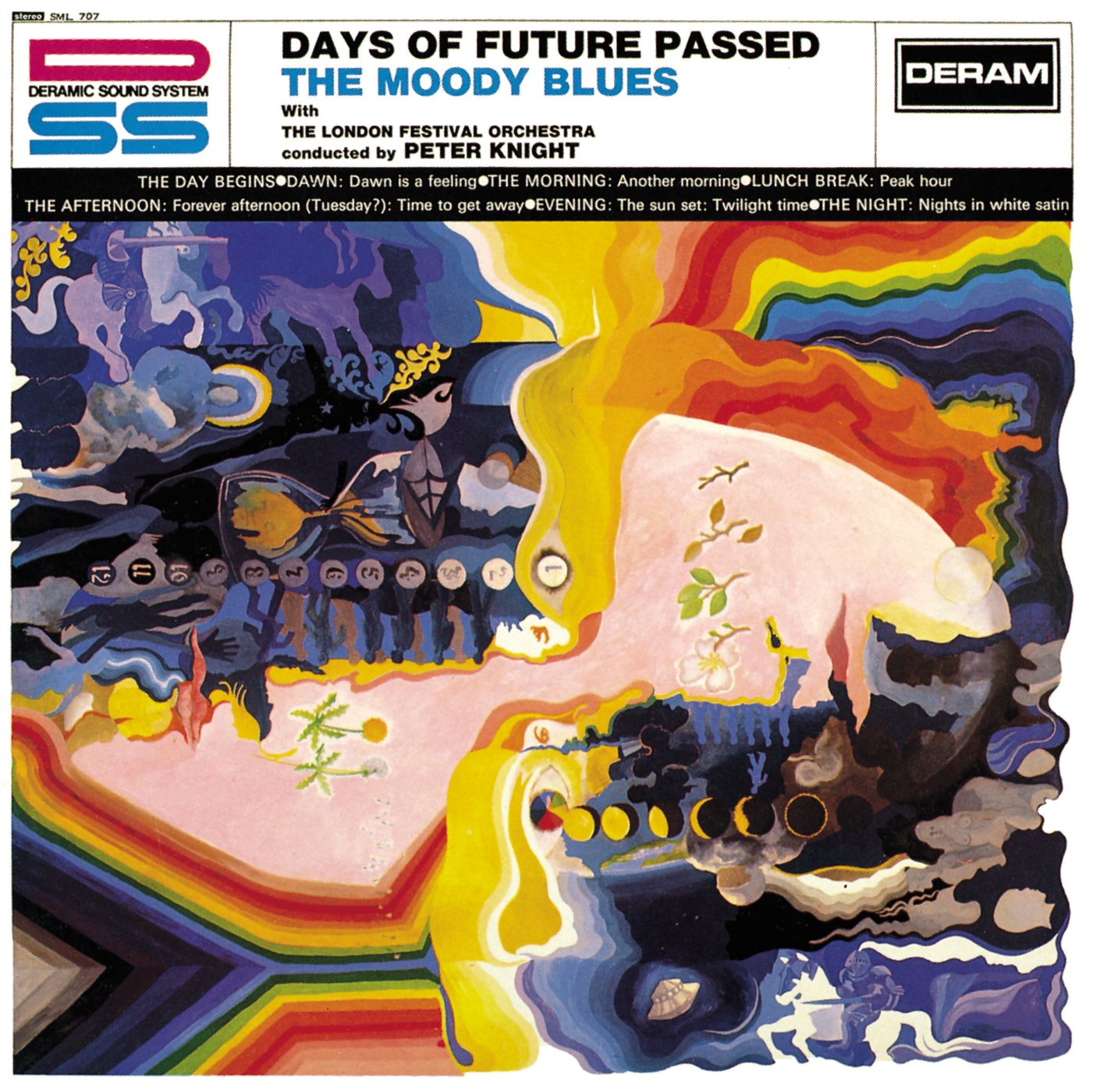
The album they got, “Days of Future Passed,” was fairly astounding. It is regarded as one of the very first concept albums, released in 1967 in the wake of The Beatles’ “Sgt. Pepper” and Pink Floyd’s “Piper at the Gates of Dawn,” neither of which utilized classical music structures and instruments as comprehensively as The Moody Blues did. Although Decca had little hope that the album would sell much, it became a surprise hit, reaching #27 in the UK on the strength of its two singles, “Nights in White Satin” and “Tuesday Afternoon” (#19 and #24 respectively).
It should be noted that the album tanked badly in the US at the time, and critics savaged it. Rolling Stone said, “The Moody Blues have matured considerably since ‘Go Now,’ but their music is constantly marred by one of the most startlingly saccharine conceptions of ‘beauty’ and ‘mysticism’ that any rock group has ever attempted. They are strangling themselves in conceptual goo.” Truth be told, I’ve found the album to be a bit tiresome to listen to all the way through, and the orchestral sections seem rather heavy-handed. But “Days of Future Passed” stands as a landmark LP in its creative blending of rock and roll arrangements with classical song structures and instrumentation.
In the UK, the album’s success gave the group the green light to continue their experimentation. Fortunately, Pinder was exceptionally well versed in the Mellotron, an analog antecedent to the synthesizer. It was designed as an organ-like device that used tape heads activated by the touch of keys, and tape loops comprised of the sounds of horns, strings and other instruments generating an eerie, orchestra-like sound. Pinder, who not only knew how to play it but also once worked for the company that developed and built them, was able to perpetuate the group’s use of orchestral sounds without the expense of hiring classical musicians for the recording process.
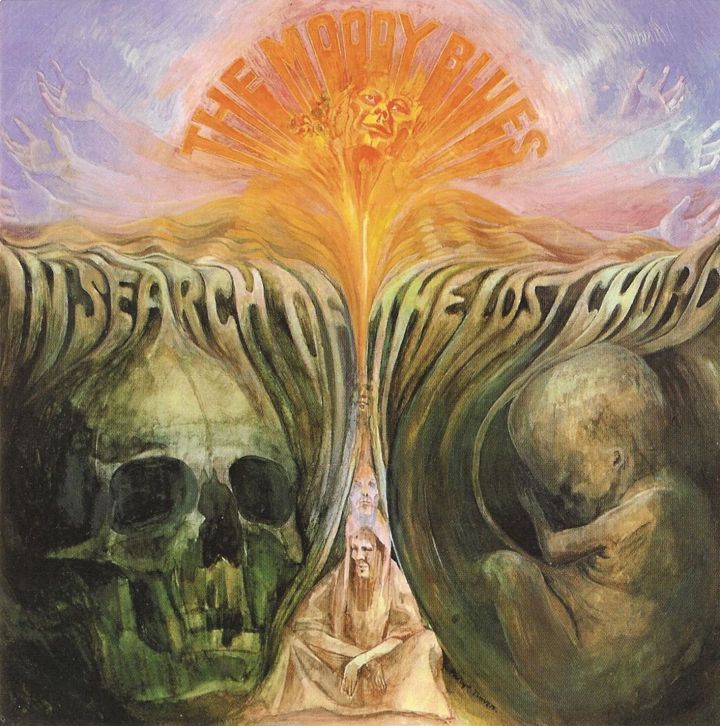
The next Moodies LP, “In Search of the Lost Chord,” revealed the depth of talent of the band’s five multi-faceted musicians. Pinder worked the Mellotron and added piano, harpsichord, autoharp and tambura; Hayward took over on lead vocals and played acoustic and electric guitar, sitar and keyboards; Lodge handled bass, cello and vocals; Thomas provided flute, oboe, sax and French horn and vocals, and Edge played drums and percussion and contributed spoken vocals. All five were songwriters as well, giving the album a wonderful diversity within the group dynamic. Lyrically, the songs examined themes like higher consciousness (Thomas’s ode to Timothy Leary and LSD, “Legend of a Mind”), spiritual development (Hayward’s “Voices in the Sky”), quest for knowledge (Lodge’s rocker “Ride My See-Saw”) and imagination (Pinder’s “The Best Way to Travel”). All this proved to establish the group as pioneers of the new “progressive rock” genre, and gurus of the counterculture on both sides of the Atlantic, while also showing robust sales in the mainstream, reaching #5 in the UK and #23 in the US.
Not that the Moodies were purveyors of 20-minute epics with multiple time signatures like their prog-rock successors (Genesis and Yes, for example). They wrote what were at heart pop songs, but wrapped them in gorgeous arrangements, with lush harmonies and rich instrumentation (the defining sound in “Nights in White Satin” isn’t guitar, it’s flute). They understood the capabilities of the studio in a way few of their contemporaries did, and in a band packed with capable songwriters, Lodge more than held his own. “Ride My See-Saw” showcased Lodge’s talents: you can hear the earlier R&B band in the rhythm section, but the vocals are layered so deeply the song becomes almost hymnal. It’s very much of its time, but also entirely fantastic — the sound of pop evolving in the moment, in the studio.
Over the next four years, The Moody Blues honed and embraced this formula, offering five rich, diverse, sonically engrossing albums that achieved ever-higher positions on the charts in both the UK and the US, and Canada and Australia as well. “On the Threshold of a Dream” and “To Our Children’s Children’s Children,” both released in 1969, cemented their reputation as an “album band,” with tracks that segued into one another. Their trippy album cover art further sealed the deal, giving their attitude-adjusted audience something to look at while the music played on. “A Question of Balance” in 1970 and “Every Good Boy Deserves Favour” in 1971 brought The Moodies back to the singles charts with two vibrant Hayward compositions: the melodramatic “Question,” with its frenetic acoustic strumming, and my personal Moodies favorite, the hard-rocking “The Story in Your Eyes.”

The band toured incessantly throughout this period, and because some of their pieces proved too daunting to attempt on stage, they found themselves consciously writing tunes that could be more easily recreated in a live setting. Consequently, “Question,” “It’s Up to You,” “Melancholy Man,” “Dawning is the Day,” “The Story in Your Eyes” and “Our Guessing Game” from the 1970-1971 LPs became regulars on their concert setlist.

An unusual thing happened in 1972. While the group’s accurately titled album “Seventh Sojourn” became the first to reach #1 on the US album charts, its two Lodge-penned singles — “Isn’t Life Strange” and “I’m Just a Singer (in a Rock and Roll Band)” — made the Top 40 but were completely overshadowed by the re-release of “Nights in White Satin.” A disc jockey in Washington had been signing off with the five-year-old song, and listeners began clamoring for it. Interest spread to other US markets, and soon Decca/Deram chose to re-release it as a single. It not only soared to #2 on the US Top 40, but also brought “Days of Future Passed” to #3 on the US album chart, giving The Moodies TWO albums in the Top Five in December 1972.

Non-stop touring and recording eventually took their toll. The 1973 tour to support “Seventh Sojourn” saw the Moody Blues living a lifestyle more commonly associated with Led Zeppelin. As Lodge recalled in the liner notes for a reissue of the album: “We had our own Boeing 707 aircraft which was decked out with TVs and sound systems everywhere. We had our own butler and our name written on the outside of the plane. I had a very empty feeling knowing that things had got this excessive.”
Encouraged by the band’s propensity for vague but faintly profound-sounding lyrics, fans took to thinking the group members possessed more wisdom than they actually did, a situation that provoked these lyrics in Lodge’s “I’m Just a Singer (In a Rock and Roll Band)”: “And if you want the wind of change to blow about you, / And you’re the only other person to know, don’t tell me, / I’m just a singer in a rock and roll band.”
Consequently, The Moodies chose to go on hiatus for a few years, much to the displeasure of their record label. Pinder had grown tired of England and relocated to California to start a new family there, and Hayward, under pressure to come up with new Moody Blues-like material, teamed up with Lodge and their longtime producer Tony Clarke to make an album as a duo (“Blue Jays”) in 1975, which reached a respectable #16 in the US and #4 in Britain, even without any noteworthy singles.
The whole band reunited in 1978 to record the rather flat “Octave” LP with the below-average single “Steppin’ in a Slide Zone,” but Pinder was so dissatisfied with the result that he refused to participate in the subsequent tour and officially left the group for good. It seemed that the music scene had moved on, eschewing prog rock for disco, funk, New Wave and heavy metal.

In 1981, though, The Moody Blues came roaring back with “Long Distance Voyager,” a synthesizer-driven #1 pop/rock album carried by two Top 20 Hayward hits, “Gemini Dream” and “The Voice.” Pinder’s replacement was Patrick Moraz, a keyboard wizard who had similarly replaced Rick Wakeman in Yes for a spell several years earlier. The Moodies’ triumphant return to touring, including songs from throughout their catalog, was made possible by the industry’s improved technical improvements in concert sound. I saw them in concert that year, and again a decade later in a double bill with Chicago, and found their show exhilarating.
This album, and those that followed over the next decade (1983’s “The Present,” 1986’s “The Other Side of Life,” 1988’s “Sur La Mer” and 1991’s “Kings of the Kingdom”), bore only a little resemblance to the psychedelia and mind-expanding albums of the band’s prime, but the accessible melodies, crisp production and Hayward’s ever-present voice kept the band in the limelight. Indeed, Hayward’s catchy pop song, “Your Wildest Dream,” and its similar sequel, “I Know You’re Out There Somewhere,” got as much exposure as anything they’d ever done. Still, there were precious few memorable deep tracks behind the singles, certainly a discouraging development to older fans.
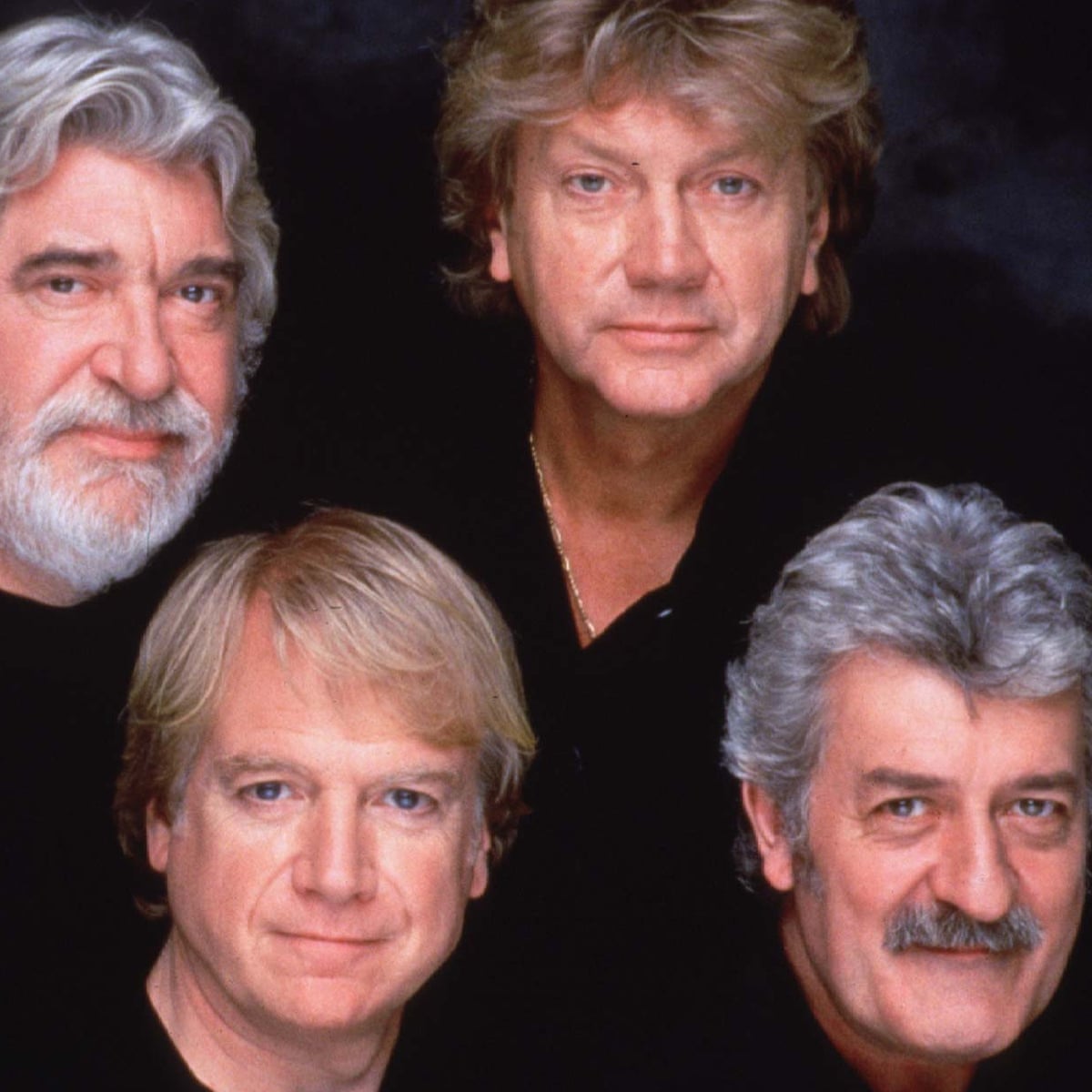
The band’s last time in the recording studio was in 2003 when they cobbled together a Christmas-themed album called “December,” which came and went quickly, like most seasonal records. The Moody Blues, augmented by additional performers on stage, continued performing well into the 2010s, with Hayward and Lodge carrying the load. First Thomas and then Edge were forced to reduce their participation due to health issues. Thomas ultimately died of cancer in 2018, and Edge passed away of cancer in 2021.
Lodge never took music lightly. He always saw in it the potential for something more than entertainment. In a 2023 interview, he was asked what “psychedelic” meant to him, and his answer was thoughtful: “I hope your mind will explore the music and take you wherever the music takes you. It’s not a case of just singing along, it’s listening. It can be one note and that transports you somewhere. And I think you can conjure up experiences and stories in your mind where the music takes you. To me, that’s psychedelic. You have to listen to things, not just hear them.”

I can’t think of any other rock band that had the audacity to offer tracks of cosmic poetry, spoken rather than sung, on almost every album. “In the late 1960s we became the group that Graeme always wanted it to be, and he was called upon to be a poet as well as a drummer,” said Hayward about Graeme Edge in the wake of his death. “He delivered that beautifully and brilliantly, while creating an atmosphere and setting that the music would never have achieved without his words.”
There’s a song on “Long Distance Voyager” that, while not one of their better efforts, perfectly describes how The Moody Blues were perceived in their later years — “Veteran Cosmic Rockers.” Their spacey music and intelligent lyrics mesmerized a sizable fan base during their 1967-1974 era, and their 1981-1991 period perpetuated The Moodies brand as a worthy rock band that absolutely deserved their long-overdue induction in the Rock and Roll Hall of Fame in 2018.
As Edge himself put it in a 2008 interview, “I never get tired of playing the hits. I think we have a duty. You play ‘Nights in White Satin’ for them. You’ve got to play ‘I’m Just a Singer (in a Rock and Roll Band),’ and you’ve got to play ‘Tuesday Afternoon’ and you’ve got to play ‘Question.’ It’s our duty, and the audience’s right.”
R.I.P. John Lodge, and The Moody Blues as a band. You left a valuable legacy.
************************


 Hack's Back Pages