Lord knows I’m a voodoo chile

(First published May 2016)

Periodically, I use this space to pay homage to musical artists who I believe are worthy of focused attention — artists with an extraordinary body of work who made an enormous impact and have a compelling life story to tell.  Some have careers that span many decades; others rocketed to stardom and then left us far too soon.  In this essay, I take a closer look at a man who is perhaps the greatest instrumental genius in rock music history — Jimi Hendrix.

********************

In the late 1960s, Eric Clapton, Pete Townshend, Jeff Beck, Jimmy Page, John Lennon, Keith Richards — the recognized elite of British rock guitarists — all were at the peak of their game.  And they were all in agreement about one thing:  There was no one better than Jimi Hendrix.

images-76

This visually arresting , flamboyantly dressed black man from the States had showed up in London in late 1966, playing the guitar left-handed, behind his back, with his teeth, with his feet, on the floor, but mostly producing an otherworldly yet beautiful sound, and nobody had ever seen or heard anything like him.  He was intriguing, shocking, even vaguely threatening.  He was, without a doubt, the real deal.

“The effect he had on English musicians – -not just guitarists, but all musicians — was just phenomenal,” said Townshend.  “I, for one, was completely floored the first time I heard him.  He was taking rock, blues, soul and jazz and mixing it with feedback and weird noises he seemed to pull out of the air.  It was completely different, so outrageous, so revolutionary…and it was spectacular.”

In the 60-year history of rock music, you can count on one hand the number of musicians who have had the earthshaking impact that Hendrix had during his all too brief time in the public spotlight.  He seemed to come out of nowhere to take first England and then the U.S. by storm, rewriting the book on what an electric guitar could sound like, both on record and in concert.  And then, four years after his arrival, he was gone, dead at 27 from a tragic “misadventure” with drugs.

Hendrix was an enigmatic figure in a number of ways.  His troubled upbringing and unstable family life in and around Seattle made it difficult for him to maintain the healthy relationships later in life he so desperately wanted.  His mother was absent for most of his childhood and died when he was 16; his father raised him halfheartedly and was a far cry from a solid role model.  Early run-ins with the law led him to enlist in the Army at 18 to avoid jail time.

images-73

Throughout his adolescence and young adulthood, however, Hendrix developed and nurtured a passion for the guitar, practicing every spare moment, and performing alone and in combos at dances, parties, clubs, road houses, every available opportunity.  Upon discharge from the Army, he headed for Nashville and performed relentlessly on the “chitlin circuit” in bands fronted by Little Richard, the Isley Brothers, and Curtis Knight as part of R&B and blues revues that featured stars like Jackie Wilson, Sam Cooke and Solomon Burke.

His desire for the limelight and the chance to grow led him to New Jersey and New York, where he assembled his own bands — “Jimmy James and the Blue Flames” — but continued to struggle until Chas Chandler, former bass player in the British blues band The Animals now interested in managing, saw him perform at Cafe Wha? in Greenwich Village.  “I was looking for someone to represent, and I thought, someone must’ve already signed this guy, because he was just stunning,” Chandler recalled.  “But no one was doing anything for him, so I persuaded him to come back to London with me to audition musicians for a new group.”

In short order, Noel Redding on bass and Mitch Mitchell on drums were selected to be in the three-man band to be known as The Jimi Hendrix Experience.  “I always liked that idea,” Hendrix wrote in his journal, “that seeing us and hearing us would be an experience.”  Word quickly spread that there was an amazing new sensation making the rounds of the Soho clubs, and the trio’s debut single, “Hey Joe,” zoomed up the charts to #4, firmly establishing Hendrix as a force to be reckoned with.  Chandler, knowing that songwriting royalties were where the money was, urged Hendrix to write his own material, but little did he know how astonishing those songs would be.

imgres-18

The release of the Experience’s debut album “Are You Experienced?” in May 1967 was, in its own way, as seismic an event as the release of The Beatles’ “Sgt Pepper” LP a month later.  Original material ranged from the cataclysmic “Purple Haze” and “Foxy Lady” to the tender “The Wind Cries Mary” and the psychedelic experiments of “Third Stone From the Sun” and the title song, and the overall effect was almost overwhelming.  You could make the case that Hendrix’s LP has more relevance today than “Pepper,” at least in terms of influence on the musical artists in the decades that have followed.

images-72

Much has been written about Hendrix’s incendiary performance at the Monterey Pop Festival, where the California musical elite and many thousands of concertgoers were present for America’s first Experience with Jimi.  In hindsight, the attention-getting gimmicks — humping his amplifier, setting his guitar on fire, bashing it to pieces as he walked off stage — would come back to haunt him, as fans continued to clamor for such silliness long after Hendrix had tired of these things.  Far more important was the fact that the debut album, and each subsequent LP released during his lifetime, went Top Five in the US and the UK, cementing his reputation as a genuine star.

I can’t write about Hendrix without mentioning one of the most bizarre moves in music promotion history. Following Monterey, Micky Dolenz of The Monkees had become so captivated with Hendrix that he pulled strings to get The Experience booked as the supporting act on a leg of The Monkees’ upcoming tour.  At the time, they were the most popular act in the country, selling more units than The Beatles and Stones combined, but their audience couldn’t have been more different from Hendrix’s followers.  “It was a lunatic idea, doomed from the start,” notes Mitchell.  “We typically attracted the rebels, the hippies, the runaways looking for something radical and new.  But these audiences were filled with inexperienced suburban 10-year-old girls and their parents, and they didn’t like us at all.  It was a disaster, and we were soon released from the contract.”

images-75

Hendrix, meanwhile, was interested in stretching the boundaries, exploring new territory and melding different genres and elements in his music.  As he wrote in his journals, “I liked to experiment with different instrumentation, keeping the basic trio but adding other musicians.  I want to create new sounds, try to transmit my dreams to the audience.  Music must always continue to expand further out, further away.  Kids listen with open minds, and I don’t want to give them the same things all the time.”

Hendrix’s next LPs — “Axis: Bold as Love” and especially the double-album opus “Electric Ladyland” — were mind-benders of the first order, both musically and lyrically.  Some critics found some of it self-indulgent and excessive, which it probably was — the 13-minute exploratory track “1983 (A Merman I Should Turn to Be)” comes to mind.  But he would soon evolve further, moving on to other avenues.

Engineer Eddie Kramer remembers Hendrix being captivated by the recording studio.  “He became much more involved in the mixing process.  I would show him about echo and compression, and panning and phasing, and he’d get so excited about the possibilities.  There was nothing he wouldn’t try.  To him, recording was fun.”

Hendrix often mentioned his frustration about the songs he had in his head that he couldn’t seem to translate to the guitar, and then to tape.  Nevertheless, his songwriting became more nuanced and compelling, as shown in songs like “Burning of the Midnight Lamp,” “Room Full of Mirrors” and the beautiful “Little Wing,” which several people have recorded since, including Sting in 1987.  “Most people remember his guitar playing, which was unforgettable, but his songwriting was surprisingly adept.  I tried performing ‘Little Wing’ in a small club and it went really well, so I recorded it as a tribute to Jimi.”

Kathy Etchingham, Hendrix’s girlfriend at the time, recalls his admiration of and devotion to the music of Bob Dylan.  “He loved Dylan’s music and always wished he could write songs of that caliber.  He used to play them around the flat, and he thought about recording “I Dreamed I Saw St. Augustine’ from the ‘John Wesley Harding’ album, but he resisted, saying it was too personal a song.  I persuaded him to take a stab at ‘All Along the Watchtower’ instead, which he did.  And he totally enjoyed playing that one.”  Hendrix’s radically different arrangement ended up being his only appearance on the US Top 40 singles chart, peaking at #20 in the fall of 1968.
images-71

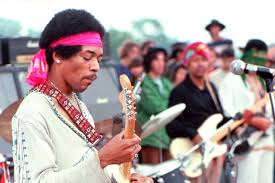
The Experience toured the US and Europe relentlessly in 1968 and 1969, performing savage versions of blues songs like “Red House” and “Tax Free” and more concise tracks like “I Don’t Live Today” and “Voodoo Child (Slight Return).”  In August of 1969, he was the highest paid rock star in the world when he appeared as the final act on the three-day extravaganza at Woodstock, where his apocalyptic rendition of “The Star-Spangled Banner” became one of the iconic moments of the counterculture’s anti-war movement.

His restlessness led to the eventual dismissal of Redding and, later, Mitchell, replacing them with Billy Cox and Buddy Miles, known as his Band of Gypsys, who played gigs in 1969 and 1970, including a memorable New Year’s Eve show at Madison Square Garden which was recorded for the live “Band of Gypsys” LP.

In between these tours, Hendrix literally lived in studios in New York and London, amassing hundreds and hundreds of hours of tapes of alternate takes, loose jam sessions, unfinished songs and, in a few instances, completed tracks that weren’t released until many years later.  Two albums of this material — “The Cry of Love” and “Rainbow Bridge” — were released the year after his death, and the ambitious double album he’d been working on in 1970, “First Rays of the New Rising Sun,” didn’t see the light of day until 1997.  Still more high-quality recordings have continued to trickle out posthumously, most notably “Valleys of Neptune” (2010) and “People, Hell and Angels” (2013).

imgres-19

An interesting, articulate, intelligent guy, Hendrix was also too naive and trusting.  Although he appeared supremely confident on stage, he was often unsure of himself in relationships and business matters, which proved to be his undoing.  He was embroiled in a number of lawsuits over contract disputes and other matters that weighed heavily on him emotionally, and he sometimes self-medicated to escape.  Even worse, the sycophants, hangers-on and questionable lady friends he surrounded himself with took advantage of his innocent “free spirit” tendencies, pushing and pulling him in all directions, often working in conflict with his best interests.

Kramer added, “By the end, the recording studio had begun to lose its magic for him.  He wanted to be taken much more seriously as a musician.  He was growing as an artist and he felt his audience wasn’t growing along with him.  It was a source of great frustration for him.”

Suffice it to say his death from asphyxiation following an ill-advised dosage of sleeping pills in September 1970 was not only avoidable but a regrettable waste of monumental talent and potential.  His journals hint at his plans for the future:  “My initial success was a step in the right direction, but it was only a step.  Now I intend to get into many other things.  In five years, I want to write some plays and some books.  I want to write mythology stories set to music, based on a planetary thing and my own imagination.  It wouldn’t be like classical music, but I’d use strings and harps, with extreme and opposite musical textures, with great contrasts.”

Although he left us some incredible recordings to enjoy (check out my picks on the Spotify playlist below), it’s clear that Jimi Hendrix had only scratched the surface.  I can’t help but wonder what kind of music he would’ve been creating in the 1970s…or the 1980s…or beyond.  Of all the rock stars who left us too soon, I think I’m most saddened about Jimi.  Imagine what he might have accomplished…

**************************

They cut you down to size. Or not.

Why did all the pop songs of the ’50s and early ’60s last only three minutes or less? Technological limitations.

As rock and roll music came of age in the 1950s, the 45-RPM record had just been introduced. Like its predecessor, the 78-RPM record, its physical properties would allow no more than about three minutes of music per side, depending on the range of sound required and the depth of the groove in the disc.

That three-minute limitation worked out just fine for a while. Radio stations typically wanted songs that lasted between 2:00-2:30, allowing more songs per hour and more opportunities to sell air time for money-making commercials.

The pop music business had long ago chosen to operate under the assumption that the attention span of the average listener was also around the three-minute mark. The rule seemed to be, “Better to keep the songs short and play them repeatedly, and the public will rush to buy them and keep tuning in.”

As the Sixties progressed, however, it seemed as if every norm in society was being questioned and challenged, and the length of a standard pop song was not immune to this phenomenon.

As early as 1959, Ray Charles had recorded a marvelous melange of rhythm and blues, boogie-woogie and gospel called “What’d I Say,” a relentless, irresistible tune featuring the Raelettes on backing vocals. The problem was, it was more than five minutes long. If they wanted to release it as a single, they had two choices: Edit it down to three minutes or less, or cut it in half and put the two parts on two sides of a 45-RPM single. They opted for the latter, with Part 1 (lasting 3:05) as the A-side and Part 2 (lasting 1:59) as the B-side.

Record manufacturers eventually found ways to fit more than just three minutes of music on one side of a 45, and a few artists took advantage of that by releasing ever-longer songs as singles.

In 1964, producer Phil Spector was thrilled with the results of his “Wall of Sound” studio recording of The Righteous Brothers’ “You’ve Lost That Lovin’ Feeling,” but he was concerned that radio might not want to play it because it lasted 3:45. His solution was to deliberately mislabel the record with a 3:05 length, tricking DJs into thinking it was shorter than it really was.

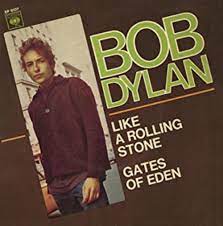
The real change came in 1965 with Bob Dylan’s titanic song “Like a Rolling Stone” from his iconic “Highway 61 Revisited” LP. The song clocked in at an unheard-of 6:13, and Columbia Records was hesitant to release it as a single. But once pop music clubs and influential DJs and program directors started playing it, the label went ahead and officially released it without any cuts. If it had stiffed on the charts, it probably would’ve been a case of “lesson learned,” and artists wouldn’t attempt such song lengths anytime soon. But against all odds, “Like a Rolling Stone” made it to #2 on the Billboard Hot 100, which shattered the length barrier and opened the door to many more longer-than-usual hit singles.

As the less rigid formats of FM radio stations took hold in the late ’60s, artists realized they had a new platform that would play their songs regardless of length. This forced some AM stations to ease up on their restrictions, and suddenly, songs lasting five, six, even seven minutes were climbing the pop charts.

In 1968, actor Richard Harris made his recording debut with a bombastic, near-operatic rendition of Jimmy Webb’s “MacArthur Park,” which lasted 7:21. It was one of those polarizing records that you either loved or hated, but enough people loved it to propel it all the way to #2 that summer. You would think it would’ve been truncated into two parts, or pared down to a more conventional length, but inexplicably, it remained whole.

Also in ’68, The Beatles, who had been breaking so many rules in pop music, released Paul McCartney’s gem “Hey Jude” as their next single. The basic song lasted just over three minutes before they broke into a chorus of “Na na na na-na-na-na” that went on and on and on for another four minutes, for a total running time of 7:11. Some DJs took the liberty of fading out on the interminable ending after maybe a minute or two, but still, the biggest band in the world had now joined the chorus of game-changers who wanted the freedom to create longer singles.

“American Pie,” Don McLean’s 1971 tribute to Buddy Holly and rock music up to that point, was the #1 song in the nation for four weeks in early 1972, despite its 8:42 length. The label broke it into Parts 1 and 2 (4:11 and 4:31) to fit it on a 45, but because of its enormous popularity, nearly every radio station played it in its entirety.

The late Harry Chapin said he often wrote songs cinematically, “which is an uneconomical technique, and that’s why my songs are so long.” His first hit “Taxi,” which reached a respectable #24 on the charts in 1972, ran 6:44. “I literally put you in that cab and let you experience the characters’ loneliness,” he said. “It’s a more involving form of music than sitting and hearing somebody sing ‘I’m lonely.'”

Later in 1972, The Temptations reached the top of the charts with their dramatic piece “Papa Was a Rolling Stone,” which ran 7:01. Incredibly, that was an edited version of the original album recording, which lasted just shy of 12 minutes, with a four-minute instrumental intro.

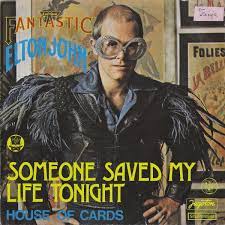
The biggest artists of the ’70s, who usually played by the rules and released conventional-length singles, sometimes wanted to release longer-than-usual songs as singles, and they were rarely denied. Elton John went to #1 in 1975 with “Someone Saved My Life Tonight” (which lasted 6:45), and The Eagles’ “Hotel California,” arguably the most popular song of the decade, ran 6:31. In 1978, “Paradise By the Dashboard Light,” Meat Loaf’s mini-opera from his “Bat Out of Hell” album, made the Top 40 despite its 8:28 length (although some stations excised the baseball play-by-play segment that cut the tune to about 5:30).

The above examples notwithstanding, Top 40 radio never really wavered much in their time constraints. If artists and their record labels wanted their 5:00+ songs in front of a mainstream audience, they would have to agree to edited versions. Consequently, many hits of the ’60s, ’70s and ’80s were heard in two different lengths — the complete long version, which could be found on the album, and the abbreviated single, which sometimes was edited down to less than half of the original length.

Music aficionados like me hated hearing the butchered version of our favorite long tracks, but we could take solace by spinning the album at home. Casual listeners who didn’t collect albums may have never heard the album renditions of hit songs as the artists had intended…but they probably didn’t care. Many folks preferred their songs shorter and punchier, without the instrumental passages and extended endings.

I have assembled a list of 40 of the more popular songs from the ’60s, ’70s and ’80s that were truncated (sometimes severely) to make them suitable to Top 40 format. Read ’em and weep, music lovers. Walking amongst you are many thousands of people who have never heard the full versions of iconic songs like “Light My Fire,” “Layla” and “Radar Love”…

**********************

House of the Rising Sun,” The Animals, 1964. Original: 4:29. Single: 2:59.

Sunshine Superman,” Donovan, 1966. Original: 4:34. Single: 3:15.

Rainy Day Women #12 and #35,” Bob Dylan, 1966. Original: 4:36. Single: 2:26.

Light My Fire,” The Doors, 1967. Original: 7:06. Single: 2:52.

Sunshine Of Your Love,” Cream, 1967. Original: 4:08. Single: 3:03.

White Room,” Cream, 1968. Original: 4:58. Single: 3:04.

Magic Carpet Ride,” Steppenwolf, 1968. Original: 4:25. Single: 2:55.

Time Has Come Today,” The Chambers Brothers, 1968. Original: 11:07. Single: 3:05.

Suzie-Q,” Creedence Clearwater Revival, 1968. Original: 8:37. Single: 4:33.

You’ve Made Me So Very Happy,” Blood Sweat & Tears, 1969. Original: 4:19. Single: 3:26.

Spinning Wheel,” Blood Sweat & Tears, 1969. Original: 4:05. Single: 2:39.

Whole Lotta Love,” Led Zeppelin, 1969. Original: 5:33. Single: 3:10.

Suite: Judy Blue Eyes,” Crosby Stills and Nash, 1969. Original: 7:28. Single: 4:35.

Make Me Smile,” Chicago, 1970. Original: 3:16 + 1:26 reprise = 4:42. Single: 2:58.

I’m Your Captain (Closer to Home),” Grand Funk Railroad, 1970. Original: 10:09. Single: 5:31.

All Right Now,” Free, 1970. Original: 5:31. Single: 4:14.

Green-Eyed Lady,” Sugarloaf, 1970. Original: 6:53. Single: 3:33.

Black Magic Woman,” Santana, 1970. Original: 5:20. Single: 3:16.

Beginnings,” Chicago, 1971. Original: 7:54. Single: 2:50.

Signs,” Five Man Electrical Band, 1971. Original: 4:05. Single: 3:20.

Layla,” Derek and the Dominos, 1971. Original: 7:04. Single: 2:43.

Won’t Get Fooled Again,” The Who, 1971. Original: 8:31. Single: 3:40.

Roundabout,” Yes, 1972. Original: 8:36. Single: 3:37.

Freddie’s Dead,” Curtis Mayfield, 1972. Original: 5:27. Single: 3:17.

Hold Your Head Up,” Argent, 1972. Original: 6:15. Single: 3:15.

Nights in White Satin,” The Moody Blues, 1972. Original: 7:38. Single: 4:26.

Radar Love,” Golden Earring, 1973. Original: 6:27. Single: 3:43.

Piano Man,” Billy Joel, 1973. Original: 5:40. Single: 4:30.

Give It to Me,” J. Geils Band, 1973. Original: 6:32. Single: 3:07.

Free Bird,” Lynyrd Skynyrd, 1974. Original: 9:08. Single: 4:41.

Miracles,” Jefferson Starship, 1975. Original: 6:52. Single: 3:25.

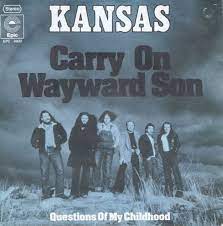
Carry On Wayward Son,” Kansas, 1976. Original: 5:26. Single: 3:26.

Got to Give It Up,” Marvin Gaye, 1977. Original: 11:52. Single: 4:12.

Heroes,” David Bowie, 1977. Original: 6:07. Single: 3:32.

Disco Inferno,” The Trammps, 1977. Original: 10:54. Single: 3:35.

Who Are You,” The Who, 1978. Original: 6:20. Single: 3:24,

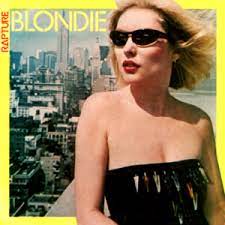
Rapture,” Blondie, 1981. Original: 6:31. Single: 4:58.

I Can’t Go for That,” Hall and Oates, 1981. Original: 5:09. Single: 3:45.

Edge of Seventeen,” Stevie Nicks, 1981. Original: 5:28. Single: 4:10.

Rock the Casbah,” The Clash, 1982. Original: 6:35. Single: 3:42.

Eye in the Sky,” Alan Parsons Project, 1982. Original: 4:36. Single: 3:55.

Let’s Dance,” David Bowie, 1983. Original: 7:37. Single: 4:08.

Here Comes the Rain Again,” Eurythmics, 1984. Original: 4:56. Single: 3:51.

Touch of Grey,” Grateful Dead, 1987. Original: 5:50. Single: 4:35.

**********************

Also part of the rock music scene in this era were the bands that had little or no interest in the singles market. They preferred to write and record extraordinarily long songs, or suites of songs, that challenged the serious listener. The underground and college FM stations might play them, but mostly, they were there on the albums for those who enjoyed diving in to lengthy, complicated works.

I’m referring only to studio recordings here. Many bands have released live recordings through the years that lasted 10-15 minutes or more (Allman Brothers and Grateful Dead, for example), but they were often conventional length studio songs they had stretched out in concert.

Below you’ll find a healthy sampling of extended studio recordings that I find worthy of your attention.

***********************

Desolation Row,” Bob Dylan, 1965. (11:21)

Sad-Eyed Lady of the Lowlands,” Bob Dylan, 1966. (11:23)

A Quick One, While He’s Away,” The Who, 1966. (9:10)

The End,” The Doors, 1967. (11:43)

When the Music’s Over,” The Doors, 1967. (10:59)

Alice’s Restaurant Massacree,” Arlo Guthrie, 1967. (18:35)

Viola Lee Blues,” Grateful Dead, 1967. (10:15)

Alligator,” Grateful Dead, 1967. (11:20)

A Saucerful of Secrets,” Pink Floyd, 1968. (11:57)

1983 (A Merman I should Turn to Be),” Jimi Hendrix, 1968. (13:39)

Voodoo Chile,” Jimi Hendrix, 1968. (14:59)

In-a-Gadda-Da-Vida,” Iron Butterfly, 1968. (17:04)

Moonchild,” King Crimson, 1969. (12:12)

In the Court of the Crimson King,” King Crimson, 1969. (10:02)

Lizard,” King Crimson, 1970. (23:19)

Child in Time,” Deep Purple, 1970. (10:20)

I Heard It Through the Grapevine,” Creedence Clearwater Revival, 1970. (11:02)

Take a Pebble,” Emerson, Lake and Palmer, 1970. (12:32)

Tarkus,” Emerson, Lake and Palmer, 1971. (20:38)

The Low Spark of High-Heeled Boys,” Traffic, 1971. (11:41)

Echoes,” Pink Floyd, 1971. (23:32)

The Musical Box,” Genesis, 1971. (10:25)

Thick As a Brick,” Jethro Tull, 1972. (43:50)

Close to the Edge,” Yes, 1972. (18:38)

Supper’s Ready,” Genesis, 1972. (23:05)

A Passion Play,” Jethro Tull, 1973. (45:06)

Lady Fantasy,” Camel, 1973. (12:45)

Grey Day,” Jesse Colin Young, 1974. (11:19)

The Gates of Delirium,” Yes, 1974. (21:49)

Shine On You Crazy Diamond,” Pink Floyd, 1975. (25:58)

High Falls,” Allman Brothers Band, 1975. (14:27)

Baker St. Muse,” Jethro Tull, 1975. (16:39)

2112,” Rush, 1976. (20:33)

Paprika Plains,” Joni Mitchell, 1977. (16:21)

Awaken,” Yes, 1977. (15:31)

*************************

There are three Spotify playlists below. The first (“Let it last longer”) includes the songs mentioned in the essay text that pushed the barriers of how long a hit single could be. The second (“They cut you down to size”) includes both the original and edited versions (those available on Spotify) of most of the songs listed that were released in both lengths. The third (“Lonnnnnnng rock tracks”) includes the extra-long tracks I referred to at the end of the post.