He coulda been the champion of the world
Two of the most popular pasttimes across the United States and around the world are live music concerts and live sports events, both of which have taken a big hit during the pandemic. Stadium crowds were either limited in size or eliminated, while concerts have been banned outright. We are all hoping and praying that, as more of us receive the vaccines, things will start to return to something like normal, and concerts and sports may once again resume their place on our to-do lists.
But it got me thinking about the relationship between music and sports, especially rock and pop music. I went searching for songs of the ’60s, ’70s and ’80s that have lyrics dealing with sports, and I was surprised to find precious few of them. Even some of those I decided to include have only the barest of connections to sports or the athletes who play them. Kind of puzzling, I think.

Anyway, for what it’s worth, here is my playlist of a dozen songs that mention athletics in some form or another, with a brief back story on each one. I hope you enjoy them, but if not, don’t sweat!
********************
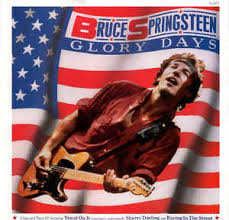
“Glory Days,” Bruce Springsteen, 1984
The rollicking organ playing of the late Danny Federici carries this great track from Springsteen’s mega-platinum 1984 LP “Born in the USA.” It’s a rousing anthem musically, but it belies poignant lyrics that warn against being the guy who, in middle age, has only “boring stories” of his glory days in high school sports. First time I heard this, I was really getting into the groove but then read the words and realized this was to be another life lesson from Professor Bruce: Enjoy your memories, but don’t let them define you. Live in the now, and participate. The song topped out at #5 on US charts in 1985 as the fifth of seven Top Ten singles from “Born in the USA.”

“Backfield in Motion,” Mel & Tim, 1969
Melvin Hardin and Timothy McPherson were cousins from small-town Mississippi who headed to Chicago in the late ’60s and became an R&B musical duo who enjoyed a small measure of success for a few years. Most notable was “Backfield in Motion,” an infectious soul tune with clever lyrics that use sports terminology to describe a romantic relationship ruined by infidelity: “You know you’re cheatin’, baby, fakin’ the bout, /You know you’re balkin’, baby, oh yeah, strike three, you’re out, /And I caught you with your backfield in motion, yeah, /I’m gonna have to penalize you…” The song, written by the duo, peaked at #10 in 1969. They also had one more Top 20 hit, “Starting All Over Again,” in 1972.

“Centerfield,” John Fogerty, 1985
This track by the former leader of Creedence Clearwater Revival is probably the most genuine sports-related song in this bunch. Fogerty always enjoyed baseball but grew up in California at a time when there were no major league teams on the West Coast yet. The lyrics mention specific star baseball players and make use of phrases like “rounding third, heading for home” and “Put me in, coach.” In 2010, Fogerty became the only musician ever celebrated by the Baseball Hall of Fame when “Centerfield” was honored at that year’s induction ceremonies. The song stalled at #44 on the pop charts but peaked at #4 on mainstream rock charts, and the “Centerfield” LP reached #1.
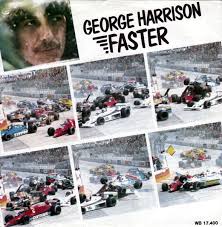
“Faster,” George Harrison, 1979
In 1977, Harrison took a year off from music-making to spend time pursuing his interest in Formula 1 auto racing, traveling the world to attend various racing events and befriending such auto racing luminaries as Jackie Stewart, Niki Lauda and Emerson Fittipaldi. As he made plans to return to the recording studio, Harrison wrote “Faster,” a song about the life and motivations of professional race car drivers. He titled it after Stewart’s published 1972 diary, which explains Stewart’s obsession behind his desire to participate in a dangerous profession. The song, which uses race car sound effects throughout, appeared on the ex-Beatle’s “George Harrison” LP in 1979.

“We Are the Champions,” Queen, 1977
Musically based on Freddie Mercury’s jazz-chords piano and four-part harmonies that built into anthemic proportions, this huge international hit was adopted by sports teams of all kinds when they won championships. It was paired with the far less interesting “We Will Rock You” on their 1977 LP “News of the World” and performed as the finale of most Queen concerts during that period. Lyrically, it appreciates the difficulty of overcoming adversity (“It’s been no bed of roses, no pleasure cruise, I’ve had my share of sand kicked in my face, but I’ve come through…“) and the exhilaration of coming out on top (“I’ve taken my bows and my curtain calls, ’cause we are the champions of the world…”)

“I Go Swimming,” Peter Gabriel, 1983
After departing Genesis in 1975, singer-songwriter Gabriel began a critically acclaimed solo career, confounding retailers by releasing four solo albums in 1977, 1978, 1980 and 1982 all titled “Peter Gabriel.” They came to be known by their album cover artwork (“Car,” “Scratch,” “Melt” and “Security”). This period was summed up very nicely on the 1983 double live album “Plays Live,” recorded during a 1982 U.S. tour. The only previously unreleased track was “I Go Swimming,” which had been intended for the 1980 LP but was shelved. The song, featuring the phenomenal bass playing of Tony Levin, focuses more on the sensations of floating and immersing yourself in water than on competitive swimming.

“Sail On, Sailor,” The Beach Boys, 1973
There seems to be some discrepancy about this song’s authorship, but the prevailing opinion is that Brian Wilson collaborated with Van Dyke Parks on the basic track in 1971, and then others contributed a line of lyric here and there along the way, which is reflected in the “all-over-the-map” final product. Essentially the song is more about the rigors of persevering through life’s choppy waters than the competitive sport of sailing. The tune was added at the last minute to the lineup of their celebrated 1972 “Holland” LP and then released as a single, but it stiffed badly at #79, improving to #49 upon re-release in 1975. The lead vocals are by guitarist/singer Terry “Blondie” Chaplin, who was a full-fledged Beach Boy for a couple of years.

“Anyone For Tennis?” Cream, 1968
Admittedly, this strange little tune co-written by Eric Clapton and Martin Sharp has almost nothing to do with the sport of tennis, except that its lyrics suggest a round of tennis would be a nice distraction from the hectic psychedelic images that dominate the rest of the words. Clapton wrote it on commission for the lame outlaw biker film “The Savage Seven,” but the soundtrack featured the song as performed by the unknown band American Revolution. Despite it sounding very little like Cream’s usual material, “Anyone For Tennis?” was recorded by the trio during the sessions for “Wheels of Fire,” but it was released only as a single. It stiffed at #64 in the US and #40 in the UK.

“The Boxer,” Simon and Garfunkel, 1969
One of my very favorite Paul Simon compositions is this masterpiece from 1969, which reached #7 on the pop charts. It tells, in first-person narrative, a heartfelt story of a young man struggling against loneliness and poverty in a tough world. Then in the final verse, it switches to a third-person description of the hardscrabble life of a boxer: “In the clearing stands a boxer and a fighter by his trade, and he carries the reminders of every glove that laid him down or cut him till he cried out, in his anger and his shame, ‘I am leaving, I am leaving,’ but the fighter still remains.” “The Boxer” also appeared on the following year’s “Bridge Over Troubled Water,” Simon and Garfunkel’s final studio album.

“Run For the Roses,” Dan Fogelberg, 1981
ABC-TV, who in 1980 had recently taken over the broadcasting of The Kentucky Derby, wanted a new song that would commemorate horse racing, and commissioned singer-songwriter Fogelberg to come up with one. In short order, he wrote and recorded “Run For the Roses,” which has since endured as a sort of unofficial anthem of the annual event. It was included on Fogelberg’s 1981 double LP “The Innocent Age” and released as the album’s fourth single, reaching #18 in May 1982. Fogelberg, who grew up on a farm in Illinois, loved horses and accepted the assignment with enthusiasm: “And it’s run for the roses as fast as you can, /Your fate is delivered, your moment’s at hand, /It’s the chance of a lifetime in a lifetime of chance, /And it’s high time you joined in the dance…”

“Baseball,” Michael Franks, 1980
A talented practitioner of the late ’70s/early ’80s smooth jazz/romantic R&B genre known among radio biz folks as “quiet storm,” Franks is a literate songwriter and appealing singer who has more than 15 albums to his credit. Jazz greats like guitarist Larry Carlton, saxophonist David Sanborn and horn men Randy and Michael Brecker were regular session players on his soothing records. In 1980, he wrote and recorded “Baseball,” a whimsical piece that adroitly compares the face-off between a league-leading closer and a rookie batter with the tentative relationship between a seasoned woman and a young man new to romance.
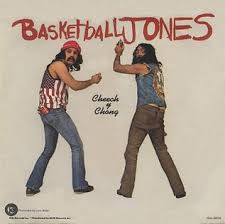
“Basketball Jones,” Cheech & Chong, 1973
In early 1973, a Chicago-based R&B group called Brighter Side of Darkness had a Top 20 hit with a half-spoken, half-sung single called “Love Jones,” about a boy who felt addicted to his romantic feelings for a girl. Six months later, the drug-humor duo Cheech and Chong made their own Top 20 appearance with a funny quasi-parody called “Basketball Jones,” about a young man named Tyrone (as in “tie-your-own”) Shoelaces who is obsessed with basketball: “I need someone to stand beside me, I need someone to set a pick for me at the free-throw line of life, /Someone I can pass to, someone to hit the open man on the give-and-go and not end up in the popcorn machine…”
**********************
Bonus track on the playlist:
“Baseball and Football,” a brief comedy routine by the late great George Carlin comparing the two sports
***********************






 Hack's Back Pages